

Son of the salt chaser, p.1
Son of the Salt Chaser, page 1
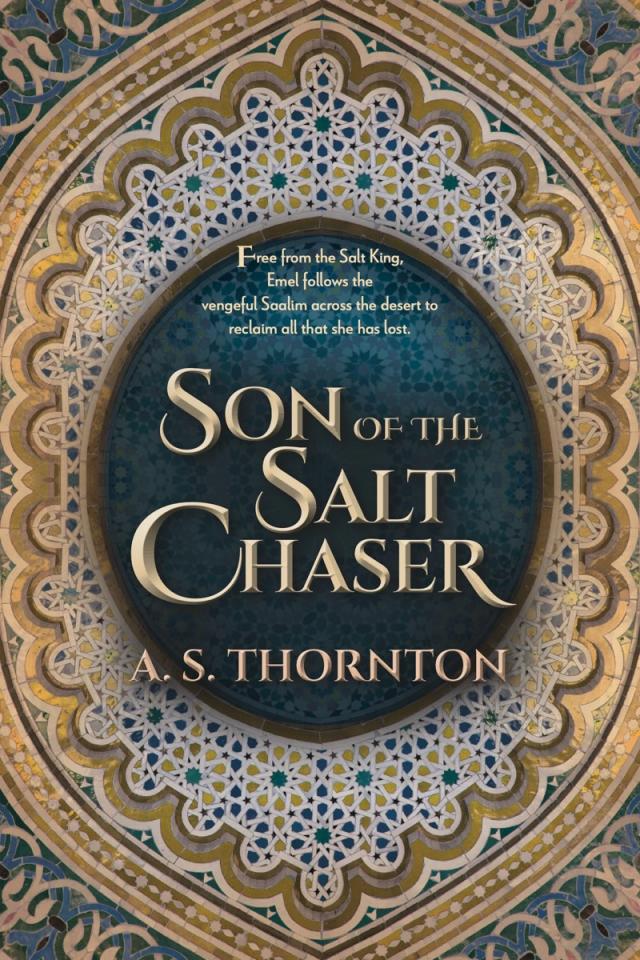


SON OF THE SALT CHASER
A. S. THORNTON
For E,
* * *
I would watch the moon cross the sky
every night for you.
CONTENTS
Amir’s Map
Part I
Unopened Letter
1. Emel
2. Saalim
3. Emel
4. Emel
5. Emel
6. Saalim
7. Emel
8. Emel
Part II
Excerpt from the Litab Almuq
9. Saalim
10. Emel
11. Emel
12. Saalim
13. Emel
14. Emel
15. Saalim
16. Emel
17. Emel
18. Saalim
Part III
Torn Correspondence
19. Emel
20. Emel
21. Saalim
22. Emel
23. Emel
24. Saalim
25. Emel
26. Saalim
Part IV
Excerpt from the Litab Almuq
27. Emel
28. Saalim
29. Emel
30. Emel
31. Saalim
32. Emel
33. Saalim
34. Emel
Acknowledgments
About the Author
More from CamCat Books
Karma of the Sun
More Fantasy from CamCat Books
CamCat Books
CamCat Publishing, LLC
Brentwood, Tennessee 37027
camcatpublishing.com
This is a work of fiction. Names, characters, places, and incidents are either products of the author’s imagination or are used fictitiously.
© 2022 by A. S. Thornton
All rights reserved. Printed in the United States of America. No part of this book may be used or reproduced in any manner whatsoever without written permission except in the case of brief quotations embodied in critical articles and reviews. For information, address CamCat Publishing, 101 Creekside Crossing Suite 280, Brentwood, TN 37027.
Hardcover ISBN 9780744306132
Paperback ISBN 9780744306071
Large-Print Paperback ISBN 9780744306378
eBook ISBN 9780744305678
Audiobook ISBN 9780744306170
Library of Congress Control Number: 2022941017
Cover and book design by Maryann Appel
Map illustration by Maia Lai
5 3 1 2 4
Amir’s Map
PART I
DECEPTION / ALKHIDAL
Tahira,
* * *
Papa won’t look at any of us. Mama won’t stop crying. I know you are angry, but it won’t do to stay there. We can help you take care of it. They only want their daughter back. And I want my sister, my friend.
Our caravan moves southeast in two nights. It will be the quarter moon of winter’s end when we arrive. We will stay for three dozen days. This should reach you in time, so please come back to us. I have heard Ibrahim seeks another wife. The king’s son! A better man than that animal who took your future with his fine clothes and gleaming crown.
Do you know what those sea-people call us? Salt chasers. As if that is what we want! They can’t understand that we don’t wander to pursue riches; we journey to chase our desires. And we always get that for which we hunt.
If you don’t come home, I will search for you. And him.
* * *
Zahar
* * *
—Unopened letter, found deep under sand
1
EMEL
The moon was only a sliver, and I was grateful I could not see the dunes around us. Watching them shift from the wind’s hands would drive me to madness sooner. Already I was sure I could hear the hatif whispering, telling me to turn back. The bones of my knees, my feet, my spine, all agreed.
Instead I focused on the sounds: creaking barrels and crates stacked on grunting camels, the swishing of weary travelers’ robes, the tinkling of tack on royal horses.
The ache in my bones would diminish when our journey stopped at sunrise, but there was another pain that would not stop when my feet did. It slid its fingers around my ribs and pulled so hard that, at times, breathing seemed impossible. It was incessant, because it was grief.
Tavi was silent beside me, her breath coming in soft huffs as we walked in the long caravan.
It was the third night of our journey to Madinat Almulihi, and already I regretted the decision to leave home. Without a camel to carry food and water, I would not survive on my own if I turned back. I was trapped in the middle of this desert. What a foolish plan it was to leave everything behind, hoping to find my lost love in a sparkling city by the sea. Stretching open my eyes, I tried to see the man who rode his horse at the front of the caravan, King Saalim. I saw nothing. The darkness had swallowed him completely.
I chewed my cheeks and stared at the blue-black sand, focusing on each step forward. That was the only direction I could go: forward. There was no going back to the life I’d once had.
My mother and father were dead. The rest of my family—my half-sisters, other mothers in the harem, full and half-brothers—were all to be dispersed into the settlement to try to find their way without their father or their husband. Without the Salt King. And there was no Saalim. At least, not the Saalim I knew. The careful jinni with strong hands. Enslaved just as I was—with cuffs of magic instead of silk—he was kind and thoughtful. That man I loved was free. I should be overjoyed, but now he was someone else.
Saalim was a king who belonged in Madinat Almulihi, his life could not intersect with mine. I had promised I would find him, though. I’d promised we would be together again. I could not give up.
Would it have been better to stay an ahira, bound to a life of seduction and submission, and for Saalim to remain a jinni, no less a slave? If my hand hadn’t been forced—if my father hadn’t determined to send me away to live as the whore of Omar, a cruel and despicable man—could we have found happiness? It was not a perfect life, but its familiarity was a comfort. And I would still have Saalim.
I shook my head against my traitorous thoughts. No. There was no part of that life that we deserved. At least now I had freedom.
The caravan slowed. Murmurs met my ears.
“Thank Eiqab,” Tavi whispered as we stopped. “I am so hungry.” She sank slowly, achingly, onto the ground and dropped her head onto her knees.
Forty days, they had said, to reach Madinat Almulihi. After tonight there were thirty-seven more. We could not survive this.
Tavi and I had been foolishly confident when we ventured on this journey. We had nothing to lose, the world was at our fingertips. At least, that is what I had thought. Did Tavi believe it only because I did? Did she resent me and my role in her choice? Guilt pricked at me.
“I’ll be back,” I said, and set out after other villagers and soldiers toward the front of the caravan to collect our rations. The hope that I might see Saalim at each stop gave me strength.
Slung across my shoulders was a sack containing my things from home. The gentle clatter of those objects was a balm to the ache in my legs and chest. I touched them through the fabric with the delicacy of a mother with child caressing her belly.
“Your name?” the man said as I handed him my empty goatskin.
“Emel, and my sister is Tavi,” I replied, taking my now-full skin and giving him Tavi’s. He was generous with our water ration. At dawn we would arrive at an oasis where our water stores would be filled.
He nodded. “Emel and sister Tavi. Parvaz.”
It was this way every time. They asked our names, told us theirs. It was strange they bothered at all.
I followed the crowd to the man who handed out our meals. My heart thudded as I leaned around the line of people, hoping to see Saalim.
The man—whose face was shadowed beneath his guthra—gave me two handfuls of dates and two thin slices of dried goat’s meat. We could not risk lighting a fire at night to cook, alerting opportunistic nomads to our presence. It was why we traveled at night, slept during the day. That, and the fact that a foot journey like this would take twice as long under Eiqab’s draining sun.
“Emel!” the man said, and I recognized him as Amir.
Behind him, several men were seated with legs crossed in quiet discussion. Their boots were off, set beside them, and their horses were tied to the trunk of a nearby tree. These were men of Almulihi. King’s men. At Amir’s exclamation, one of them turned toward me. Even in the shadows I knew that man’s face. Saalim. My stomach flipped; my breath shallowed.
“We should be at the oasis before the sun has lifted from the ground,” Amir said. “Don’t forget to find me.”
Dragging my attention from Saalim, I smiled, pleased Amir had remembered his promise to me.
“I will.” I was nudged out of the way by a hungry traveler before I could look once more at the seated king.
Amir had promised to help me with my map when we arrived at the oasis tomorrow. On the first night of our journey he had shown me his bawsal when I asked him how they knew the way. The glistening gold direction-teller pointed north—to Almulihi—as if by magic. I had shown him my map in return, and he’d tutted at its blankness.
My sister was sitting with my friend from home, Firoz, and his lover Rashid when I returned. All were silent in their fatigue. Firoz and Rashid walked further back in the caravan and often only joined us for meals. Rashid was the one who said it was better if we were separated, so we might learn different things about Almulihi.
I was still cold toward Rashid for taking Firoz from me since undertaking our journey, as we might otherwise have lent one another some of our will to move forward, but I no longer had the strength to feel betrayed.
Tavi nibbled at the dates. “Oh yes,” she said. “This is the best one I have had in my whole life.”
Smiling, I turned to Firoz. “How has your night been?”
Smacking his lips after a long drink of water, he shrugged. “Quiet.”
“That’s good, eh?”
He didn’t reply.
Rashid nodded. “It is good. No sign of nomads, no sand-winds, no hatifs.” He peered around as if checking to ensure it was indeed still quiet. I scowled at Rashid before looking away, the date in my mouth suddenly losing its sweetness. It was Rashid who had poisoned Firoz with fear.
Firoz was my dearest friend, and like me, had always dreamed of escaping the stifling life of our settlement. But the Firoz I knew and loved seemed to disappear more each day—growing uneasy and taciturn. Did he, too, regret coming on this journey?
After Saalim—not my Saalim, the jinni, but this new and distant stranger—had slain my father, the infamously power-hungry Salt King who controlled the salt trade as a means to rule the desert, he told my family we could join him on the journey back to Almulihi. Villagers were welcome, too. I worried it would be impossible for Firoz. He lived with his mother and younger siblings, eking out a life selling coconut juice at the marketplace. There was no extra coin to support Firoz’s desperate dream.
But Rashid had found the money. I did not ask how, nor did I ask Firoz what his family thought of his leaving. I saw his siblings’ tear-stained faces when they said goodbye. It was unlikely Firoz would ever see his family again. Did he, too, sometimes regret this journey?
“Sons, my feet hurt.” Firoz slipped off his sandals and foot wraps. His knuckles kneaded the curves of his soles.
“Like I’ve been walking atop a carpet of scorpions,” Tavi agreed.
Rashid rubbed the back of Firoz’s neck until Firoz leaned into him, dropping his head onto his shoulder. Jealousy hit, and I looked away. Regret would not lurk so near were I taking this journey at Saalim’s side.
But Saalim did not remember me, so it mattered not that he was nearby. And none knew what nor whom I had lost. Magic had stolen those memories from everyone. None knew the ahira had fallen in love with a jinni, and both had found everything in their freedom. Except each other.
That I was alone with those memories made the pain all the worse.
“It will get easier,” Rashid said.
I looked at him, confused, before I realized he spoke of the journey.
“Yes,” Tavi agreed with too much enthusiasm. We knew nothing of long journeys, but hope was our only companion.
“It will,” I said. “Our feet will ease into this; our bones will quiet. It will be worth it.” I hoped they did not hear my doubt.
“We have been talking about a plan for when we arrive in the City,” Rashid said as he looked to Tavi and me. Why did I hear hesitation? “It seems best if we find the baytahira.”
I spat a date seed into the sand. “No.” The baytahira was where the whores did their work. It was the only place I would have found coin, should I have been cast out by my father for refusing to serve as ahira to gain him powerful allies.
“I don’t like it,” Tavi said.
Rashid at least looked ashamed. “I know. But it’s not for long. It’s an easy place to find work.”
“Work?” I huffed.
He ignored my heaving chest. “We’re likely to find somewhere to stay for a few nab.”
Firoz saw my fury. “It’s just an idea. Until we can figure out something better. Nothing is settled.”
Back home, Rashid and Firoz had spent much of their time in the baytahira. There, they were free to be as they were. There, people knew how to keep secrets. Perhaps they were not completely wrong for reaching for what was familiar and safe.
Exhaling slowly, I picked up my last date.
Rashid continued. “We can’t show up in the bazaar expecting someone to have work for us.”
Tavi asked, “How do you know they have a baytahira?” Then, she looked at me and pointed to the date in her mouth, raising her eyebrows like it really was the best one yet.
Rashid huffed and stood. “Because desperation fuels fortune, and Madinat Almulihi is a city of wealth.” With his teeth, he tore off a piece of dried meat and walked away.
We had so many days left in our journey. Things could change. I would not argue this now.
But I refused to leave my life as an ahira only to settle somewhere else and do the same.
When the sun had barely risen, we saw the oasis.
“Not much farther now,” I whispered to Tavi.
Sand had found its way between the folds of the cloth wrapped around my feet, the grains digging into the raw parts of my foot left exposed by my sandals. I looked ahead at the copse of trees that protected the water at its center, and counted the steps until I could lie down and finally sleep.
Though I wanted to crawl into a shady slumber right when we arrived, we all assisted where we could to get the caravan settled: guiding the camels to the trees to be tied and fed, leading the horses to water and sparse grass, helping to unload the cargo from the animals’ backs.
This oasis was much larger than the one near my home, and once the animals were tended to, the people spread throughout the trees that circled the dark blue pool. Some sought bits of privacy—a lost luxury. Some rushed to the deepest, clearest water and filled their goatskins, drinking heartily. Others waded into the shallow areas to splash their faces and cool their feet. Tavi and I found a large patch of shade and lay down on our cloaks. I did not bother to search for Rashid or Firoz. So tired, I did not even search for Saalim.
“I don’t know if I’ll get used to this,” I said to Tavi through a yawn, pulling my scarf over my eyes.
“Hmm?”
“Sleeping at day, waking at night.”
After a long pause, Tavi said, “I remember when the hardest part of my day was pretending to be more interested in the muhami than the trays of food.” She laughed. It was sputtery—little puffs of air.
“Or the wax. I thought it was the worst pain I’d ever felt.”
We spoke slowly and breathlessly, our words working their way up through our fatigue.
“Hadiyah. Adilah,” Tavi whispered. “I wonder what they’re doing now?”
I wondered, too. If I were home, I could go and see them. I regretted speaking aloud of the zafif and our attendants. It only served to bring back the gnawing ache of what I’d lost.
It’s already done. There is no turning back.
When sleep found me, I dreamt of a bird with two broken wings flapping sadly at the bottom of its cage. It had soft gray eyes that pleaded with me. People watched as I pulled it from its cage. Speaking softly to it, I ignored them. Then, I clamped my fingers over its neck, fragile and soft. It thrashed as if begging me to stop. But I didn’t. I didn’t stop until it was lifeless in my hands.






