

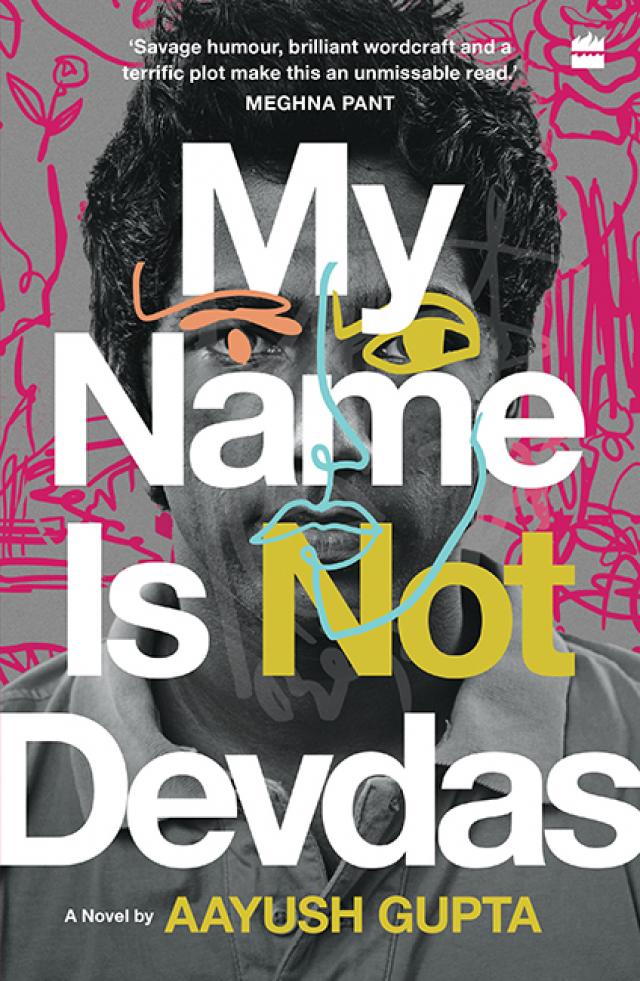
My name is not devdas, p.1
My Name Is Not Devdas, page 1


To my special three, for putting up with me. I don't think anyone else could.
‘...if true love breaks as easily as a delusion, on what can we rely? What will people pin their hopes on?’
‘They'll have the sweet, intimate memories of a lost paradise, and beside it a sea of sorrow...’
—Saratchandra Chattopadhyay
Contents
1. The Inmate
2. The Artisan
3. The Courtesan
4. Migration
5. Checks And Balances
6. Love You, Dear
7. Protest
8. Honour
9. The Search
10. The Fight Club
11. Swadeshi
12. Azaadi
13. Slam
14. The Mark
15. The Mark
16. Thud. Thud. Thud
17. Quid Pro Quo
18. Whores Don’t Die
19. Coward
20. Ether
21. All Her Talent
22. Not in My Name
23. Domestication
24. Meta
Acknowledgements
About the Book
About the Author
Copyright
1
THE INMATE
Devdas
Here on the Inside, everything mattered more—your name, your crime, your God. That’s my summation.
Every great summation needs an example, so I’ll give you one. For instance, on my last day, the inmates had asked my name. I told them, but I don’t think I’ll tell you. I am disinclined to make the same mistake twice. No offence, humans are untrustworthy and stupid. And for no particular reason, I shall labour under the impression that you are amongst those unfortunate enough to no longer be apes.
Anyway, my name, which I told them, meant more to them than it had to me.
‘Tui ki Ban-gaal?’ the smallest, meanest of them asked. Were your parents, or their parents, or theirs—you get my drift—from Bangladesh?
Now, I am a fairly intelligent person, more than most people. You could say I am almost an ape. That didn’t keep me from baring my contempt.
‘Ami Ghoti.’ I declared with pride. No one in my family had set foot in that pseudo-Bengal, assured as we were of our worth through the many das of the true Bengal. Manik da, Pancham da, Dada, collectively ingrained in me a self-belief usually reserved for religious nuts.
The other inmates didn’t share my belief. They had plenty of their own.
‘Ami Ban-gaal,’ another Small One said. His tone was challenging. The Small Ones were always overcompensating.
I wrinkled my nose. They caught that, I am afraid to say. Almost immediately, a closed fist made contact with my left temple. Somehow, my feet gave way beneath me. My last memory was a foot swinging in a perfect arc, an arc that had my face in its trajectory.
In the right circles, a kick like that could have landed the foot a spot at Mohun Bagan. Here, it would do nothing but land me in the infirmary. What a waste.
The last sound I heard wasn’t my nasal cartilage collapsing in on itself. It wasn’t the light, appreciative laughter. It was,
‘Bhadralok.’ Gentleman.
Yes, that was me all right. And gentlemen have names. As a last service to my father, I shall refrain from mentioning mine.
Tell you what, my name is not Devdas. But call me that.
I’ve never actually read the story, but I strongly believe that he and I are quite alike. Did he ever go to jail for being jilted in love? I don’t know, but I hope he did. The thought provides some comfort. ‘Devdas’ is still better than all the mouth-breathers calling me Juvenile.
Moreover, he dies at the end. And the way things are going, it doesn’t look like my fate is going to be any different.
The Law will kill me. Law—sounds like a Chinese name, doesn’t it? But no, I meant the one with the milord, milord! Not that the milord-ing would save me. My father’s father was a Lord, and trust me, when they finally came for him, he could save no thing and no one. No one because there was no one to save. No thing because there were simply too many.
The Law had got him too. Not the milords, mind you, but the Chinese. Not really the Chinese, but the Maoists. He’d died in the makeshift People’s Court, set up in the paddy fields he had lorded over, crying, clutching his dhoti. I had never seen him or his paddy fields, but I envied the man’s death. He died in a place he loved. He got to die someplace that wasn’t the Inside.
He died not of a bullet, a sickle or by tripping over his own dhoti. As the Court sentenced him to bankruptcy, the capitalist died of heartbreak. Must’ve been some paddy.
You reap what you sow, my father had said when he heard. That was the last time he’d spared his highly erudite words for the late landowner. In that young age, I had foolishly wondered if he hadn’t died because he couldn’t reap what he had sowed.
Paddy causes heartbreak, I learnt that early on. What doesn’t?
In one of his private lectures to one of his certifiably over-eighteen female students, my father had lamented the fact that communists just didn’t know how to win. He had never specifically said that communists didn’t know how to love, but I strongly, strongly believe that we don’t.
It wasn’t like I had a large pool of communists to test my theory on. The total number of communists whose love lives I knew anything about was two: me and my father. It wouldn’t have been proper to go gallivanting amidst the enlightened gentlefolk of Kolkata, asking who they screwed over a cup of communally-grown coffee.
So, given the lack of information, I had no choice but to form an opinion: communism is shitty for your love life. My father was the star of Jadavpur academia, most of his students worshipped him, but the poor man didn’t know much love. Not even from those M.Phil girls that stayed over in Father’s Night School, wearied from all the education.
And I, Devdas? I didn’t have groupies. What I had was a groupie, singular. Her name wasn’t Paro.
So, what shall I tell you about Paro?
2
THE ARTISAN
Paro
I suppose that’s my cue. And I suppose I’m Paro.
A sweet, sharp stinging over the left side of my face—that is my earliest memory of pain and Devdas. There was more to come, from the same source, but I didn’t know that yet. I was just six.
‘That’ll teach you a lesson.’ My new Life Coach, a boy my age, his eyes black as Goat, the goat in our house.
As my gaze took in his majestic countenance, I realized that he had complete authority to slap me. There are so many things in the kitchen that you identify based only on where they are placed and what packaging they have. It’s much the same with humans. This was a city boy, he was important. The Packaging told me that. That he was older and wiser than his years, his wrinkles told me.
There they were, on the outer edges of his eyes, first convincing me of his absolute righteousness, and as we grew older, of my own corruptibility. That he possessed a superpower only strengthened my belief in this, for he sneezed in exact multiples of six.
‘Didn’t I tell you to stop cutting it?’ he and his Goat eyes demanded an answer, as he wiped the snot from my face with a hankie. ‘The grass is alive. They are living beings.’
I looked at the dry sarkanda grass in my hand. In my other hand was Mother’s sickle, dutifully waiting to cut more sarkanda to weave into cheap stools. I hadn’t known the grass was alive; that was an interesting titbit.
I yelled something at him, my Haryanvi so thick that the poor boy wouldn’t know to distinguish it from a fellow goat’s bleating. Tears welled up in my eyes, and I trudged back to the village. At the chaupal, the Bengali professor was at it again, raving in his deep-sweet voice. The artisans sat around him, mesmerized.
They said he was teaching us about increased productivity as a collective. So, each day for two hours, everyone took time off from work to listen to him.
Others said that he wanted us to join his Revolution. He promised that other people elsewhere were also Revolutioning somehow. Apparently, the farmers were too content for their own good. It was the time of the handicraftsmen to lead the next set of rabble-rousers.
The productive-collective saw me emerge crying from the woods, the city boy closely following me. His unfortunate father saw us, too. The Old-Goat-boy hit me, I pronounced without being asked.
Mother was in the house, sick, so Father got up and rounded on—what, we’re calling him Narayan Mukherjee, right? —Yeah, he rounded on Professor Mukherjee, as did the others.
It didn’t occur to me then, but Honour was a big deal in my village, for there was a scarcity of everything else. Men of Haryana either toiled on the fields, or the battlefield. Both were equally noble and life-threatening, though the latter offered the promise of a full meal.
My muddha-maker-highway-seller community wasn’t involved in either, but Honour they weren’t short of. Most of them were on their feet, and in an objective frame of mind, the Professor might have been proud of the way the rabble was roused.
‘Accountability above all,’ the Professor reassured them when he couldn’t placate them. ‘Devdas will be punished.’
As they took the scaredy Old-Goat-boy to be locked up with the rest of the chickens, he caught my eye. Between rhythmic sobs, I winked.
Living with seven older brothers and sisters, I had an instinctive awareness of the power of tears. Like all good weapons, the threat of use was more potent than the actual deployment; sometimes, though, you just needed to demonstrate.
This particular demonstration would change my life. For the Professor saw the wink. And in his infinite wisdom, he decided that I’d be a great foil for the unruly, motherless child of his. No one else could put him in his place.
How mistaken he was. The wrinkled boy would corrupt me easily, for he was an excellent communicator. He had taught me early on that the best way of getting the message across was an open palm. Not the Buddha kind, but the across-your-face kind. Away from home, from the Honourable people, the occasional open palm was my sense of belongingness.
I would come to accept the apathy and the wrinkles and the Goat-eyes.
The Professor spoke to my father. He would take me to Kolkata, where he taught English and Bengali Literature. He would give me an education, the proper kind. How different things would have been, if he’d raised his one kid right, rather than two kids raising each other all wrong.
That was the last of the sarkanda I had cut. The grass would always go through many degrees of conversion before it turned into that warm feeling in the pit of my stomach. That blissful absence of hunger.
Grass. Muddha. Money. Wheat. Roti.
Don’t rinse. Do repeat.
Not anymore. For the next ten years, Bengal beckoned. I didn’t know of the epic famines it had borne witness to. For me, Bengal turned out to mean a full stomach. I had the Professor to thank for that.
Checks and Balances, Dev, I’d say to the Goat. There was a power imbalance in the Mukherjee household. Paro was secondary, it was in the Packaging. It’d remain so until I somehow repaid Narayan Mukherjee’s debt. And I think I finally have, so much so that some must’ve spilled over.
I have a much more beautiful name, so why am I still calling myself Paro? Why is Devdas, Devdas?
Well, it all started with that girl. The Saratchandra fan. Chandramukhi.
3
THE COURTESAN
Chandramukhi
The value of every achievement, reward or position is built on the broken dreams of those who never attained it. A thousand schmucks applying for one seat—that’s nine hundred and ninety-nine of them making it sweeter for the one person. Simple mathematics.
If badi didi’s orgasmic ‘aahs’ and ‘oois’ are the reward, their value is built on the disappointed dicks of those customers who could never get her there. And she never faked it.
So, if they ask why I fell for Devdas, tell them that he wasn’t special. He wasn’t the first to my heart, neither did he have a happy dick. The only thing special about him was Paro. Her broken dreams. I know that now.
That’s what drew me in, like the zig-zagginess of a snake charmer. In a trance, I slithered into that hand-woven basket with all the other snakes it had consumed.
Before I had been trapped by his countenance, I had been out on a hunt. The alleys of Paharganj had once been like the deep end of the Dal Lake, easy to get lost in, but not anymore. I was sifting through the blind cacophony of enterprise, lost in my search, when I saw him in the flesh for the first time.
Devdas. Such an apt name for him. Beaten. Lovelorn. Chaotic. The maddest in a mad world. The only one who made sense.
His eyes were a hue of hurt, his face bruised, his skin doused red—his own blood or someone else’s, I did not know. The Workers gave him a wide berth. He was like a rock, around which they swerved like the mighty Ganga. He was young, no more than seventeen, but he looked like trouble, like the guy who wouldn’t have any money afterwards. Like he was already spent.
I recognized him from the photo frame next to the bed I faked most of my orgasms in to keep my own Happy Dick happy. I was seeing him in the flesh for the very first time. In a span of weeks, Devdas had gobbled up a lifetime.
‘What—don’t!’ He recoiled as I touched him. The snake charmer was afraid of snakes. How unfair.
‘You look like you need help, mister,’ I was firm, like an older sibling. I was, in fact, older. Twenty-one.
He barely saw me, but he registered my grasp on his elbow. ‘My friend is upstairs …’ He pointed at the narrow, faded-blue staircase that lay hidden behind the creaking double doors; use and old age had broken the marriage between them, and they hardly ever fit together any more.
He called out, almost pleading. ‘Chunnilal …’ Yeah, that’s what we’re calling a guy from the twenty-first century.
‘Some friend, this Chunnilal. Leaving you here like this.’ Still very much the older sibling.
Devdas couldn’t conjure up words. I tightened my grip and led the staggering boy through the alleyway, the homeless blood rubbing against my kurti. A couple of Workers threw me warning looks, one smirked. I had caught myself a deadbeat.
He echoed them, whispering in my ear. ‘Don’t waste your time on me.’ Oh, but I so wanted to.
Impassively, I walked on. It had been eleven years since my mother and I had walked from Nayi Dilli railway station to this place. Since we had rushed on to a train from Jammu. Since we had left our little village of Sopore under the night’s hijab. Since the Uniforms took interest in us. Since Father had blown up a marketplace full of people.
It had felt like the deep end of the Dal, then. That’s what Father used to say. Throw the bloody Uniforms in the deep end of the Dal. Throw their laws there. Throw Grandmother’s cursed illness there. Inshallah.
The Uniforms would’ve loved to throw us in the deep end, mother and me. We were traitorous scum, they’d informed us. They’d come knocking, and sure enough, they hadn’t believed we knew nothing. Only idiots believe scum, especially Muslim scum. They did something to mother, and next time, they promised to do something more permanent. Terror drove us into the capital for more of the same. Father was comfortable next-door in Tihar, while they debated whether to throw him in the Dal. They never stopped debating.
‘Who’s this?’ Our resident Punjaban’s eyes were narrow as I set foot inside the haveli, through another set of disjointed double-doors. My foot rested on the discoloured, cheap marble which once upon a time had a geometric pattern that had since been eroded by the dragging feet of countless drunkards. Now the circles bled into the squares.
I had been trying to be inconspicuous, forgetful of the lug of carelessness that hung from my shoulder, and averted the Punjaban’s gaze.
‘Who’s this?’ she repeated, pale, fair-skinned, petite, and radiating righteousness. Like many of the others, she thought I was treated special. I was.
I put a finger on my lips, shushing her, and pointed to the temple inside—where the haveli’s Goddess was lightly snoring.
‘I ought to wake Amma up,’ she said, an eyebrow raised.
‘As you wish,’ I called her bluff, knowing too well she wouldn’t dare to.
It wasn’t business hours yet. The haveli was chockfull of inactivity. Heaving with angry sensuality. Two hundred years hadn’t taught it patience. The walls had been painted over so many times by people of such different tastes that it was difficult to tell where one designer tongue merged into another. Like the earthen cup, the kulhad, it was all ready to crumble. We stood at the bottom, and a glance upwards showed nothing but sky. No sign of parched lips. Nobody was drinking yet.
I’d talk to Amma later. Quietly, I led Devdas to my quarters on the roof, up four flights of stairs. Our little building was taller than the rest. My room was taller still. The smell of sweat would never go from this room, but I didn’t think he noticed. He was awash in his own stink.
I put Devdas on the creaking diwan-cum-bed, and threw my copy of Saratchandra’s Devdas over the most essential piece of gear in running a brothel: a first-aid kit. Other than a cupboard, a dozen stacked boxes took much of the space, containing an assortment of less innocent items.
It seemed impossible that he’d ever wake up, so I jumped as sound emanated from his almost still lips.
‘You know, sometimes, how the leaves rustle and you think it’s raining but it’s actually the wind?’
A couple of seconds later, I smiled. ‘Yes.’
‘I hate that. It’s so misleading, that wind. I’d rather have the rain.’
So would I.
Devdas mumbled to someone in a dream. ‘Am I mad? I think I am mad.’
I shook my head and realized he couldn’t see me. ‘No, of course not.’ I didn’t know if I should go on, so I did. ‘Don’t worry, even I think that sometimes.’






