

The opinions of jerome c.., p.1
THE OPINIONS OF JEROME COIGNARD, page 1
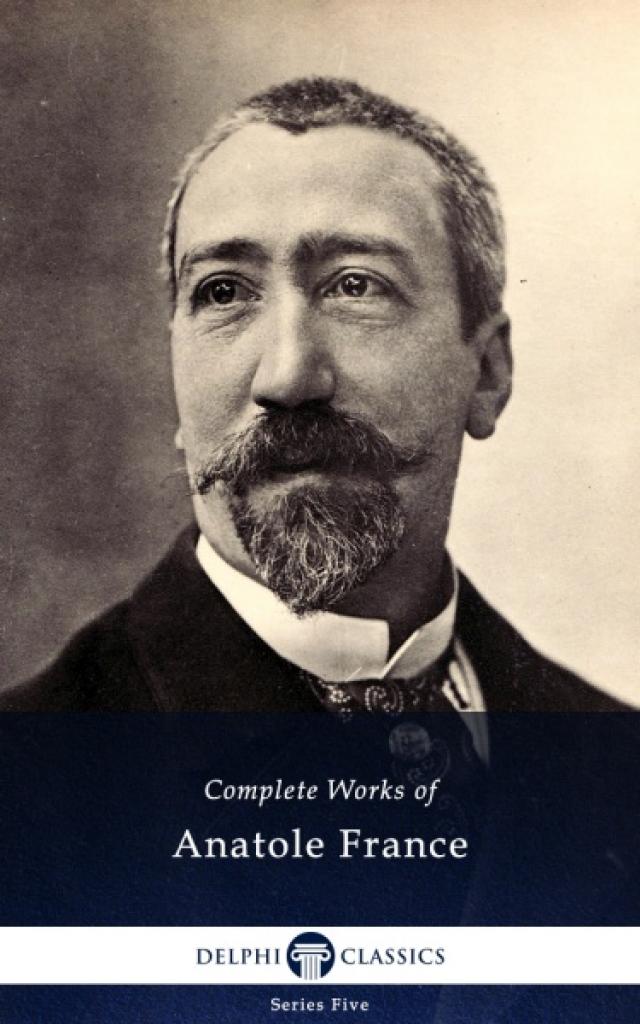


THE OPINIONS OF JEROME COIGNARD
Translated by Mrs. Wilfred Jackson
The Opinions of Jerome Coignard was first published in 1893 in France and two decades later it was translated and released in Britain. The work is a companion piece to France’s novel At the Sign of the Reine Pedauque, consisting of a series of fictionalised essays attributed to the controversial priest Jerome Coignard. Jacques Tournebroche (Menetrier) returns as a prominent figure in this novel, which details philosophical discussions often held at an old bookstore near where they both reside. Coignard is an intriguing figure, representing a combination of philosophical positions, while also managing to appear cohesive as a character and a great thinker. While often employing irony, he is shown to be incredibly harsh in debunking notions he believes to be illusions. He launches satirical attacks on the problems with the government and Church, while somehow being able to also reaffirm aspects of faith.
The essays address a plethora of issues and topics, including the priest’s dismal view on the nature of humankind and its inability to evolve or progress. One intriguing discussion is focused on the notion of justice: a concept and ideal which has plagued philosophers since Plato’s The Republic. France explores how morality becomes established, the inadequate form that justice takes in society, and the faulty means through which this justice is supposedly enacted.
CONTENTS
I. MINISTERS OF STATE
II. SAINT ABRAHAM
III. MINISTERS OF STATE (concluded)
IV. THE AFFAIR OF THE MISSISSIPPI
V. EASTER EGGS
VI . THE NEW MINISTRY
VII. THE NEW MINISTRY (concluded)
VIII. THE CITY MAGISTRATES
IX. SCIENCE
X. THE ARMY
XI. THE ARMY (continued)
XII. THE ARMY (concluded)
XIII. ACADEMIES
XIV. SEDITION-MONGERS
XV. REVOLUTIONARY MEASURES
XVI. HISTORY
XVII. MONSIEUR NICODEME
XVIII. JUSTICE
XIX. THE BEADLE’S STORY
XX. JUSTICE (continued)
XXI. JUSTICE (continued)
XXII. JUSTICE (concluded)
TO OCTAVE MIRBEAU
THERE is no need for me to tell over again here the life of Monsieur l’Abbé Jérôme Coignard, professor of oratory at the college of Beauvais, librarian to Monseigneur de Séez, Sagiensis episcopi bibliothecarius solertissimus, as his epitaph has it, later on secretary at the Cemetery of the Holy Innocents, and finally curator of that queen of libraries (the Astaracian), whose loss is for ever to be deplored. He perished, assassinated, on the Lyons road, by a Jew cabalist of the name of Mosaïde (Judæa manu nefandissima), leaving several incomplete works, and the memory of his admirable familiar conversation. All the circumstances of his odd existence and tragic end have been reported by his disciple Jacques Menétrier, called Tournebroche, or Turnspit because he was the son of a cook in the Rue St. Jacques. This Tournebroche professed for him whom it was his habit to speak of as his good master, a lively and tender admiration. “His was the kindliest soul,” said he, “that ever blossomed on this earth.” Modestly and faithfully he edited the memoirs of the Abbé, who lives again in the work as Socrates does in the Memorabilia of Xenophon.
Observant, exact, and charitable, he drew a portrait full of life and instinct with a loving faithfulness. It is a work that makes one think of those portraits of Erasmus by Holbein that one sees in the Louvre, at Bâle, or at Hampton Court, the delicacy of which never wearies the sense of appreciation. In short, he left us a masterpiece. It will cause surprise no doubt, that he was not careful to have it printed. Moreover, he could have published it himself, for he set up as a bookseller in the Rue St. Jacques at the sign of the Image de Sainte Catherine, where he succeeded Blaizot.
Perhaps, living as he did among books, he feared to add, if it were but a few leaves, to the horrible hoard of blackened paper that mildews unseen on the book-stalls. We may share his disgust when we pass the twopenny box on the quays, where the sun and the rain slowly consume pages written for immortality. Like those pathetic death’s-heads that Bossuet sent to the Abbot of la Trappe to divert his solitude, here are subjects for reflection fitted to make the man of letters conceive the vanity of writing. I may say, for my part, that between the Pont Royal and the Pont Neuf, I have felt that vanity to the full. I should incline to believe that Abbé Coignard’s pupil never printed his work because, formed by so good a master, he judged sanely of literary glory, and esteemed it at its worth, and that is exactly nothing. He knew it for uncertain, capricious, subject to every vicissitude, and dependent on circumstances themselves petty and wretched. Seeing his contemporaries, ignorant, abusive, and mediocre, he saw no reason to hope that their posterity would suddenly become learned, balanced, and reliable. He merely divined that the Future, a stranger to our quarrels, would accord indifference in default of justice. We are well-nigh assured that, great and small, the Future will unite us in oblivion and cover us in a peaceful uniformity of silence. But if, by some extraordinary chance, that hope deceives us, if future generations keep some memory of our name and writings, we can foresee that they will only make acquaintance with our thoughts by the ingenious labour of gloss and super-gloss which alone perpetuates works of genius through the ages. The long life of a masterpiece is assured only at the price of quite pitiable intellectual hazards, in which the gabble of pedants reinforces the ingenious word-twisting of aesthetic souls. I am not afraid to say that, at the present day, we do not understand a single line of the Iliad, of the Divine Comedy, in the sense primitively attaching to it. To live is to change, and the posthumous life of our written-down thoughts is not free from the rule: they only continue to exist on condition that they become more and more different from what they were when they issued from our minds. Whatsoever in future may be admired in us, will have become altogether alien from us.
Possibly Jacques Tournebroche, whose simplicity we know, did not put himself all these questions in reference to the little book under his hand. It would be an insult to think that he had an exaggerated opinion of himself. —
I think I know him. I have meditated over his book. Everything he says, and everything he doesn’t say, betrays an exquisite modesty of soul. — If, however, he was not without knowledge of his talent, he knew also that it is precisely talent that is least pardonable. In people of note we tolerate easily bareness of soul and falseheartedness. We are quite content that they should be bad or cowardly, and their good-luck even does not raise over much envy so long as it is not merited. Mediocrities are at once raised up, and carried along, by the surrounding nobodies who are honoured in them. The success of a commonplace person disturbs nobody. Rather, it secretly flatters the mob. But there is an insolence of talent which is expiated by dumb hatred, and calumnies not loud but deep. If Jacques Tournebroche consciously renounced the painful honour of irritating the foolish and the wicked by eloquent writing, one can only admire his good sense, and hold him the worthy scholar of a master who knew mankind. However it may be, the manuscript of Jacques Tournebroche, being left unpublished, was lost for more than a century.
I had the extraordinary good luck to find it again at a general broker’s on the Boulevard Montparnasse, who spreads behind the dirtied panes of his shop, croix du Lis, médailles de Sainte-Hélène, and decorations de Juillet, without a suspicion that he is furnishing the generations a melancholy lesson on peacemaking. This manuscript was published under my care in 1893, under the title: La Rotisserie de la Reine Pédauque. I refer the reader to it. He will find there more novelties than he looks for ordinarily in an old book. But it is not with that book that we have to do here.
Jacques Tournebroche was not content to make known the doings and sayings of his master in a connected recital. He was careful to collect much discourse and conversation of Monsieur l’Abbé Coignard that had not found place in the memoirs (for that is the name we must give to La Rotisserie de la Reine Pédauque) and he made a little note-book of it, which has fallen into my hands along with his other papers.
It is the note-book that I print now under the title: The Opinions of The Abbé Jerome Coignard. The kind and gracious welcome the public gave the preceding work by Jacques Tournebroche, encourages me to commence forthwith these dialogues, in which we meet once more the former librarian of Monseigneur de Séez with his indulgent wisdom, and that kind of generous scepticism to which his considerations tend, so mingled with contempt and kindliness for man. I have no notion of taking responsibility for the ideas expressed by this philosopher on divers questions of politics and morality. My duties, as editor, merely bind me to present my author’s thought in the most favourable light. His unfettered understanding trampled vulgar beliefs underfoot, and did not side uncritically with popular opinion, except in matters touching the Catholic faith, wherein he was immovable. In anything else he did not fear to oppose his age. Were it only for that he would merit esteem. We owe him the gratitude due to minds that have fought against prejudices. But it is easier to praise than to imitate them. Prejudices melt away and grow unceasingly with the eternal mobility of the clouds. They are by nature most imposing, until they become hateful, and men are rare who are free from the superstition of their period, and look squarely at what the crowd dares not face. Monsieur l’Abbé Coignard was independent in a humble walk of life; enough, I think to put him far above a Bossuet, and above all the great people that glitte
But while we hold that Monsieur l’Abbé Coignard lived as a free man, enfranchised from common errors, and that the spectre of common passions and fears had no empire over him, we must further observe that his surpassing intelligence had originality of outlook on nature and society, and only wanted, in order to astonish and delight mankind by some vast and beautiful mental engineering feat, the skill or the will to scatter sophisms, like cement, in the interstices between truth and truth. It is only in that way that great systems of philosophy are built up and held together by the mortar of sophistry.
The synthetic faculty was wanting in him, or, (if you like), the art and law of symmetry. Without it, he was bound to appear, as in fact he did, a kind of wonderful compound of Epicurus and St. Francis of Assisi.
Those two, it seems to me, were the best friends that suffering humanity has yet met on its confused progress through life.
Epicurus freed the soul from empty fears and taught it to proportion its idea of happiness to its miserable nature and feeble powers. Good St. Francis, tenderer and more material, led the way to happiness by interior vision, and would have had souls expand like his, in joy, in the depths of an enchanted solitude. Both were helpful, one, to destroy illusions that deceive, the other, to create illusions from which one does not wake.
But it does not do to exaggerate. Monsieur l’Abbé Coignard was certainly not the equal, in action or in thought, of the boldest of the sages, nor of the most ardent of the saints. The truths that he discovered he could not fling himself upon headlong. In his hardiest exploration he maintained the pose of a peaceful pedestrian. He did not sufficiently except himself from the contempt other men inspired in him. He lacked that valuable illusion that sustained Descartes and Bacon, who believed in themselves when they believed in no one else. He had doubts of the witness he bore, and scattered heedlessly the treasures of his mind. That confidence, however common in thinkers, was withheld from him, the confidence in himself as the superior of the greatest wits. It is an unpardonable fault, for glory is only given to those who importune it. In Monsieur l’Abbé Coignard it was, moreover, a weakness, and an illogicality. Since he pushed philosophical audacity to its farthest limits, he should not have scrupled to proclaim himself the first of men. But his heart remained simple and his soul pure, and his poorness of spirit that knew not how to rear itself above the world, did him an irreparable wrong. But need I say that I love him better as he was? I am not afraid to affirm that Monsieur l’Abbé Coignard, philosopher and Christian, mingled in an incomparable union the epicurism that wards off grief, and the holy simplicity that conducts to joy.
It is to be remarked that not only did he accept the idea of God as furnished him by the Catholic faith, but further, that he tried to uphold it against argument of the rationalistic kind. He never imitated that practical address of professed Deists, who make a moral, philanthropical and prudish God for their own use, with whom they enjoy the satisfaction of a perfect understanding. The strict relations they establish with Him give much authority to their writings, and much consideration to their persons, before the public. And this God, akin to the government, temperate, weighty, exempt from fanaticism, and who has His following, is a recommendation to them in salons, academies, and public meetings. Monsieur l’Abbé Coignard did not figure the Eternal to himself in so profitable a light. But considering the impossibility of conceiving of the world otherwise than under the category of intelligent beings, and that the cosmos must be held to be intelligible, even if but to demonstrate its absurdity, he referred the cause to an intelligence he called God, leaving the term in its infinite vagueness, relying for the rest on theology, which as we know, treats of the unknowable with minutest accuracy.
This reserve, which marks the limits of his understanding, was fortunate if, as I believe, it deprived him of the temptation to nibble at some appetising system of philosophy, and kept him from putting his nose into one of those mousetraps wherein independent minds are in such hurry to get caught. At his ease in the big old rat-run, he found more than one opening to look out on the world and observe nature. I do not share his religious beliefs, and am of opinion that they deceived him, as they have deceived, for their good or ill, so many generations of men. But it looks as if the old errors were less vexatious than the new, and that, since we are bound to go wrong, it were best to hold by illusions that have lost their sparkle.
It is certain, though, that Abbé Coignard, in accepting Christian and Catholic principles, did not deny himself the deduction of some original conclusions therefrom. Rooted in orthodoxy, his luxuriant spirit flourished singularly in epicurism and in humility. As I have said before he always tried to chase away those phantoms of the night, those empty fears, or as he called them, those gothic diabolisms, which make the pious existence of the simple bourgeois a kind of sordid and day-long witches’ sabbath. Theologians have, in our own day, accused him of carrying hope to excess, and even beyond bounds. I meet the reproach once more under the hand of an eminent philosopher.
I do not know if Monsieur Coignard really reposed an exaggerated trust in divine goodness. But certainly he conceived the meaning of grace in a large and natural sense, and the world, in his eyes, less resembled the deserts of the Thebaid than the garden of Epicurus. He took his way through it with that daring ingenuousness which is the most marked trait in his character, and the foundation of his teaching.
Never did a mind show itself at once so bold and so pacificatory, nor soften its disdain with greater gentleness. His rule conjoined the freedom of the cynics and the innocence of the primitive community of the Portiuncula. Tenderly he despised men. He tried to show them that having no measure of greatness about them save their capacity for sorrow, they could lay up for themselves nothing useful or beautiful save pity; that fit only for desire or suffering, they should practise themselves in the indulgent and the pleasure giving virtues. He came to consider pride as the source of greatest evil, and the one vice against nature.
It seems likely indeed, that men make themselves miserable by the exaggerated opinion they have of themselves and their kind, and that if they could form a humbler and truer notion of human nature they might be kinder to others and kinder to themselves.
His sympathetic regard, then, urged him to humiliate his fellows, in their opinions, their knowledge, their philosophy, and institutions. He put his heart into showing them that their weak and silly nature has never constructed nor imagined anything worth the trouble of attacking and defending very briskly, and that if they knew the crudity and weakness of their greatest works, such as their laws and their empires, they would only fight in fun or in play, like children building sand-castles by the sea.
We must not be astonished or scandalised then, that he depreciated every conception which makes for the honour and glory of mankind, at the expense of their peace. The majesty of the law did not impose on his clear-sighted intellect, and he deplored the fact that the wretched were subjected to so many restraints, of which in most cases, they could not discover the origin or the meaning. All principles appeared equally contestable to him. He had at last come to believe that members of a state would never condemn so many of their kind to infamy, if it were not to taste, by contrast, the pleasure of respectability. Such a view made him prefer bad company to good, after the example of Him who lived among publicans and sinners. But he kept his purity of heart, his gift of sympathy, and the treasure of his pity. I shall not speak here of his actions, which are recounted in La Rotisserie de la Reine Pédauque. — I have no means of knowing whether, as was said of Madame de Mouchy, he was more worthy than his life. Our actions are not altogether our own; they depend less on us than on fortune. They come to us from all sides. We do not always merit them. Our inviolable mind is all we have of our very own. Thence the vanity of the world’s judgments. Nevertheless, I can say with pleasure that our leading lights have found Monsieur Coignard an amiable and pleasing person. Indeed one must be a Pharisee not to see in him a beautiful creation of God. So much said I hasten to return to his teachings, which alone matter here.






