The marigold, p.1
The Marigold, page 1
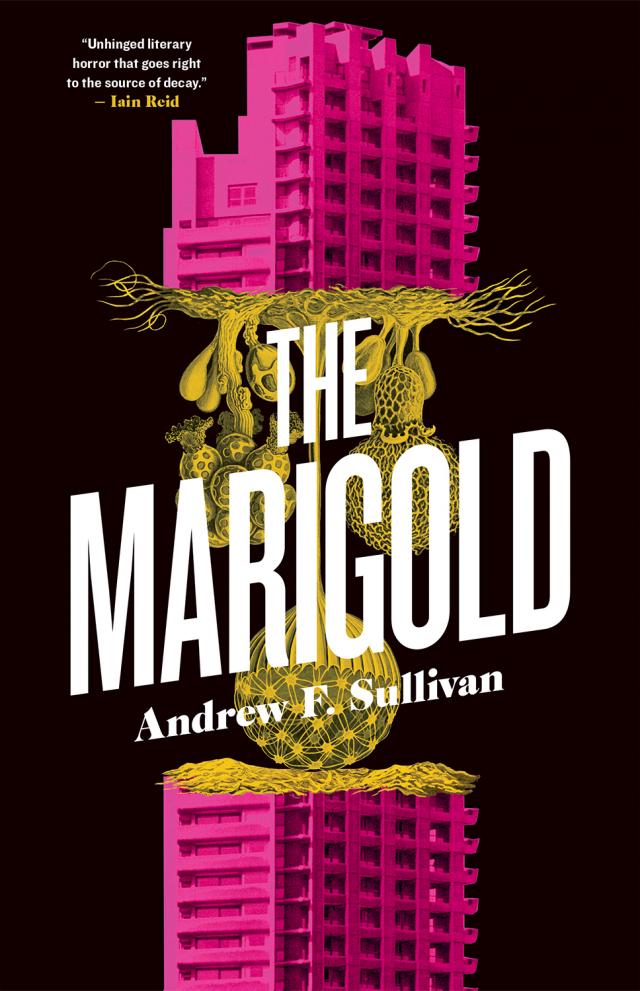


The Marigold
Andrew F. Sullivan
Contents
Praise for The Marigold
Dedication
Epigraph
1.
2.
3.
Suite 605
4.
5.
6.
Suite 1212
7.
8.
Suite 806
9.
10.
11.
Suite 307
12.
13.
14.
Suite 4004
15.
16.
17.
18.
Suite 3003
19.
20.
21.
Suite 2809
22.
23.
24.
Suite 1710
25.
Penthouse B
26.
27.
28.
29.
30.
Suite 1301
Acknowledgements
About the Author
Copyright
Praise for The Marigold
“The Marigold is a tremendous book, a damning indictment of the greed that drives the suicidal hostility we display toward our own environment, and an exhilarating dive into the weird new realities that brings. Juggling multiple viewpoints and always keeping one foot on the gas, Andrew F. Sullivan has written a vicious, delightfully bizarre ecological horror story. This one’s going to live with me for a while.”
— Nathan Ballingrud, author of North American Lake Monsters, Wounds, and The Strange
“In this keen and surprising work of eco-horror, Andrew F. Sullivan feeds his inventive terrors on the dark fruits of our contemporary precarity: the inequities of the gig economy, the bloated cost of urban housing, the uncanniness of climate change. The Marigold is a fast-paced thrill ride, populated by sharply written characters you won’t soon forget.”
— Matt Bell, author of Appleseed
“Andrew F. Sullivan’s The Marigold grows a terribly plausible urban future from the capitalist wreckage of the modern ‘world class’ city and drowns it in a tide of Boschian chaos that folds apocalypses of body horror, techno-fascism, economic, and climate collapse into one roiling, angry wave that’ll sweep you away with its narrative force.”
— Indrapramit Das, author of The Devourers
“Andrew F. Sullivan’s books delve into dark territories other writers are too timid to explore, finding nuance and emotional resonance in that stony soil. The Marigold has all the hallmarks of his past work while being something all its own, daunting and daring and just a little scary.”
— Craig Davidson, bestselling author of The Saturday Night Ghost Club and Precious Cargo
“Andrew F. Sullivan’s The Marigold is a Cronenbergian Bonfire of the Vanities, a scalpel-sharp near-future thriller about an all-consuming city in thrall to greed and power, and the disparate creatures, human and otherwise, caught in its draintrap. Sullivan brings a pulsing urgency to his prose, a mordant wit to his unsettling extrapolations from our current technological, social, and economic plagues, and an epic sweep to his depiction of the age-old struggles between the ruling class, the arrivistes, and those who serve and defy them. A gripping tour-de-force torn from tomorrow’s headlines.”
— David Demchuk, author of Red X and The Bone Mother
“Sullivan cultivates a truly suffocating atmosphere of economic and social tension, a sense that the world has moved beyond the verge of collapse and into a long, slow slide to oblivion. This is urban horror done right, layered with the cold, unalloyed terror of watching the world crumble in real time. The Marigold is a back-breaker for the genre.”
— Gretchen Felker-Martin, author of Manhunt
“As weird as it is wild, The Marigold is a bold eco-horror fable with biting critiques about climate change, the gig economy, and other aspects of our modern dystopia. Once The Marigold gets its spores in you, you’ll be compelled to read to the end.”
— Lincoln Michel, author of The Body Scout
“A bold dystopian novel that captivates with its dread and depth. The Marigold is unhinged literary horror that goes right to the source of decay.”
— Iain Reid, award-winning author of I’m Thinking of Ending Things, Foe, and We Spread
“The Marigold is social critique written in the only way that makes sense right now: as delirious, meticulously planned horror.”
— Naben Ruthnum, author of Helpmeet and A Hero of Our Time
The best horror is a mirror that thrills even as we dread seeing what we look like. Andrew F. Sullivan’s The Marigold is a fierce mirror, wide as the sky, many layered, reflecting our environmental doom and unending consumption back onto us because we deserve it. With smart, elegant prose and storytelling mastery, Sullivan blends the organic and the infrastructure of horror with terrifying results.”
— Michael Wehunt, author of The Inconsolables
“This impressively bleak vision of the near future is as grotesquely amusing as it is grim.”
— Publishers Weekly, starred review
Dedication
For Amy
Epigraph
“No one, wise Kublai, knows better than you that the city must never be confused with the words that describe it.”
— Italo Calvino, Invisible Cities
“Everything is fine.”
— Former Toronto Mayor Rob Ford
1.
Before everything that happened, before the towers, before the site plans, before the deeds, before the failing sports bar and two-bedroom apartment above it that often operated like another, more financially successful, unlicensed sports bar until the police shut it down after that one Polish kid got strangled with a pair of pink stockings behind the abandoned Shoppers Drug Mart a block or two south, there were trees here.
Now there was only a hole. A crane perched on the edge, its lights barely illuminating the dirt below. The stooped shape of a man clambered down the sloped side of the pit, dragging a heavy burden over the frozen mud. A short shadow rippled across the dirt as he descended like a lazy bird of prey. The gardener’s feet knew the way. His breath emerged in tiny clouds. No wind reached down this far, but the cold stitched itself into everything it touched. Far above the pit, towers scratched at the light-polluted sky. Most had undergone the ritual, paid their dues, if not to the gardener than to someone else with their own take on his faltering, archaic craft.
With spring, the hole would come to life again, thrumming with sweaty bodies and hungry machines, but before that happened, it had to be seeded. An aged protection spell practised since the bad old days. This was what the gardener was paid to do down here; a pile of bills in an Easton hockey bag waited for him in a vacant condo across the street. Fives, tens, twenties all mixed together. The money didn’t exist outside that hockey bag. It floated in its own reality.
The gardener unrolled the tarp, let its wet contents tumble down into the low trench at the very edge of the pit. Seventeen or eighteen, the gardener didn’t know. Male this time. It didn’t matter. Its clothes were burned back in the ravine. A rough image of a bird was tattooed on a shoulder, yellow and orange and dead. Fingernails bitten down to scabbed quicks. The gardener knelt down in the frozen dirt, dug his thick hands into the earth. Stone, ice, and soil scooped onto the body, a patient process, ensuring the seed was fully buried. From across the street, The Marigold leered into the pit, eighty-eight storeys topped with a crown of flickering orange lights, the sister tower to what was still only a hole.
Finished with his labour, the gardener grabbed the blue tarp that had carried the heavy seed, wrapping it around his shoulders like a cowl. He turned to begin the long trek to the surface. He didn’t worry about cameras catching his face. No sensors this far down, no one tracking his footsteps, recalibrating the city’s functions. These matters were handled far in advance. Marigold II was supposed to reach over a hundred storeys when it was complete, another tower with a golden halo, a shining monument for some desperate legacy. The gardener put one foot in front of the other, letting the satisfaction of a task well done keep him warm. His breath followed him. There were still more seeds to plant, still more bad old days to come.
2.
Even in the wet snow, Cathy Jin refused to ride the Shit Car.
Some of her kinder colleagues called it the Ghost Car. Coming from an under-financed department in the City’s struggling public health department, most Wet investigators were told to provide their own transportation or take transit. Occasionally, a cop or a paramedic might bring them along, warily watching them for any sign of a cough slipping out from under the helmet. When she wasn’t wearing the full masked helmet mandated by the department, Cathy wore sunglasses, mirrored and chrome. It helped keep the world at bay.
“I’m walking,” Cathy said.
“We can wait for another,” Jasmine said, eyes blinking through the snow. The
“I want you to look down the street there. You see anything that looks like a streetcar? Your phone lies. We can stand here like idiots or start walking.”
The Shit Car sat in front of them, one of the newer streetcars running without an operator, stupid enough to almost drown itself under the Dundas underpass during the floods two years before, filled to the brim with sewage. There were others too damaged to keep in circulation. The TTC claimed to have cleaned this one out, but the stench remained. Few riders took the risk. The Ghost Car is what the news called it, a haunted house stalking the streets.
“Progress for progress’s sake?” Jasmine asked, wiping melted flakes off her skin.
“I’d rather be a fool under my own power than stand out here waiting for a train that never comes,” Cathy said, dragging her kit behind her, the horned helmet bouncing like it was alive.
“Streetcar,” Jasmine said, following behind. She adjusted her jacket collar against the cold. It hid the public health logo on the inside. Most people didn’t ask what a Wet investigator did, even when the first bodies started popping up in bus shelters or half-eaten in the sand. They didn’t want to know. They weren’t about to start wearing their own little masks again. Cathy knew Jasmine kept her own masked helmet inside her bag, as if people didn’t know what it hid. Jasmine still thought the Wet was something you could control. Cathy wanted to tell her it was more like a weather system — something to be endured rather than confronted.
“Whatever,” Cathy said, trudging along the half-plowed sidewalk. Everything melted, refroze, melted again. The Shit Car came to life and passed them down King, empty, warm, and reeking. “I want to get there before some idiot decides to poke it with a stick.”
The latest case was assigned just an hour before, a notification blinking to life on her phone, Jasmine mouthing go time in the office kitchen. An alert in a parking garage under a condo tower in Liberty Village, a former yuppie enclave now struggling with the rising lake water.
“How bad do you think it will be this time?” Jasmine said. They used to work their own cases before people began to report some of the bodies were still alive. Cathy ran one of the safe injection sites before whispers of the Wet arrived. She didn’t fight the move; it was better than getting fired, ending up on the streets with her former clients. No one knew what the Wet was at that time. They only knew something was spreading up from the lake, a toxic mould burrowing its way through the foundations of the older buildings, sometimes appearing in large splotches on the ceiling or like fingers rising from the floorboards in the rooming houses, the ones that hadn’t been converted back into single-family homes for music producers and start-up investors.
“I’m sure we’ll need the masks,” Cathy said.
The new department was simply called Investigations. There was almost no funding. The job was solely to observe and report, tracking victims and infested sites. Like most things in the city, it only sounded simple. You came. You saw. You trembled.
“My favourite,” Jasmine said. “You know I love to play astronaut.”
Two cop cars sat in front of the building, blocking access to the parking garage. Real ones, not the private Threshold security some companies had taken to retaining in the other waterfront districts. They’d tried to paint over PIG scrawled on one of the back doors with white house paint.
One of the officers waved Cathy over. The heavy building manager paced back and forth between the cruisers, bald head decorated with melting snow. The officers ignored him.
“I don’t think it’s that bad,” the manager sputtered at Cathy. He knew what the heavy mask in her bag meant. “Could be garbage. Someone probably just overreacted, you know?”
“We’ll determine that,” Jasmine said, placing a hand on his forearm. Cathy preferred to let Jasmine handle the people. She had a talent for zeroing in on people’s insecurities, the weak points in their character. Sometimes that included Cathy’s. “No one is going to blame you for this, alright? It’s not like bedbugs or rats. We need you to stay calm until we figure this out.”
He smiled weakly under Jasmine’s grasp. The officers stood and watched. There was no solidarity here. The Wet investigators were considered disposable. Most public employees didn’t even want to know what they did, just that they disappeared, that anyone around them might be questioned, maybe even tested and quarantined during the aftermath. Cathy pulled her mask over her head, checking the seal as it closed around her neck, locking together like a metal noose. The sensors stood up like goat horns over the massive tinted eye ports and breathing chamber.
“Can’t we wait?” Jasmine said. “We don’t even know if it’s a false positive yet.”
Cathy rolled her eyes, glad Jasmine couldn’t see them. That was how most of their fights started. She did it again, savouring the moment. “Put it on.”
“It’s probably a level one at most,” Jasmine said. “You’re acting like this is my first day. I’m the one who said you’d be good at this. We are partners, right? I don’t need a lecture.”
“And if it’s not a level one, what’s your plan?”
Jasmine pulled her own silver mask out of her bag and strapped it on tight. Two shiny minotaurs now. Some of the newer masks had a matte finish. “You happy now?”
“As close as I’ll get today,” Cathy answered. “Let’s see what they got for us down here.”
It was hard to get funding for a department dedicated to a problem many believe didn’t exist. This was why there was no truck, no centralized office, no real mandate beyond trying to contain this ephemeral thing that the department had taken to calling the Wet. No government above the City wanted to recognize the problem. Cathy knew they made do with the scraps the City provided, often sponsored by funds from the Threshold districts, those corporate-owned sectors of the eastern shore. Most of the money went to the masks. Expensive, fragile, and prone to malfunction, but deeply loved. Jasmine had carved her initials into the forehead of her rig.
Cathy made her way through the lobby filled with abstract orange paintings and sculptures resembling pigs without heads. Jasmine followed behind her to the service door, and they descended concrete stairs together, heavy masks blinking and whirring under the fluorescence. The parking garage walls were slick with condensation. On the bottom floor, Cathy led the way past luxury SUVs and electric cars, letting the readout in her mask guide her toward the source.
“Buddy looked like he was going to have a heart attack,” Jasmine said. “I don’t blame him.”
Cathy knew the Wet was something people whispered about but rarely mentioned in public. There were message boards, hastily deleted accounts, owners and landlords reckoning with this new threat. If the building was officially infected, everyone would need to move out. The accusations would start with the tenants, then the management company, then eventually the developer and whoever they hired to originally build the tower. Then the lawsuits would start.
“He probably hid it as long as he could,” Cathy said. “These guys are like cockroaches, they only start scuttling if you turn on a light.” One of the sensors in her mask began flickering red and white, a gentle warning of spores in the air around her. “We’re close.”
Jasmine circled a bright red Mercedes on their right, while Cathy moved forward, her mask interpreting the world around her. It wasn’t a bloom this time, emerging from the ground or the concrete walls around them, thick, oozing, and alive. This one was a body, what was once a person. The Wet fed off of it. Cathy didn’t look away. Her mask read the scene, recording the data required before they took the first step to contain it.
“We got one. A body,” Cathy said. “Whose building is this again?”
“Looks like a Warton development,” Jasmine said. Her mask reflected the shuddering body on the ground, splaying it across her silver features. A man, maybe in his mid-forties, breathing in the spores down here in the damp. Something each woman had seen before, catalogued and quantified for those higher up the ladder. Usually the Wet went to work on the soft tissues first, working its way through the face, punching through the cheeks and soft palate. This body was a week or two old. An easy job for two people.