Whats become of waring, p.1
What's Become of Waring, page 1


The University of Chicago Press, Chicago 60637
Copyright © 1939 by Anthony Powell
All rights reserved
Originally published in 1939
University of Chicago Press edition 2014
Printed in the United States of America
23 22 21 20 19 18 17 16 15 14 1 2 3 4 5
ISBN-13: 978-0-226-13718-6 (paper)
ISBN-13: 978-0-226-13721-6 (e-book)
DOI: 10.7208/chicago/9780226137216.001.0001
Library of Congress Cataloging-in-Publication Data
Powell, Anthony, 1905–2000, author.
What’s become of Waring / by Anthony Powell.
pages cm
ISBN 978-0-226-13718-6 (pbk. : alk. paper)—ISBN 978-0-226-13721-6 (e-book)
I. Title.
PR6031.O74W47 2014
823'.912—dc23
2013033837
This paper meets the requirements of ANSI/NISO Z39.48-1992 (Permanence of Paper).
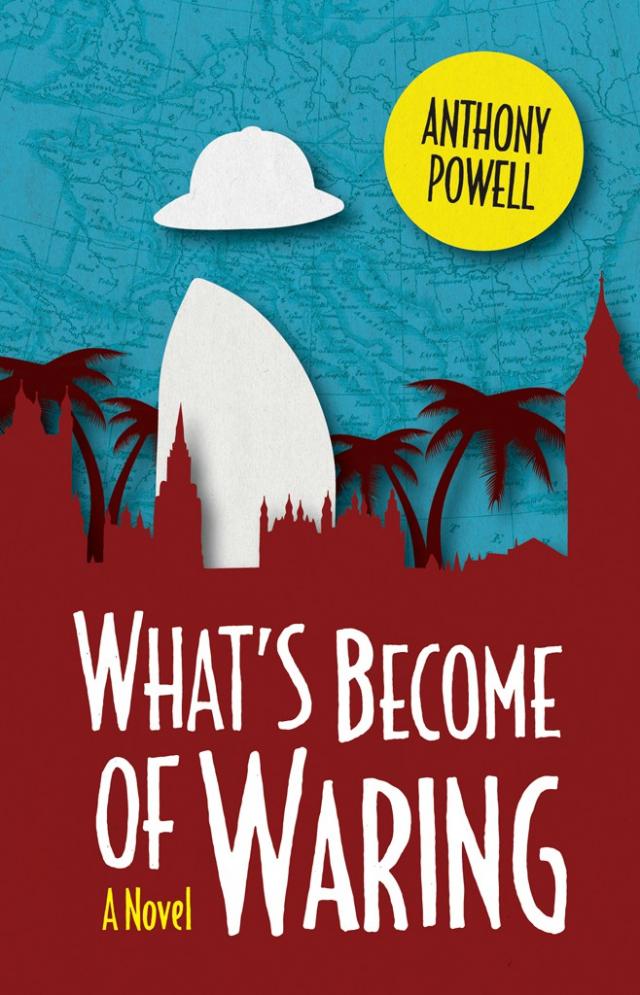
WHAT’S BECOME OF WARING
A Novel
by
Anthony Powell
‘What’s become of Waring
Since he gave us all the slip,
Chose land-travel or seafaring,
Boots and chest or staff and scrip,
Rather than pace up and down
Any longer London-town?’
ROBERT BROWNING
THE UNIVERSITY OF CHICAGO PRESS
PRAISE FOR ANTHONY POWELL AND
What’s Become of Waring
“What’s Become of Waring is a ‘powerful’ book, a good diversion for springtime, and a must for Powell devotees.”
EDMUND FULLER, New York Times Book Review
“This is a comic novel of exceptional charm and invention.”
MELVIN MADDOCKS, Christian Science Monitor
“A grand, glittering array of splendid comic characters doing funny things. Mr. Powell’s prose is beautiful and hilarious, and the whole nutty arrangement ends too soon.”
New Yorker
“What’s Become of Waring . . . ushers in the distinctive first-person narrative, at once detached and inquisitive, that is the Music of Time’s hallmark.”
Paris Review
“[This is] the kind of novel Waugh and Huxley wrote when they were younger.”
PAUL PICKREL, Harper’s Magazine
“Good funny novels are so extremely rare that when one is published it needs celebrating. I do not see how anyone who is not an imbecile can fail to be amused and delighted with What’s Become of Waring.”
Observer (London)
BOOKS BY
ANTHONY POWELL
A Dance to the Music of Time, First Movement
(including the following three novels)
A Question of Upbringing A Buyer’s Market The Acceptance World
A Dance to the Music of Time, Second Movement
(including the following three novels)
At Lady Molly’s Casanova’s Chinese Restaurant The Kindly Ones
A Dance to the Music of Time, Third Movement
(including the following three novels)
The Valley of Bones The Soldier’s Art The Military Philosophers
A Dance to the Music of Time, Fourth Movement
(including the following three novels)
Books Do Furnish a Room Temporary Kings Hearing Secret Harmonies
OTHER NOVELS
Afternoon Men
Venusberg
From a View to a Death
Agents and Patients
Fisher King
O, How the Wheel Becomes It!
What’s Become of Waring
OTHER WORKS
To Keep the Ball Rolling: The Memoirs of Anthony Powell
Volume I: Infants of the Spring
Volume II: Messengers of Day
Volume III: Faces in My Time
Volume IV: The Strangers Are All Gone
John Aubrey and His Friends
Brief Lives: And Other Selected Writings of John Aubrey
Miscellaneous Verdicts: Writing on Writers
Under Review: Further Writing on Writers, 1946–1990
PLAYS
The Garden God
The Rest I’ll Whistle
For EDITH
Contents
Chapter 1
Chapter 2
Chapter 3
Chapter 4
Chapter 5
Chapter 6
Chapter 7
Chapter 8
Chapter 9
Chapter 10
1
I WAS sitting in the Guards’ Chapel under the terra-cotta lunette which contains the Centurion saying to one, Go, and he goeth; and to another, Come, and he cometh; and to his servant, Do this, and he doeth it. The occasion was the wedding of a girl called Fitzgibbon who was marrying a young man in the Coldstream. The incident took place during the address. As the parson was approaching the end of his discourse something flicked through the air and landed in my hat resting brim upwards on the pew beside me. On examination the object turned out to be a page torn from the service paper, folded several times and inscribed in pencil: Put all your money under the seat or I’ll drill a hole through you. It was signed Red-handed Mike above a skull-and-crossbones.
The exceptional circumstances of the arrival and contents of this missive at such a juncture in such a place was some preparation, when, after choosing a suitable moment, I glanced over my shoulder, for the sight of Eustace Bromwich sitting two rows back. At the same time his presence was unexpected because he was said to be travelling in the Near East. Dark red in the face, with gleaming white eyeballs, he was staring severely at the altar as if presiding over a court-martial which had to try a particularly disagreeable case. He made no sign of recognition except for frowning and brushing up slightly the left-hand half of his moustache. The dowagers on either side of him, and beyond them the field-marshal with his nieces, sat impassive, so that Eustace’s communication had escaped their notice.
The rest of the service passed without interruption. The register was signed while the choir sang Handel’s Where’ere you walk. From the confusion of sage-green and dull gold the wedding march from Lohengrin, executed by a cluster of crimson musicians, growled out through the pillars. There was a wait while the photographers did their business; and the crowd began to struggle towards the doors of that extravagant Lombardian interior, which always seems like a place you are shown round after the revolution, the guide pointing out celebrities among the carved names, rather than a church in regular use. The congregation hung about for a while among the sad, tattered colours and glittering Victorian blazonry, until they were disgorged at last from under the massive pediment on to the barrack square.
Eustace was on the steps outside. He was wearing a grey top-hat and looked more dapper than ever. Dapper and a shade melancholy, standing there with the sun beating down on the asphalt and the elephant-coloured barracks behind him like the background to a satirical print of which he was the subject. His enormous histrionic gifts were quite apparent even in repose.
‘My God, I never thought they’d let me in there again,’ he said. ‘Not for a moment.’
‘They must have regretted doing so in view of your behaviour.’
‘Are you going to the reception?’
‘Only for a few moments. I have to get back to the office.’
‘Still advertising?’
‘I’m a publisher now.’
‘Who with?’
‘Judkins & Judkins.’
Whom do you prefer? Judkins? Or Judkins?’
‘Judkins, emphatically.’
‘How is the life of that French fellow going?’
‘It progresses slowly.’
‘I have a bus somewhere here,’ said Eustace. ‘You had better come with me.’
We walked across towards the cars parked in rows under the control of policemen and non-commissioned officers. One of the N.C.O.s opened the door of a Rolls as we approached it.
‘Get in,’ said Eustace, and, turning to the soldier, he said: ‘You used to be right-hand man in my company.’
‘Sir?’
‘Isn’t your name Madgwick?’
‘Sir.’
‘Do you remember me?’
‘It’s Captain Bromwich, isn’t it, sir?’
‘It is,’ said Eustace. ‘Congratulations on your stripes. Go and drink my health in a quart.’
The man took the half-crown and saluted. Eustace got into the car. He drove at the gates as if he meant to smash through or jump them. We turned left, making for Cadogan Square.
‘I shan’t forget that fellow in a hurry,’ Eustace said; ‘he stank like Abraham. Seeing him makes me glad I left the Army.’
‘You must be very prosperous, Eustace, to own a car like this.’
‘Just off the starvation line. This car is lent me by an American woman. She even wanted to marry me. In my present financial position I can’t afford to be too particular, but I had to draw the line there.’
‘What are you doing now?’
‘Collecting the remnants of the once vast Bromwich fortune, with which I propose to buy a boat and end my days sailing about the Mediterranean.’
‘I didn’t know you attended weddings any more.’
‘Between ourselves, old boy, I’m not sure that it wasn’t my daughter’s. After all, one has one’s duties as a parent, I suppose. Anyway, I happened to run into the girl’s mother in Bond Street the other morning. She t
No one could ever tell when Eustace was giving an imitation and when a confidence. He threw himself with such heart and soul into his impersonations of splenetic generals, White Russians, Cockney privates, and Levantine panders that for the moment he actually became them; so that it was not possible to judge whether he was revealing a scandal of twenty years before; or whether his voice had become suddenly that of some brother officer, famous in the regiment for boasts of this sort.
‘You’re not often in London now.’
‘I have an old great-aunt who is going to leave me a few hundreds. When things look bad she sends for me. She says she can’t live for ever. I think she’s wrong.’
‘Where have you been all this time? You were last heard of creating a disturbance in the bazaar at Aleppo.’
‘I visited China since then. And Tibet.’
‘We’re publishing a new book about Tibet.’
‘Who by?’
‘T. T. Waring, whom you’ve no doubt heard of.’
‘Of course I’ve heard of him,’ said Eustace. ‘That fellow gets into my hair. What do you think of his writing? I suppose he makes a lot of money out of his books.’
‘He does pretty well. So do we. He seems to get around to a lot of places people haven’t visited before.’
‘If he ever crosses my path,’ said Eustace, ‘I shall tell the little beast what I think of him. Half the hardships he brags about are what the ordinary tourist puts up with as soon as he has left the Blue Train, and sometimes before.’
‘The public don’t think so.’
‘Then they must be a lot of damned fools. Talking of books, have you seen anything of Roberta lately? She is supposed to be writing one.’
‘Not for ages. I don’t know what she can be doing.’
‘I always have a warm corner for Roberta,’ Eustace said; ‘and I think she used to be rather fond of me too. I must try and get hold of her before I go abroad.’
Eustace and I had met first a year or two before at the flat of a girl called Roberta Payne, when his Army career was already at an end. Eustace had joined the regiment about eighteen months before the outbreak of war. He had served at one time and another on most of the fronts; and in Siberia and Asia Minor after the Armistice. It had been a career not without stormy passages. Since his retirement Eustace spent his time travelling, when he was not riding, sailing, gambling, or reading. He often complained that money was getting too short for him to indulge freely in any but the last of these hobbies. This was not surprising, as he spent it copiously. As we drove along he said:
‘I haven’t decided yet where I shall make my headquarters. When I do, you will have to come out and see me there.’
‘I might look you up one summer.’
‘Don’t delay too long or I shall have made the place too hot to hold me.’
‘It will be a French port, I suppose.’
‘Yes, I’m going to make myself the scourge of the Côte d’Azur.’
When we arrived at the house where the reception was taking place he disappeared in the crowd. I wanted to write down his address, but Hugh Judkins had some things to discuss that afternoon, and it was already late, so that after a glass of champagne I had to slip away from the drawing-room without having a further opportunity to talk to Eustace about his plans.
Downstairs the hall of the house in Cadogan Square was full of men and women. More were streaming up the steps. It was astonishing that any two people could have so many friends and relations. A girl a short way ahead was also trying to make her way out into the street. As we reached the door together I recognised her as Roberta Payne.
‘I’m on my way to Fleet Street,’ she said. ‘Let’s share a taxi.’
‘I’m not going to Fleet Street. I’m for Bloomsbury.’
‘Come some of the way. I’ll drop you.’
We found a taxi.
‘Did you see Eustace? He was enquiring after you.’
‘I spoke to him for a second,’ Roberta said, ‘but a mass of people shoved their way between us. I didn’t see him again. He said he was going to live in France. I’ve just come back from there.’
‘What part?’
‘The south. I can’t tell you how lovely it was. It was awful having to go back to the old paper.’
Roberta was a tall girl with large black eyes which had a trick of increasing in area when she looked at you. Her way of walking was also provocative. She always made a lot of fuss about her poverty and her journalism. The little articles she wrote were often amusing, but they could not possibly have kept her alive. She was usually so well housed and dressed that it was generally supposed that obscure rich men, too dull to be allowed to appear, contributed something to her upkeep. At least, she was believed never to have love-affairs within her own circle of friends. That was what people said about her. Roberta was a charming creature, though you could rarely believe all she told you.
‘You know, I’m thinking of writing my memoirs,’ she said, as we moved east in the taxi. ‘I shall be twenty-five next year and I’ve had an adventurous life. Do you think Judkins & Judkins would like to publish them?’
‘I’m sure they would.’
‘Of course there are some things I could only hint at. But I think that is all the public expect these days. They like a good deal left to the imagination. It is so much more exciting than what actually happens.’
‘Where would you begin?’
‘With my parents,’ Roberta said. ‘A lot of people think that my father murdered my mother. I don’t believe that for a moment. But he used to what’s called “pass on” horses when we lived in the country, and I must say some pretty funny things sometimes happened. And then there was all the business of why he left the Yeomanry.’
‘It sounds fascinating.’
‘It was,’ said Roberta. ‘And even the story of how we lost all our money is by no means without interest.’
She sighed. No one could ever agree as to the relative truth of Roberta’s stories about having been brought up in an Elizabethan manor house in Yorkshire.
‘Have you got anything good coming out soon?’ she said. ‘I haven’t read anything amusing for ages.’
‘Odds and ends. An attack on theosophy. A book of Welsh proverbs with lino-cuts.’
‘A new T.T. Waring?’
‘Yes, there’s going to be a new T. T. Waring. About Tibet.’
‘I shall look forward to seeing it,’ Roberta said. ‘Will you let me know when it is due?’
‘I’ll send you a prospectus.’
Soon after this I handed over some money to Roberta, said good-bye, and took a bus up Kingsway. Roberta kept the taxi to pay a round of visits on editors, of whom she knew an unusually large number.
The post of reader to the firm of Judkins & Judkins was poorly paid, but not uninteresting. I had been with them for about a year. It was a small business with two partners, Hugh and Bernard Judkins, who were brothers. The house, founded by their father, Eli Judkins, for publishing text-books and works of a serious nature, had drifted gradually into general publishing, because neither Bernard nor Paul (a third brother now dead) had the energy to keep up this specialised line. Hugh had only come into the firm after Paul’s death. Before that he had been an assistant master at a small public school. Old Eli had been a Nonconformist business man and his two elder sons had spent their lives consolidating their social position, but Hugh, who was about ten years younger than Bernard, had always had revolutionary ideas. Until Paul died he had refused to join the firm. When he did so in order to keep the business in the hands of the Judkins family, he threw himself heart and soul into a profession which provided boundless scope for the intellectual fussing that he had found so congenial as a schoolmaster. He saw to it that Judkins & Judkins became a flourishing concern again.
From the day that Hugh entered the office, Bernard, never over-addicted to optimism, became increasingly embittered. He dated from the period when a reasonable standard of honesty and good manners were the best that any writer could hope for from his publisher—and even these were hard enough to obtain. As the years went by, such assets, adequately provided by himself and his brother Paul, had become of less and less value in competition with large advances and newspaper advertising. Bernard began to loathe books, so that it seemed he had only entered the trade to take his revenge on them. His life (he was about fifty-five when Paul died) became one long crusade against the printed word. Every work that appeared under the Judkins & Judkins colophon did so in the teeth of Bernard’s bitter opposition. Hugh, who had always disapproved of his elder brother’s worldly ambitions, did not take this sort of thing lying down. If Bernard could annoy him by refusing to publish authors Hugh wanted, there were ways in which Hugh could annoy Bernard. He did not hesitate to employ such methods.