Illusions, p.1
Illusions, page 1
part #24 of Nameless Series


Bill Pronzini
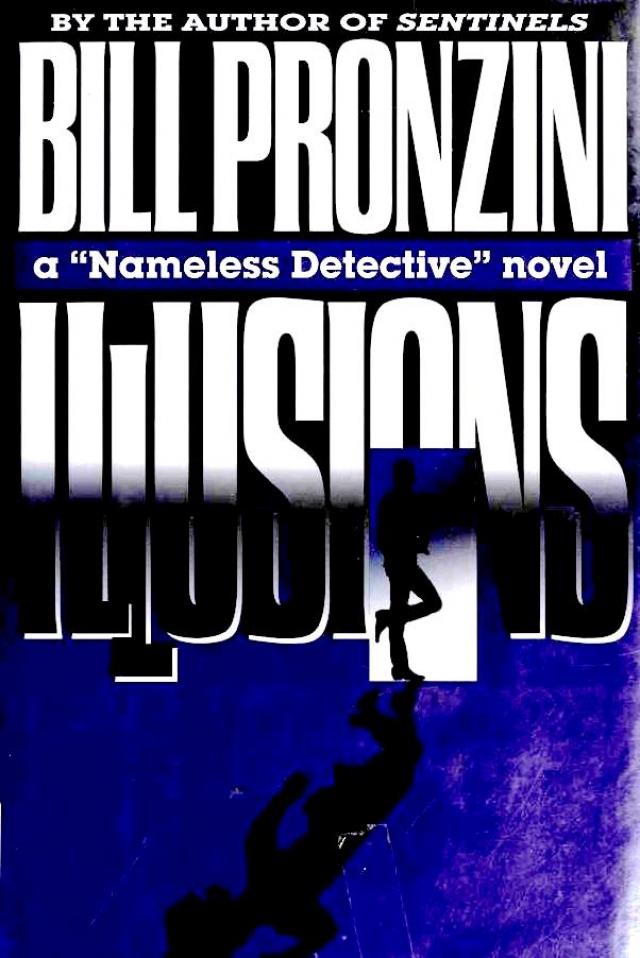
Illusions
***
In his 24th and most intriguing appearance, the "Nameless Detective" finds himself involved in two intricate and emotional investigations. The first is intensely personal: the unexpected death of his estranged friend and former partner, Eberhardt. Although there seems to be no question that Eberhardt committed suicide, "Nameless" becomes obsessed with the reasons behind the act. "A man doesn't just all of a sudden trade living for dying. Something prods him across the line between thinking about it and actually doing it. Every suicide, every homicide has its trigger. What was Eberhardt's?"
Meanwhile, he is hired by a Santa Fe businessman to find his ex-wife, who disappeared three years earlier. Locating the woman turns out to be fairly simple; she is living and working in the northern California wine country. But just when the case seems finished, it takes on bizarre dimensions-a fatal shooting that may or may not be accidental, hidden motives, and a web of lies and deception. "Nameless" is compelled to continue his investigation when it becomes clear he is partly, if inadvertently, responsible for the victim's death.
The keys to both cases lie in illusions-those people create about themselves and those they perceive in others. Additional similarities also emerge, leading "Nameless" to a series of startling revelations and ultimately to the two most difficult decisions of his career.
Both a fair-play detective story and a novel of psychological and moral complexity, Illusions is another triumph for the sleuth praised by the Chicago Sun-Times as "the thinking person's detective." It is also further proof that Bill Pronzini is "an exceptionally skilled writer working at the top of his ability" (Denver Post) and an innovator in the field of crime fiction.
***
From Booklist
Santa Fe businessman Ira Erskine hires San Francisco private eye Nameless to find his missing ex-wife, Janice, who may have relocated to the Bay Area. Erskine wants to offer Janice one last chance to see her only child, who is dying of leukemia. Nameless accepts the case, partially to get his mind off the suicide of his ex-partner and ex-best friend, Eberhardt. Within days after Nameless finds the missing woman, Erskine is found dead in a hotel room near his ex-wife's new home. While that nightmare is unfolding, Nameless tries to understand why Eb took his own life. Perhaps it wasn't suicide after all. As the cases progress, they parallel one another with an eerie similarity that forces Nameless to reexamine his previously unshakable moral certitude and self-proclaimed position as a sentinel of black-and-white justice. The Nameless series is 26 entries and almost 30 years old, and Nameless himself is edging toward 60. The sheer duration of the series, as well as its increasing depth and the steady maturation of Nameless-both chronologically and emotionally-represent a stunning and unique achievement in crime fiction. The series, the character, and this book are not to be missed. Nameless has become an American treasure.
***
From Kirkus Reviews
Think the death of the Nameless Detective's (Sentinels, 1996, etc.) embittered ex-partner Eberhardt will finally close the book on the bad blood between the two? You don't know brooding Nameless, who, seeing Eberhardt's pathological moodiness as the mirror of his own, won't rest till he knows exactly what happened to make Eberhardt shoot himself in the chest. But soon his sorrowing investigation into Eberhardt's last assignment, a series of inside-job thefts from a pair of loutish liquor distributors, gets interrupted by a new assignment of his own: finding the ex-wife of Santa Fe financial consultant Ira Erskine, armed only with a postcard to a female friend saying that she's in the Bay Area and desperate to find the woman who left him and their hometown four years ago before their son dies of leukemia. So Nameless, continuing his exhaustive tour of northern California, heads out to the wine country in Alexander Valley and finds Janice Erskine just in time for his client to get shot as dead as his ex-partner. You can't help thinking the two cases will have something to do with each other, and so they do, but not at all in the way you expect. Characteristically overblown but solid midgrade work from Nameless, even if the old guy (now pushing 60) is awfully full of illusions for a veteran of 23 earlier cases.
***
"The 'Nameless' novels are exciting, mysterious, beautifully rendered, and filled with humor about the vagaries of life in California. F. Scott Fitzgerald once said that all first-rate writers are moralists. Pronzini aims to tell us about himself and his times, and thus 'Nameless' is a bit of a secular priest."
-Ed Gorman
"Pronzini makes people and events so real that you're living those explosive days of terror."
-Robert Ludlum
"The 'Nameless Detective' is a classic private-eye hero."
-Chicago Sun-Times
"Once in a crocodile's age you come across a writer whose work you instinctively like. I've found one-Bill Pronzini."
-Los Angeles Times
"One of the best in the mystery-suspense field is Bill Pronzini."
-Washington Post
"An exceptionally skilled writer working at the top of his ability."
-Denver Post
***
DEDICATION
For all the loyal readers who have helped keep "Nameless" and me in business for three decades.
1
I HAVE A THING about funerals.
The entire ritual from start to finish strikes me as senseless. You stand in a mortuary reeking of the perfume of already withering flowers and stare down at a wax dummy in a satin-lined box, a dummy with the vague features of someone you once cared for. You sit in a church or synagogue and listen to well-intentioned but hollow eulogies and a lot of words about mortal troubles ended and everlasting life in the Kingdom of Heaven that have little to do with the departed and everything to do with the living. You stand beside a rectangular hole in the ground, listening to more hollow words, smelling grass and freshly turned earth, and if you're a man like me, what you think about is not the prospect of a blissful eternity but the futility of man's earthly existence, living and dying both.
Some people, the fortunate ones who have an unshakable faith, find comfort in all of this; it gives them hope to honor the dead in a formalized ceremony. But as far as I'm concerned there is a better, less painful, just as hopeful way to pay your respects. One that has nothing to do with perching on a cemetery lawn waiting for an object like a half-formed pod creature to be lowered into a hole and covered up with a mound of dirt. Honoring the dead ought to be a personal and private act, like making love. And it ought not to involve a preoccupation with death but rather a celebration of life, of one person's time on this earth and its interaction with your own-memories of good times shared, days lived with pleasure and purpose.
Kerry says my feelings have to do with mortality itself, that it isn't really funerals I hate but the concept that everyone and everything must eventually cease to exist. She says this gently, without censure; she doesn't care for religious ceremony or ground burial any more than I do. We have a pact: no service of any kind for either of us, cremation and the ashes scattered to the winds. Could be she's right about the way I feel. I've seen too much death over the years, too much waste. It doesn't frighten me, it makes me angry because I can't seem to come to terms with why it has to be that way. Issues without apparent meaning, questions without answers, frustrate me. It's the sort of man I am. It's what makes me good at my work.
So there I stood next to Kerry in the Olivet Memorial Cemetery in Colma, half listening to the minister delivering his graveside incantation, thinking these thoughts and waiting for Eberhardt's remains to finally be planted and the ordeal to be over. And the irony was, for all I believed in honoring the dead privately and through a celebration of life, I couldn't seem to dwell on the good memories of my ex-friend and ex-partner. The way he'd died kept intruding, taking over. And what I felt was anger and frustration.
When I'd first heard of his sudden demise, the shock had been like a physical blow. It couldn't have been suicide; Eberhardt wasn't the kind of man who took his own life. It must've been foul play, or some freak accident. But the circumstances and the police investigation pretty much ruled out any other explanation. It was suicide, all right. And why had I even questioned it? A lot of cops and ex-cops finish themselves off with a bullet, for reasons that all too often involve stress and alcohol. Eating their guns, they call it.
Once I accepted the suicide verdict I not only lost the sense of shock but the feelings of guilt and sadness that had followed it. Friends for thirty-five years and yet I could not seem to feel any grief, any real sense of loss. The fact that he'd killed himself was part of the reason; I've always considered suicide to be cheap and selfish, the ultimate act of cowardice. Another part was our estrangement for the past four years-not one word spoken directly to each other in all that time. Still, I should've felt something more than the dull anger, the nagging frustration, shouldn't I? It was Eberhardt lying down there inside the ornate box fitted into that tight little hole… Except that it wasn't. A damn wax dummy. The real Eberhardt, the man who'd once been my closest friend, had been gone physically for three days now and from a place in my heart and gut a lot longer than that.
Morbid thoughts, making me even twitchier, more impatient. Kerry sensed my discomfort, moved closer and linked her arm through mine. "You okay?" she whispered.
"Yeah. More or less."
"It'll be over soon."
I squeezed her hand, thinking: He'd have hated this, same as me. That's another little piece of irony. Born Jewish, lost his faith early on; not just nonreligious but a virtual atheist.
And here he's being buried in a sanctioned nondenominational cemetery in a service presided over by a Lutheran minister from Bobbie Jean's church.
I made an effort to focus on the other mourners. Bobbie Jean standing in a tight little cluster with her two daughters and the married one's husband, Cliff Hoyt. Thin and pale and shrunken inside a loose-fitting black dress that covered all of her except for face and hands, the hands washing each other constantly as if she were trying to rub out a stain. Dry-eyed and in rigid control; she'd done all her grieving in private. Dana Macklin, Eberhardt's ex-wife, remarried to the Stanford professor she'd left Eb for ten years ago and now one of the pillars of Palo Alto society, wearing a moist look of bewilderment. Joe DeFalco, once almost as close to Eberhardt as I was, looking rumpled and as ill at ease as I felt. Jack Logan and a handful of other SFPD old-timers-Eberhardt's cronies from the days when he'd been a detective lieutenant. Barney Rivera, tubby little Barney, popping peppermints on the sly and glancing at his watch the way a man does when he's worried he'll be late for an appointment. He caught my eye, scowled, turned aside. He didn't like me much any more and the feeling was mutual. I'd tried to talk to him shortly after I heard the news; he'd shut me off cold. I knew why and maybe one day I'd confront him about it, get it out into the open. But not today.
Two other men completed the graveside gathering, neither of whom I knew. Cops, probably; or maybe clients Eberhardt had developed over the past four years, or casual drinking buddies. People who cared enough to attend the funeral, but who wouldn't care long or deeply. Eberhardt hadn't made friends easily or been close to more than a handful of persons in his sixty years. Dana, Bobbie Jean, Joe, Barney, Jack Logan, me-that was about all. A loner and a workaholic, at least in the old days. Introspective, oversensitive, stubborn and sometimes inflexible, and given to dark moods…
Just like me.
Right. But I had saving qualities he hadn't: drive, a sense of worth and purpose, an intense desire to create order out of chaos. I also had a woman I loved too much to want to hurt, an agency that was reasonably profitable, and a line of work I found fulfilling. And I cared too much about life to want to give it up so easily and cheaply, or to leave so much pain behind.
The minister finally finished speaking. Time, now, for the first small shovelful of dirt to be tossed onto the coffin, Bobbie Jean's last good-bye. I couldn't watch that; I looked away, out over the trees and rolling lawns and jutting monuments. It was a cool, blustery day with a high wind that sent broken clouds rushing inland from the sea. The pale sunlight and the fast movement of the clouds created shadow shapes on the cemetery landscape-an animal running, a tall-masted sailing ship, a gigantic ice cream cone, a zeppelin. Illusions. Like the attitudes we build up toward others and toward ourselves that turn out to be false or distorted, so much vapor and so many tricky shadows.
Why'd you do it, Eb? I thought. Who were you, really?
The homicide inspectors had found a suicide note in the glove compartment of his car. A few words scrawled on a piece of notepaper that explained nothing: I've had enough. I can't keep hurting anymore. You won't believe it Bobbie Jean but I love you.
Bobbie Jean's words to me on the phone three days ago explained nothing either. "All I can tell you," she'd said, "is that he was deeply depressed and drinking way too much. No, he never mentioned suicide. He didn't talk about anything that mattered, hadn't in a long time. He wasn't the same man, the man I fell in love with five years ago. The last year or so… I was sleeping with a stranger."
A stranger to Bobbie Jean made him twice one to me. The Eberhardt I'd known, or thought I knew, wasn't the same man who'd put a .357 Magnum to his chest and blown his heart to shreds. The bottom line was, I hadn't known Eberhardt at all. I'd been surprised when he ended our partnership and our friendship on such a bitter note; surprised that he'd maintained four years of silence; surprised that he'd suddenly broken it by calling my office last week for an unspecified reason; surprised that an apparently moderate drinker had turned into a depressive alcoholic; and surprised that he'd been capable of killing himself. All the surprises added up to one harsh truth: The Eberhardt I'd thought I knew was an illusion created and solidified through a series of misconceptions. Even my reading of his private demons had been false.
More than once I'd tried to imagine the way it'd been for him that last night. Sitting alone in his car at three a.m., in an alley out near Islais Creek-the fifth straight night he'd been there on a futile stakeout to catch a thief who'd been stealing cases of expensive hooch from a liquor distributor's warehouse. Brooding because this was the only job he'd had in over a month and his future prospects were just as bleak. Drinking from a bottle of Jack Daniel's, finishing it, throwing it on the floor where the homicide inspectors found it. Taking out the Magnum, a big, deadly piece he'd bought sometime after opening his own one-man agency. Holding the weapon in his hand, peering at the shape of it in the dark, feeling its coldness, nerving himself. And then instead of putting the muzzle in his mouth the way most of them did-pressing it tightly against his chest and squeezing the trigger. I could visualize all of that with no trouble, but the man who'd done those things had no face. He was all shadow and silhouette, the way Eberhardt would be in my memory from now on.
Kerry moved against me and I realized the burial rite was done; the other mourners were already drifting away. We went too. Ahead I saw Joe DeFalco say something to Barney Rivera, who ignored him and hurried on. Joe stopped, frowning, and when Kerry and I reached him, he fell into step alongside me.
"What the hell's the matter with Barney?" he said. "He acts like the two of us have leprosy."
"You know the answer to that, Joe."
"Yeah. But for Christ's sake, we didn't have a clue Eb was suicidal. Not a clue."
"We might've if I'd returned Barney's calls." Rivera had telephoned my office twice last week.
"You don't know he was calling about Eberhardt. And even if he was, why the hell didn't he say something?"
"Maybe he didn't know how bad the situation was, any more than we did."
"Then why blame you and me? We're not miracle workers."
"I didn't return Eb's call either," I reminded him.
"And he told Barney you didn't? Yeah, I suppose. Still, Eb's message to you didn't say why he wanted to talk. Didn't have to be that he was looking for help, somebody to keep him from pulling the trigger on himself."
"Why else, Joe? His message did say it was urgent I contact him by Sunday night. Figures that was his original target date. The fact that it took him another two days to nerve himself up indicates second thoughts."
"Maybe. So why didn't he call me when he didn't hear from you? Or go to Bobbie Jean? Or call the suicide hotline? Why you and nobody else except maybe Barney?"
I had no answer for that. I shook my head.
"Anyhow," DeFalco said, "it's not your fault any more than it's Barney's or mine. You were two hundred and fifty miles away, up to your ass in white supremacists. I wouldn't've returned personal calls either, in your place. I didn't get in touch with Eb, for that matter, and I could have. We talked about it on the phone, remember?"
"I remember."
He blew out a heavy breath. "So what about you?"
"What about me?"
"You're not shouldering any blame, are you?"
At first I had, a little. No longer. Even if I had talked to Eberhardt and he'd unloaded on me, what could I have done or said from a distance of two hundred and fifty miles and four bitter years? How can you stop a stranger from acting on a death wish you don't condone and can't really understand?
"No," I said.
"I hope not."
"Let's drop the subject, okay?"
"Sure. Over and done with anyway, the whole sorry business. I don't even know why I put myself through today. I should've stayed home with Nancy." Nancy was his wife. DeFalco's only religion was the newspaper business, but she was a strict Catholic and Catholics consider suicide a cardinal sin.