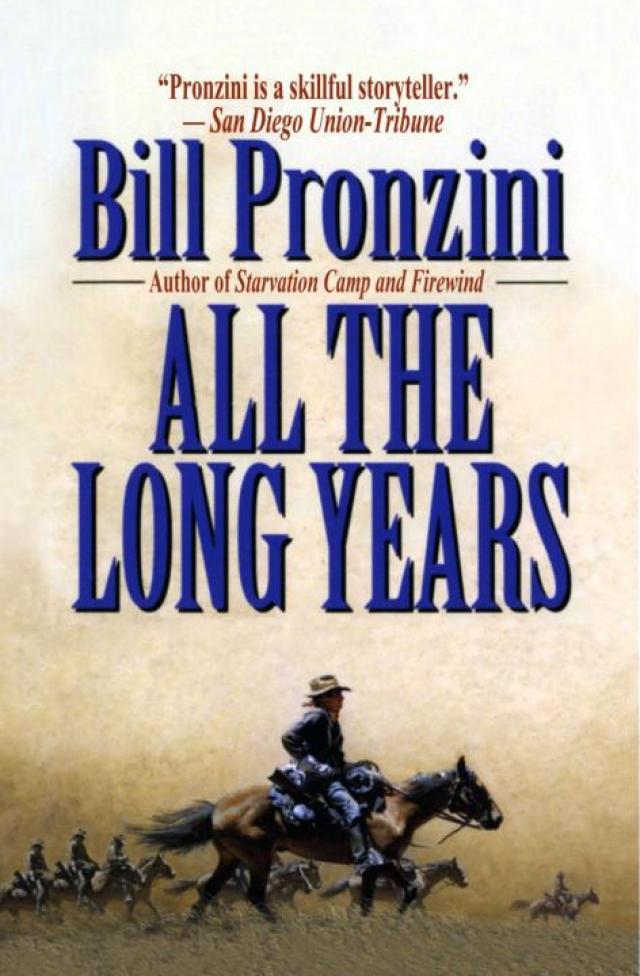
All the long years, p.1
All the Long Years, page 1


THE TORMENTOR
MASQUES
NIGHT FREIGHT
Bill Pronzini
Foreword
All the Long Years
Lady One-Eye
Hero
Doc Christmas, Painless Dentist
McIntosh's Chute
Fyfe and the Drummers
Markers
"Give-A-Damn" Jones
The Gambler
Wooden Indian
Decision
Fear
Not a Lick of Sense
Engines
The stories in this collection span thirty years of Western fiction writing and encompass a variety of characters, settings, and themes. They are peopled by such familiar figures as lawmen, ranchers, cowhands, gamblers, detectives, newspapermen, and timber jacks, and by such little used individuals as stable hands, bartenders, saddle-makers, tramp printers, traveling dentists, moonshiners, and patent medicine drummers. Settings extend from small, mythical Montana towns to actual locales: the California Mother Lode, the Oregon wilderness, Death Valley. In scope they run the gamut from grim character studies to tales of action and mystery to farcical humor.
The earliest, "Decision," first published in 1971, shares a similar theme-the drifter in search of roots and commitment who encounters a woman in distress-with one of the most recent, "Engines," first published in 1997. The former is Western myth, the latter contemporary and grounded in fact, and the resolution to each is completely different. Other selections are also variations on classic Western themes. "All the Long Years," a tale of wrong choices and bitter loss, begins with the brand blotting of a wealthy rancher's cattle by the angry son of a neighbor. The hardships faced by a deepwoods logging gang, the fitting vengeance they exact on a tyrannical leader, and "the damnedest sight a man ever set eyes on" is the stuff of "McIntosh's Chute." Three stories, "Hero," "Markers," and "Fear," deal in diverse ways with the long-range effects of acts of violence and cowardice. "Lady One-Eye" is a Western mystery hybrid featuring 1890s San Francisco detectives Sabina Carpenter and John Quincannon-whose other adventures can be found in the novels, QUINCANNON (Walker, 1985), BEYOND THE GRAVE (Walker, 1986) written with Marcia Muller, and the collection, CARPENTER AND QUINCANNON, PROFESSIONAL DETECTIVE SERVICES (Crippen & Landru, 1998).
The remaining entries are less easily categorized. "`GiveA-Damn' Jones" champions the life and times of a 191h-Century tramp printer, and tells how a brief encounter with one such "hand-pegger" alters the entire shape of a young man's life. "The Gambler" examines nearly fifty years of professional gambling in the Old West in a stylistically unconventional fashion. "Doc Christmas, Painless Dentist" and "Wooden Indian" are ironic and light-hearted tales, respectively, of an amazing extraction made by a shrewd traveling charlatan and of a band of native Americans and their remarkable chief. "Fyfe and the Drummers" and "Not a Lick of Sense" are humorous short-shorts that might be classified as Western tall tales.
Some critics would have us believe that the traditional Western story is limited to conventional plots, stock characters, and simplistic themes. This is patently not the case. The Western tale can be and is many things. 1 hope the fourteen stories gathered here demonstrate this fact, although they represent only a fraction of the broad range of possibilities.
Bill Pronzini
Petaluma, California
1 caught him some past noon on the second day, over on the west edge of my range near Little Creek. Thing was, he wasn't much of a cow thief. He'd come onto my land in broad daylight, bold as brass, instead of night herding and then doing his brand burning elsewhere. And he'd built his fire in a shallow coulee, as if that would keep the smoke from drifting high and far. You could hear the bawling of the cattle a long way off, too.
I picketed my horse in some brush and eased up to the rim of the coulee and hunkered down behind a chokecherry to have a look at him. 1 wanted him to be a stranger, or one of the small dirt ranchers from out beyond the Knob. But you don't always get what you want in this life-hell, no, you don'tand 1 didn't this time. He wasn't a drifter, and he wasn't a dirt rancher. He was just who 1 figured the brand blotter to be: young Cal Dennison.
He had a running iron heating in the fire, and he was squatting alongside, smoking a quirly while he waited. Close by were a lean-shanked orange dun cow pony and two of my Four Dot cows that he'd hobbled with piggin' strings. The cows were both young brindle heifers, good breeding stock.
The tip of the running iron was starting to turn red. Cal Dennison rotated it once, finished his smoke, and went to drag one of the heifers over near the fire. When he set to work with that iron, he had his back to where 1 was. The smell of singed hair came up sharp on the warm afternoon breeze.
1 stood and drew my Colt six-gun. Off on my left there was an easy path into the coulee. 1 moved there and made my way down, slow and careful. The bawling of the heifers covered what sounds 1 made. I stopped a dozen paces behind and to one side of him, close enough to see that he was almost done turning my Four Dot brand into a solid bar. If 1 gave him enough time, he'd burn a D above the bar, the way he had with other of my cows over the past week or so. Then he'd do the other heifer and afterwards herd both over onto D-Bar graze, next to mine on the other side of Little Creek. D-Bar was Lyle Dennison's brand.
But I didn't give him enough time. 1 put the Colt's hammer on cock and said fast and loud: "You're caught, boy. Set still where you are."
He must have heard the sicking of the hammer because he was already moving by the time 1 got the words out. Cat-quick, he came all the way around with a look of wild surprise on his face.
"1 said set still! You want to die, boy?"
Sight of the Colt and the tone of my voice, if not the words themselves, finally froze him on one knee with the running iron still in his hand. 1 could have emptied the Colt into him by the time he dropped the iron and drew his own sidearm, and he knew it. 1 watched him wet his mouth, get hold of himself, watched the wildness smooth out into an expression of sullen defiance.
"Bennett," he said, the way most men would say:
"Horseshit."
"Put the iron down. Slow."
He did it.
"Now your six-gun, even slower. Just two fingers."
He did that, too.
"Untie the heifer. Then go do the same with the other one."
It took him a minute or so to get the piggin' strings off the first heifer's legs. She scrambled up and went loping away down the coulee, still bawling. He got the second cow untied in quicker time, and, while that one ran off, he stood hipshot, glaring at me. 1'd seen him in Cricklewood a few times, but the Dennisons and the Bennetts had kept their distance these past twenty years; this was the first 1'd had a good look at the boy up close. He'd be past nineteen now. Tall and sinewy and fair-skinned-the image of his ma, I thought. Same light brown curls and dark smoky eyes and proud stance. How long had Ellen Dennison been dead? Ten years? Eleven? Funny how time distorts your sense of its passage, how single years among all the long years blend and blur together until you can't tell one from another.
"Well!" young Cal said. "Now what?"
1 didn't answer him. Instead, I moved over to where he'd been by the fire and kicked his sidearm, an old Allen & Wheelock Navy .36, in among the branches of a wild rose bush.
He said angrily: "What'd you do that for? Them thorns'll scratch hell out of it."
"You won't be using it again."
"You going to shoot me, Bennett?"
"Mister Bennett to you."
"Go to hell, Mister Bennett."
"This was twenty years ago. ..I'd have already shot you."
"Well, it ain't twenty years ago."
"Rustling can still get you hung in this county."
"1 ain't afraid of that. Or you, Mister Bennett."
"Then you're a damn' fool in more ways than one."
He tried to work his mouth up into a sneer, but he couldn't quite bring it off. He wasn't near so tough or fearless as he was trying to make out. His gaze shifted away from me, roved up along the rim of the coulee. "Where's the rest of your crew?"
"There's just me. 1 don't need a crew to run down one punk brand blotter. Only took me a day and a half."
He had nothing to say to that.
I said: "How many of my cows have you burned?"
"You're so god-damn' smart, you figure it out."
"My riders say at least half a dozen."
"Two thousand," he said, smart-mouth.
"All right, then. Your pa know what you been up to?"
...No."
"1 didn't think so. Whatever else Lyle Dennison is, he's not a brand burner and a cow thief."
"I'll tell you what he is," the boy said. "He's twice the man you are."
"Maybe so. But you're not half the man either of us ever was."
That flared up his anger again. "You stole three thousand acres that belonged to him! You turned him into a brokendown dirt rancher!"
"No. That land belonged to me. Circuit judge said so in open court...."
"You bought that judge! You bribed him! That's always been your way, Mister Bennett. Get what you want any way you can... lie and steal and cheat to get it. Ain't that right?"
There was another lie on my tongue, but it tasted bitter, and 1 didn't say it. What did he know about how it was in the old days, a kid like him? Those three thousand acres were mine by right of first possession; my cattle were on free range before Lyle Dennison and others like him showed up in this valley. A man has to fight for what belongs t o him, even if it means fighting dirty. If he doesn't, he loses it-and, once it's gone, he'll never get it back. It's gone for good.
"That's what this brand-blotting business is all about?" 1 asked him. "Something that happened between your pa and me twenty years ago?"
"Damn' right that's what it's all about. Way I figure it, 1 got as much right to steal your cattle as you had to steal my pa's land."
"Twenty years is a long time, boy. More years than you been on this earth."
"That don't change the way it was. Pa never would do nothing about it... he just gave up. But not me. It's my fight now, and I ain't giving up until it's settled, one way or another."
"Why is it your fight now?"
"Because it is."
"Something happen to your pa?"
"That's none of your look-out."
"You've made it my look-out. He didn't pass on, did he?"
"Might as well have."
"Sick, then? Some kind of ailment?"
The boy was silent for a time. But 1 could see it eating at him, the pain, and the rage and the hate; he had to let it come out or bust with it. When he did let it come, he threw the words at me as if they were knives. "He had a stroke last week. Crippled him. He can't hardly move, can't hardly talk, just lies there in his bed. You satisfied now? That make you happy?"
"No, boy, it doesn't. I'm sorry."
"Sorry? Christ ...orry! You son-of-a-bitch...."
"That's enough. Go get your horse."
"What?"
"Get your horse. Lead him up to where mine is picketed."
"You takin' me to town?"
"We're going to the D-Bar. 1 want to see your pa."
"No!"
"You don't have a say in it. Do what 1 told you."
"Why? You aim to tell him about this?"
"Maybe. Maybe not."
"You do and it'll kill him."
"You should have thought of that before you came onto my land with that running iron."
"I won't go."
"You'll go," I said. "Sitting your saddle or tied across it with a bullet in your leg, either way."
He didn't move until I waggled the Colt at him. Then he spat hard into the grass and swung around and stomped over to where the orange dun was picketed.
Following him and the horse up to the coulee rim, I tried to figure what had put the notion to do this in my head. It wasn't just the brand blotting. And it wasn't because 1 wanted to mortify the boy in front of Lyle, or that 1 wanted to pour salt in old wounds. Could be I would tell Lyle about the rustling, but more likely 1 wouldn't. Maybe it was because Lyle Dennison and me had been friends once, and now he was ailing, likely dying. Maybe it was that young Cal needed to be taught some kind of lesson. Or maybe it was just that there was a crazy need in me to touch the past again.
A man doesn't always know why he does a thing. Or need to know, for that matter. It's just something he has to do, so he goes ahead and does it. Let it go at that.
It was mid-afternoon when we came in sight of the D-Bar ranch buildings. They were grouped in a hollow where Little Creek ran, with the gaunt, snow-rimmed shapes of the Rockies rising up in the distance. 1'd expected changes after so many years but none like the ones 1 saw as we topped the hill above the creek. The place appeared run-down, withered, as if nobody lived there any more. Gaps in the walls of the hip-roofed barn, missing rails in the corral fence, a rusty-wire chicken coop where the bunkhouse had once stood. The main house needed whitewash and new siding and a new roof. There had been flower beds and a vegetable garden once. Now there were a few dried-up vines and bushes here and there, like scattered bones in a graveyard.
Cal said-"You like what you see, Mister Bennett?"-and 1 come to realize he'd been watching me take it all in. It was the first he'd spoken since we had left my land.
"Why haven't you and your pa kept things up?"
"Why? Why the hell you think? He's old, and I ain't got but two hands, and there ain't but twenty-four hours in a day."
"Nobody working for you?"
"Not since anthrax took most of our cows two years ago."
"Anthrax took some of my cows, too," 1 said.
"Sure it did. But then you went right out and bought some more, didn't you?"
We rode the rest of the way in a new silence. The boy leaned down and pulled the wooden pin that held the sagging gates shut, and we went on across the yard. Even the grass that grew here, even the big shade cottonwoods behind the house and the willows along the creek, seemed to have a dusty, lifeless look.
We drew rein at the tie rail near the house and got down. I said then: "I'll see him alone."
"Hell you will! You go waltzin' in there like you owned the place, he'll have another stroke...."
"You got no say in this, boy. I told you that."
"You can't just bust in on him!"
"I'll announce myself first."
"What about me? You expect me to just stand here and wait for you?"
"That's just what 1 expect. You won't run. And you won't try fighting me, neither, not with your pa lying in there."
We locked gazes. There was as much heat in it as a couple of maverick steers locking horns. But I was older and tougher, and 1 had a six-gun besides, holstered though it was now and had been for most of the ride. Cal knew it as well as 1 did. It was what made him look away first, hating himself for doing it and hating me all the harder for backing him down.
He said thickly: "You goin' to tell him?"
"Still haven't made up my mind."
"He'll call you a liar if you do."
1 said-"Stand here where you can hear me if 1 call you."-and went on up the stairs to the screen door. He didn't try to follow me. When 1 turned to glance back at him, he was rooted to the same spot with the hate shining out of his eyes like light shining out of a red-eye lantern.
1 opened the screen door-the inside door was already open-and called: "Lyle? It's Sam Bennett. I've come to talk."
No answer.
"Sing out if you object to my coming in."
Still no answer.
1 moved inside, let the screen door bang shut behind me. The day's warmth lay thick in the parlor. Dust, too-a thin layer of it on the floor and on the old, worn furniture. Ellen Dennison had been a neat, clean woman; she would have kept house the same way. But she was long gone. For ten or eleven years now it had been just Lyle and the boy.
"Lyle?"
My voice seemed to come bouncing back at me off the walls. 1 walked across the room, into a hall with three doors opening off of it. He was beyond the last of them, in the back bedroom. Lying in a four-poster with an old patchwork quilt draped over him. His eyes were wide open. One look at them that way and I knew he was dead.
One thin, veined hand lay palm up on the quilt. I went over and touched it, and it was cool and stiff. The stiffness was in his face and body, too. Dead a while, since sometime this morning.
For a time 1 stood looking down at him. We were the same age, forty-six, but the years had ravaged him where they had only eroded me some. His hair was thin and gray-white, there were lines in his face as deep as cracks in sun-dried mud, and his hands were the hands of a man in his sixties. Death, for him, had come as something of a mercy.
A sadness built in me, seeing him up close like this, newly passed on. I'd never hated Lyle Dennison. He had been my friend once, and then he'd been my enemy, but 1 had never hated or even disliked him much. I'd hardly thought about him at all after the court fight. Hell, why should 1? I'd claimed the three thousand acres, and they were what counted. Land and money and power were the only things that counted.
That was the way I'd thought back then and most of my life, anyhow. It wasn't the way I thought now.
1 leaned down to close Lyle's eyes. Then I made my way back through the house and out onto the porch. Cal was standing where I'd left him. The only thing he'd done was to take out the makings and build himself a smoke.
He said around the quirly: "That was some short talk."
"He's dead, Cal," I said.
"What?"
"Your pa is dead. Passed away this morning sometime, looks like."
"You're a god-damn' liar!"
"Go in and see for yourself."
The cigarette dropped out of his mouth, hit the front of his hickory shirt, and showered sparks on the way to the ground. He didn't notice. His face had gone bloodless. "You told him about me. You told him, and he had another stroke...."