

The scandalous hamiltons, p.1
The Scandalous Hamiltons, page 1
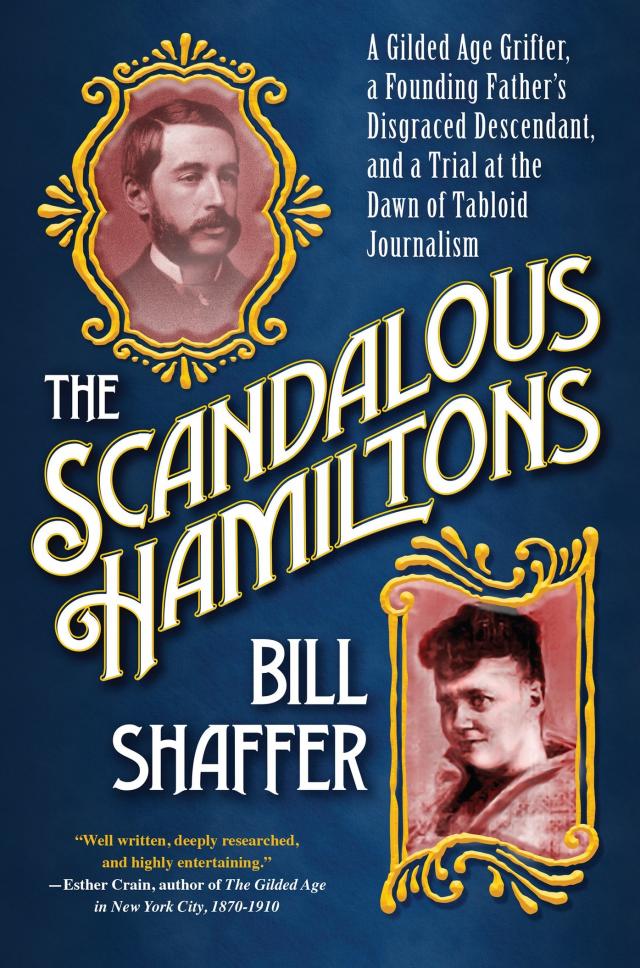


THE SCANDALOUS HAMILTONS
BILL SHAFFER
CITADEL PRESS
Kensington Publishing Corp.
www.kensingtonbooks.com
All copyrighted material within is Attributor Protected.
CITADEL PRESS BOOKS are published by
Kensington Publishing Corp.
119 West 40th Street
New York, NY 10018
Copyright © 2022 William R. Shaffer
All rights reserved. No part of this book may be reproduced in any form or by any means without the prior written consent of the publisher, excepting brief quotes used in reviews.
CITADEL PRESS and the Citadel logo are Reg. U.S. Pat. & TM Off.
ISBN: 978-0-8065-4225-6
First Citadel hardcover printing: August 2022
Library of Congress Catalog Number: 2022934733
Electronic edition:
ISBN: 978-0-8065-4227-0 (e-book)
For my two loves:
CHRISTINE and CAROLINE
Table of Contents
Title Page
Copyright Page
Dedication
INTRODUCTION
CHAPTER ONE - IN THE WOMAN’S POWER
CHAPTER TWO - A WOMAN’S READY DAGGER
CHAPTER THREE - A VILLAINOUS CONSPIRACY
CHAPTER FOUR - MR. HAMILTON’S PLIGHT
CHAPTER FIVE - MRS. HAMILTON WEEPS
CHAPTER SIX - MRS. EVA HAMILTON’S STORY
CHAPTER SEVEN - MANN OR HAMILTON?
CHAPTER EIGHT - MR. HAMILTON’S FATE
CHAPTER NINE - EVA BEGINS HER FIGHT
CHAPTER TEN - EVA AT THE FOOTLIGHTS
CHAPTER ELEVEN - MRS. GAUL’S QUEER GOINGS-ON
CHAPTER TWELVE - SEQUEL TO TRAGEDY
CHAPTER THIRTEEN - LET HIM BE FORGOTTEN
EPILOGUE
NOTES
IMAGE CREDITS
SOURCES
ACKNOWLEDGMENTS
ABOUT THE AUTHOR
INTRODUCTION
Had the Hamilton story that unfolds on these pages occurred today, it would merit blanket coverage on cable news and provide ample fodder for a barrage of biting headlines on the front pages of the New York tabloids. Conspiracy theories would be breathlessly tweeted from those laying claim to inside information. Rumors and innuendo would be passed along, sotto voce, at fashionable New York dinner parties—a perfectly tawdry tale involving a Founding Father’s descendant would be impossible to ignore.
During the Gilded Age, however, the only medium available for “breaking news” was the newspaper. In 1889, there were 1,492 daily newspapers published in the United States—an additional 14,787 monthlies, weeklies, and semi-weeklies printed in America’s largest cities and smallest towns fueled the nation’s insatiable appetite for news. There were nineteen English-language dailies published in New York City alone, joined by a host of others published in the native languages of recently arrived immigrants. The largest New York dailies, the World, Tribune, Herald, Sun, and Times had a combined total of 475,000 daily readers—almost one newspaper for every three citizens of New York. (The 1890 population of New York City totaled 1.51 million people, the City of Brooklyn, 806,000.) Telegraph networks and the recently formed Associated Press allowed for news stories published in one part of the United States to be transmitted across the country to run simultaneously in editions nationwide.
The rise of yellow journalism in the last decades of the nineteenth century, epitomized by Joseph Pulitzer’s New York World, marked a turning point in the public consumption of news. Publishers increasingly sought to capture the attention of their audience by printing provocative headlines and titillating stories rife with hearsay and gossip. Articles that recounted violent crimes, attempted blackmail, prostitution, alcohol-induced mayhem, morphine addiction, or a mysterious death were lapped up by readers thirsty for even a hint of scandal. The story of the tumultuous, five-year relationship between Robert Ray Hamilton and the woman born as Evangeline Steele combined every one of these elements. For the New York dailies, Ray and Eva were heaven-sent—an unexpected gift wrapped in truths, half-truths, and lies.
When the salacious details of the Hamilton story emerged in August 1889, dailies were typically published as eight-page editions, with eight columns per page. The front page might feature up to twenty short articles laid out over those eight columns, the sea of text broken up only by an occasional, small illustration. For a story to command a full column on page one, it had to be sensationally newsworthy. From the outset, the Hamilton drama played out not only in full columns on page one, but in multiple columns that continued onto the interior pages. The headlines used as chapter titles in this book are representative of the many articles about the Hamiltons.
Why was such attention paid to Robert Ray Hamilton and Evangeline Steele? In the nineteenth century the Hamilton name was recognized by all Americans and almost universally revered—akin at the time to the Kennedy name today. In 1804, the news of Alexander Hamilton being shot in a duel with Aaron Burr produced the same level of shock as the news of JFK’s assassination in 1963. Fifty-eight years after Dallas, our interest is still piqued when we hear the Kennedy name in the news; so, too, with the Hamilton name long after that fatal event in Weehawken, New Jersey.
Members of the Hamilton family were listed in the Social Register, well known in political and financial circles, and many were members of Ward McAllister’s “Four Hundred,” the pinnacle of New York society (four hundred is the number of guests said to fit comfortably in Mrs. Astor’s ballroom). Men like Ray Hamilton, born into the upper classes of the Gilded Age, traded stocks and real estate, entered into socially acceptable professions—the law, finance, medicine—and spent a fair share of their time with other members of their class idling in private clubs and fine restaurants. Their life of privilege was assumed from birth.
Conversely, Eva was raised dirt-poor in the northeast Pennsylvania coal country, the daughter of an alcoholic, itinerant logger. Women who were born into difficult circumstances, and who weren’t afforded much of an education, had to scratch and claw for everything they obtained in life. If that scratching and clawing flirted with the law or social norms, so be it. They did what they had to do to get by.
And while Ray’s name and identity were clearly defined at birth, Eva used multiple surnames over the course of her life—Steele, Parsons, Brill, Mann, Hamilton, and Gaul—and claimed at various times to be from New Jersey, Pennsylvania, or New York. This was easy to do during the nineteenth century. There were no such things as photo IDs, social security numbers, or background checks. You were, quite simply, whoever you said you were. The ability to invent and re-invent one’s identity was particularly useful for a person who may have been inclined to engage in illegal or nefarious activities.
The newspapers had a field day contrasting Eva’s hardscrabble roots with Ray’s inherited wealth and privilege. Members of the working class who pored through newspapers like the World reveled in stories about the vulnerability of the rich and powerful—comforted in some way by the knowledge that even the privileged were susceptible to the vicissitudes of life, just like them.
Beyond following the blow-by-blow accounts of the events that transpired beginning in August 1889, readers were intrigued by Ray’s and Eva’s disparate socioeconomic backgrounds and how a man of his stature could become entangled with a woman regularly described by the press as a “bold adventurous.” And one unanswered question hung over the entire drama: How could such a seemingly smart man be so stupid?
As Ray Hamilton left little record of his own judgment about the matter, it is difficult to conclusively determine his feelings about his life with Eva. What Ray did leave, however, was a lasting memorial in his own name, the Hamilton Fountain. It remains today at Seventy-Sixth Street and Riverside Drive in New York, more than one hundred years after it was set in place. Today, children splash their hands in the fountain’s basin and local residents stroll past the outstretched wings of its crowning eagle, few of them knowing the long-forgotten Hamilton story and the fountain’s raison d’être.
Attached to a lamppost adjacent to the fountain is a small plaque put in place by the New York City Parks Department that offers a brief biography of Ray Hamilton, explains the significance of ornamental fountains in early twentieth-century parks, and mentions a “public scandal involving Eva Mann, who he had secretly married, and who had used this alliance to raid his substantial financial holdings.”
That one line piqued the curiosity of this author and instigated a search through court records, case files, personal correspondence, and archival material in an effort to learn more about this mysterious public scandal involving Robert Ray Hamilton and the woman the Parks Department referred to as Eva Mann. While these materials certainly provide pertinent details about their relationship, it is through the dramatic newspaper accounts that ran nationwide during the last years of the nineteenth century that we learn of the public fascination with Ray and Eva and the white light of media attention that focused on the regrettable decisions made by these two ill-fated figures of the Gilded Age.
CHAPTER ONE
IN THE WOMAN’S POWER
On Monday, January 7, 1889, an unlikely couple crossed the Hudson River from Manhattan to Paterson, New Jersey, to be married. Robert Ray Hamilton and Eva Brill were improbable candidates to become husband and wife—during the course of their four-year relationship they had maintained separate lives and spent as much time apart from each o ther as they had together. A wealthy attorney and real estate investor, Ray also represented the fashionable Murray Hill District in the New York State Assembly from 1884 to 1888 and spent a great deal of time in Albany, only seeing Eva when he returned to the city on weekends.
When Ray was away, Eva associated with a dubious collection of friends and acquaintances who were far removed from the stature of her soon-to-be husband. The birth of their first child out of wedlock, three weeks before their journey to Paterson, provided the impetus for Eva to convince Ray to marry her. After four years, Eva’s ambition to become Mrs. Robert Ray Hamilton was about to triumph over Ray’s indifference to legalizing their relationship.
The Pavonia Ferry ran between Jersey City and Chambers Street in lower Manhattan. The wood-clad steamer bobbed through the chop of the Hudson on its fifteen-minute journey across the river, briefly slowing to square up to its Jersey City terminal before the engines revved, smoke belched from its stacks, and the captain made his final push into the pier. In warm weather, passengers lined the open bow front of the Pavonia to see the blocky silhouettes of factories and warehouses that lined the Jersey waterfront come into focus as the ferry neared the shore. On a cold January day, though, a bench inside the cabin would be the seat of choice for a couple seeking shelter from the winter winds that blew up the Hudson from New York harbor.
Ray and Eva’s trek to Paterson, two stops inland from the ferry on an Erie Railroad branch line, ended at the Market Street Methodist Episcopal Church. The forty-year-old, russet-colored stone church in the center of town was topped by a hexagonal white steeple that rose to one of the highest points in the city. Neither Ray nor Eva were congregants of the Market Street church, but it was sufficiently out of the way as to not bring undue attention to the couple. The pastor, Reverend Edson Burr, (no relation to Aaron Burr) had never met Ray or Eva before they knocked on his door and asked to be married.
Reverend Burr held a Doctor of Divinity degree from Wesleyan University, was a staunch believer in the doctrines of his faith, and cherished every opportunity to preach the Gospel. Above all, he believed that a Christian minister had a responsibility to speak as a defender of truth. His obligation to the truth extended beyond the eyes of God—for a wedding to be legally recognized in New Jersey the state required that the truth be told by all applicants. Accordingly, Reverend Burr was duty-bound to gather pertinent information from the couple standing before him.
Boyishly handsome, Ray looked ten years younger than thirty-eight, his age at the time of the wedding. Thin and of medium height, he had jet-black hair and a full mustache that extended fully across his upper lip and connected with bushy sideburns. Ray wore the sharply tailored, narrow suits popular at the time, his jacket properly buttoned over a crisp white shirt finished with a Warville collar and a Windsor tie firmly knotted against his neck. He carried himself with the confidence and manners befitting a gentleman of his upbringing. Timothy Sullivan, a friend and colleague of Hamilton’s in Albany, described him as “that thoroughbred dude.”
Complying with Reverend Burr’s directive, Ray registered as Robert R. Hamilton, a lawyer by profession. He noted his birthplace as New York City and that he was the son of Schuyler Hamilton and Cornelia Ray.
Eva’s appearance belied her impoverished childhood in eastern Pennsylvania coal country. She wore fitted jackets that tapered at her waist over long, pleated tulip-shaped skirts, her chestnut blond hair swept up under a matching hat. Strands of pearls encircled her long neck, her ensemble accessorized with jeweled brooches and earrings.
Eva entered her full name in the registry as Evangeline L. Steele, age twenty-nine, birthplace Tunkhannock, Pennsylvania, and stated that she was the daughter of William Steele and Lida Cheevers. As the average age for marriage at the time was twenty-six for men and twenty-two for women, Ray and Eva were anomalous to the couples Reverend Burr normally joined in matrimony. He asked if either of them had been married previously, to which they both answered no.
Reverend Burr also had an obligation to ensure that two witnesses were present to attest to the nuptials. As Ray and Eva had traveled to the Market Street church alone—no family or friends accompanied them across the Hudson and no one met them upon their arrival in Paterson—Burr recruited his wife, Josephine, and his mother-in-law, Harriet Hill, to serve as witnesses to the marriage of these strangers from New York. With everything in order, Reverend Burr performed the ceremony, documents were signed, and the Certificate of Marriage was sent to the Bureau of Vital Statistics at Paterson City Hall.
If Ray had conformed to the expectations of his family and social circle, his wedding would have taken place at Calvary Church on Fourth Avenue in Manhattan, around the corner from Gramercy Park. The handsome Gothic Revival brownstone was home to congregants from some of the most prominent family names in New York: Astor, Roosevelt, and Vanderbilt as well as Hamilton. The ceremony and reception would have been chronicled in gushing detail in the newspapers, the guest list filled with names plucked from the pages of the Social Register. Ray’s bride would have hailed from another prominent New York family; she would not have been a woman of undetermined character. By contrast, Eva would likely have been married by a country preacher in rural Pennsylvania with a few family members and a scattering of townsfolk in attendance, the reception organized around a pot luck and moonshine.
Ray, born in 1851, was the eldest of three sons born to General Schuyler Hamilton, a decorated veteran of both the Mexican-American and Civil Wars, and Cornelia Ray, daughter of wealthy New Yorker, Robert Ray. His younger brother, Schuyler Hamilton Jr., was born in 1853—the youngest son, Charles Apthorp Hamilton, born in 1858, died of natural causes at age seventeen. The grandfather of Ray, Schuyler Jr., and Charles was noted historian and biographer John Church Hamilton, and their great-grandfather was Founding Father Alexander Hamilton.
Much was expected from Ray, Schuyler Jr., their cousins, schoolmates, and friends. Their families produced politicians, statesmen, financiers, respected legal minds, and leading businessmen. They went to the best schools and married the daughters of other wealthy and socially connected families. Ray’s generation came of age in the 1870s and 1880s, just as the spectacular riches of the Gilded Age became manifest, visible to rich and poor alike.
Eva’s father, William Steele, was a hard-drinking woodcutter who moved his family of six children from one logging camp to another to find work. Anthracite coal was king in the northeast corner of Pennsylvania when Eva was born. It was dug out of the Appalachian hills and used to fire the mills that forged the steel rails used by the railroads to haul carloads of coal out of the Wyoming Valley and across the country. The industrialization of America was on full display around Tunkhannock, but the fortunes gained from coal mining and the railroads didn’t line the pockets of local laborers—it was the barons associated with the likes of Ray Hamilton who reaped the benefits of the backbreaking work performed by men like William Steele.
The Hamilton family had a long association with Columbia College, beginning with Alexander’s enrollment at King’s College in 1774. Exactly one hundred years later, Ray graduated from Columbia Law School and was admitted to the New York City Bar. Eva was educated in a one-room schoolhouse in a hamlet in Sullivan County, Pennsylvania, until she left school at age fifteen. The consensus in the community was that she wasn’t going to be bright.
But even though Eva lacked much of a formal education, she learned at an early age that men, regardless of their class, were beguiled by her bright eyes, curvy figure, and a smile that betrayed just a hint of mischief. Ray Hamilton was no exception.
The newlyweds chose not to linger in Paterson after the ceremony, returning to Manhattan by the end of their wedding day. While Ray had agreed to marry Eva on short notice, he made no provision for them to live under the same roof. Ray lived alone on West Fourteenth Street and Eva lived in a boarding house on East Thirty-Third Street—an older widow, Anna Swinton, and her adult son, Joshua Mann, boarded in an adjacent room. Eva had left their infant daughter, Beatrice, in Mrs. Swinton’s care while she traveled to Paterson for her wedding. When the newlyweds arrived back in the city, Ray went his way and Eva hers. Eva had no issue with this arrangement, as her new husband had made plans for them to begin an extended trip to California in March, with an eye to making their permanent home in San Diego.






