

What have we here, p.1
What Have We Here?, page 1


This Is a Borzoi Book
Published by Alfred A. Knopf
Copyright © 2024 by Billy Dee Williams
All rights reserved. Published in the United States by Alfred A. Knopf, a division of Penguin Random House LLC, New York, and distributed in Canada by Penguin Random House Canada Limited, Toronto.
www.aaknopf.com
Photos from STAR WARS: The Empire Strikes Back and STAR WARS: The Rise of Skywalker © and ™ Lucasfilm Ltd. LLC. Courtesy of LUCASFILM LTD. LLC.
Knopf, Borzoi Books, and the colophon are registered trademarks of Penguin Random House LLC.
Library of Congress Cataloging-in-Publication Data
Names: Williams, Billy Dee, 1937– author.
Title: What have we here? : portraits of a life / Billy Dee Williams.
Description: New York : Alfred A. Knopf, 2024. | Includes index.
Identifiers: LCCN 2023031857 (print) | LCCN 2023031858 (ebook) | ISBN 9780593318607 (hardcover) | ISBN 9780593318614 (ebook)
Subjects: LCSH: Williams, Billy Dee, 1937– | African American actors—Biography.
Classification: LCC PN2287.W464 A3 2024 (print) | LCC PN2287.W464 (ebook) | DDC 791.4302/8092—dc23/eng/20230830
LC record available at https://lccn.loc.gov/2023031857
LC ebook record available at https://lccn.loc.gov/2023031858
Ebook ISBN 9780593318614
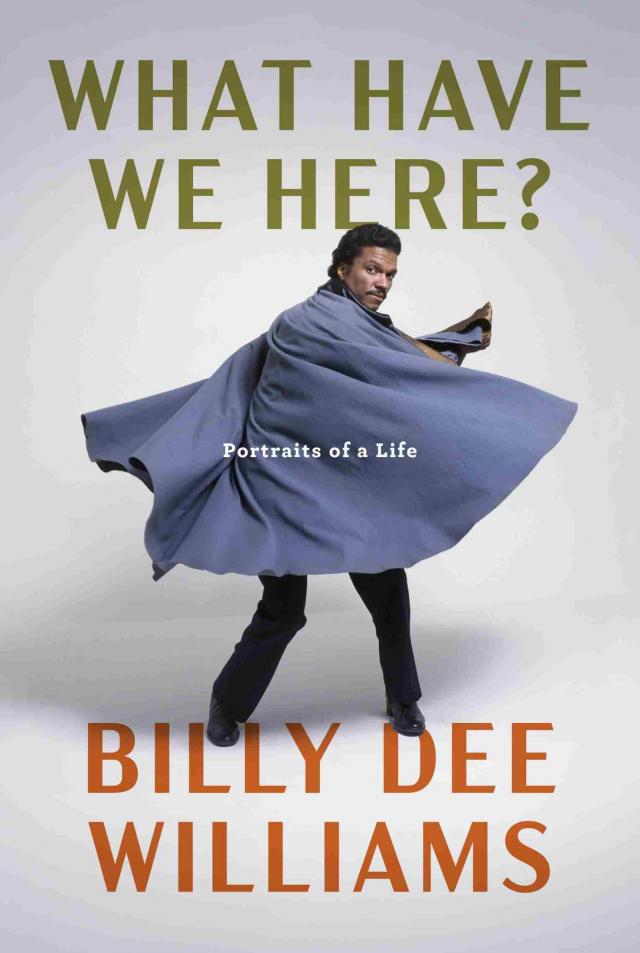
Cover photograph: Courtesy of Lucasfilm Ltd. LLC
Cover design by Jenny Carrow
ep_prh_6.3_146139109_c0_r0
To
Mommy, Daddy, and Grandmommy,
my children, Corey and Hanako,
my grandchildren, Finnegan and Lucy,
my Marci,
all my wives,
and
everyone else in my life
who has put up with me
through the madness
Contents
What Have We Here?
Illustrations
Acknowledgments
Index
Illustration Credits
_146139109_
Prologue
Hello, what have we here?
It’s afternoon on the crowded outdoor patio of my favorite West Hollywood bistro. I have a glass of wine in front of me and am enjoying a warm spring day when I have nothing to do and no place I need to be other than where I am at the moment. Screw the pandemic, the politics, the divisions and name-calling, and the hate that is all we hear about these days.
The sun is shining. A gentle breeze massages my skin. The chardonnay in my glass is dry and chilled, a hint of citrus on my tongue.
I look at everyone bustling around me, the young people, all my darlings. Life is happening. The random, energetic, optimistic choreography of youth—the best and longest-playing show on the planet. I appreciate it. “Your walk is marvelous,” I say to the manager. “Like a dancer.” The waitress wants to model. “Your face is a painting,” I tell her. The busboy refilling my water has written a novel. “There’s the author,” I say.
The host stops by the table. He could have stepped out of a fashion magazine.
“Michael, you are beautiful today,” I say.
“Thanks, Billy. You are, too.”
The banter continues for the next few hours of my leisurely lunch. A couple visiting from London ask if they can take a picture with me, giggling nervously that they can’t believe they’re meeting Lando Calrissian in person. A man who appears to be in his sixties apologizes for interrupting my meal but explains that he feels compelled to tell me that Brian’s Song is one of his favorite movies and he cried when he saw it in 1971 and still cries whenever he sees it rerun on TV.
Before dessert, two women—a mother and her adult daughter—stop by the table. “We love you,” the younger woman says, before tilting her head toward her blushing mama. “This is my mother, and she loved you back in the day.”
The phrase—back in the day—makes me laugh. At eighty-six years old, the age I am right now, there are so many of those type of days gone by. It might be yesterday. It might be way back. The days sit in my memory like shards of glass of varying sizes and shades strung together and suspended from up high, dangling, reflecting light, a light of a full life, in beautiful, brilliant, shimmering colors.
At this stage of my life, there is no better day than today. I know few pleasures greater than the enjoyment of being in the moment the way I am right now, savoring the pleasure of connecting with people who have liked the work I’ve done and indulging my own curiosity about them. In some small way we have shared an experience. We have a connection. We share a smile, a handshake, a photograph, some kind words.
I have come to see it and enjoy it as the fruit of my life’s work—the work I’ve done over seven-plus decades onscreen and onstage, sharing a point of view that hopefully has helped people toward a more sympathetic understanding of who we are and what we share as human beings. Along the way, I have experienced the joys of love and family, the heartbreak of loss, the highs of challenging work, and the disappointment of unfulfilled dreams.
I have also struggled with the questions that confront many of us at one time or another: Who am I? Why am I here? What am I doing with my life? Is my life, this phenomenon of existence, at all meaningful? Or is it one long, eventful absurdity?
* * *
—
January 1988. I was in New York, starring in August Wilson’s play Fences. I took over the lead role from James Earl Jones, something I don’t recommend to any actor. I’d known James Earl and his prodigious talent since my early twenties. We’d worked together in films and on the stage many times. He had workshopped Fences at the Yale Repertory Theatre and won the Tony Award for his portrayal on Broadway. He owned the part of former Negro Leagues baseball player–turned–Pittsburgh trash collector Troy Maxson in this powerful play about the effects of racism on an individual and his family.
The challenge of stepping into this role consumed me. Taking over from James Earl was only one part of it, and not the hardest part. No, the hardest part was the effect the work had on me, the conversation it inspired me to have with myself, the voice in my head that asked hard-to-answer questions.
At fifty years old, I wanted to reestablish myself as an actor and in the process find the clarity about my life that I’d always wanted and felt was still out of reach. It wasn’t a midlife crisis as much as a reckoning, an assessment, an inventory of what I’d done, what I was doing, and what I thought I still wanted to accomplish. Who the hell was I?
I was aware of the irony of that question. My two turns as Lando Calrissian in George Lucas’s Star Wars saga had given me a rare type of movie stardom, and before I visited that faraway galaxy, two films made with Berry Gordy, Lady Sings the Blues and Mahogany, had established me as a romantic leading man—“the Black Clark Gable.” I wanted to be known as one of the best actors of my generation, period. But the opportunities weren’t the same for me as they were for Gable, and I was frustrated.
Prior to acting, I was a serious artist. After graduating from New York City’s prestigious High School of Music and Art, where I focused on painting, I attended the National Academy of Fine Arts and Design, winning awards and scholarships. Creating art was something I had done every day of my life. I was an introverted kid, and drawing and painting were the ways I expressed myself. It poured out of me. I wanted to be great. By the time I signed onto Fences, though, I hadn’t painted for more than a decade. I didn’t know why I’d stopped or how much that had affected me until I started the play in New York.
Suddenly, for no obvious reason, the old desire to create returned. At first, an idea or two would come to me, something that hadn’t happened in a long time, and I was like Lando seeing Princess Leia for the first time. “Hello, what have we here?” Then I couldn’t stop the flow of ideas. With them came the urge to paint again. It was upon me at once, overwhelming in a sense, the ideas and the desire to see them on canvas. After six months in the play, I returned to L.A., walked through the front door, and, after greeting my wife and daughter, went straight into my studio.
I’ll never forget that day. It was early evening, and I worked straight through until the next morning. After a brief rest, I was back at it. I could barely sleep. A decade of silence had ended. The drought was over. I had so much inside me that I needed to get out. It was like being possessed, which I suppose I was at the time. Each canvas began with a solid black background. Then I would find the light in that darkness. Somehow it would come to me—a glimmer at first, and then I’d see the picture—and the life within it.
It was the same thing that every brown-skinned boy or girl faces as they grow up and pursue their dreams. It was what every human being regardless of skin color faces as they journey through life. It was what I had been going through, asking myself questions, wondering if I was moving forward. We’re all trying to find the light in the darkness.
* * *
—
I lived in that studio for much of the next two years, creating several hundred paintings, each of which told a story—my story. This book reminds me of those paintings. Only now it’s thirty-some years later and I am a little gentler and a lot older, with a few more stories to tell, and I think I have a better sense of what in my life has been silly, what has been mea ningful, what has been remarkable, and what makes sense to share with you.
As you will discover, I don’t think exclusively in terms of the Black experience, the White experience, or any other experience, except the human experience. All of us enter this world the same way. We’re brought from the darkness of the womb into the light of this world, and this gift of life. Keeping that light in focus is the challenge. We hit many junctures in our lives where we lose sight of it, feel the chill of darkness, and ask ourselves, “Where is the light?”
I have had my share of those periods. The world has had its share of those periods. What I’ve learned, and what I hope to convey on these pages, is that the light is always there. Even when it’s darkest, the light is inside us.
So settle in and let’s spend some time together. I just ordered another glass of wine and have some stories to tell.
1
I was almost eight years old, and I was exactly where the universe wanted me. Somehow I knew this, I knew it in my bones, and it allowed me to proceed with calm and confidence in a situation that would normally be nerve-racking for a child.
My mother and I were in a rehearsal studio in midtown Manhattan. The whole subway ride downtown I had assured her that I was not nervous. I was auditioning for a part in the Broadway musical The Firebrand of Florence, an operetta with music by Kurt Weil, lyrics by Ira Gershwin, book by Edwin Justus Mayer, and staging by John Murray Anderson. All were giants in their field. The production starred Weil’s wife, Lotte Lenya.
“You’ll do okay, Sonny,” my mother said.
“I know, Mommy,” I said, squeezing her hand and answering her reassuring eyes with a smile of my own. “Don’t worry.”
Producer Max Gordon was in charge. He was my mother’s boss. At the start of World War II, my mother took a job as the elevator operator at the Lyceum Theatre on 45th Street between Sixth and Seventh Avenues. She had studied opera singing in school and dreamed of performing at the Metropolitan Opera House, but so far, this was the closest she got to the stage.
The Lyceum was one of the most glamorous venues on Broadway, and my mother loved working there. Once her skills as a stenographer and typist were discovered, she was promoted to a secretarial position, which brought her into contact with Gordon.
One day Gordon told her about a new Broadway show he was producing, The Firebrand of Florence. He mentioned that he was looking for a cute little boy to play the part of a page in his new production. My mother promptly mentioned me. Bring him in, he said. Let’s have a look at him.
For the audition, she dressed me in my good clothes, my Little Lord Fauntleroy outfit—bow tie, jacket, shorts, high socks, and polished shoes—and took me downtown to the theater. My tryout was in front of the director John Murray Anderson, the playwright George S. Kaufman, and the choreographer Catherine Littlefield. All were luminaries of the theater world. I had no idea.
They sat in the front row. John told me to walk across the stage.
I followed his direction perfectly, walking slowly but purposefully, while looking out at the audience.
“Very good,” John said.
“Can I do it again?” I asked.
“All right.”
I ran back across the stage and repeated my steps, this time flashing a smile in the middle of my stroll. When John said that was good and thanked me for coming in, I started to cry. He looked at my mother, wondering what had happened. She turned toward me, trying to figure out why I was upset.
“I want to do it one more time,” I said.
Even then, I knew I had a better take in me.
Afterward, John asked if I could sing. I quickly said, “Yes!”
I got the job—and ever since I’ve said I cried my way into show business.
My mother was so proud. Many years later, she wrote me a letter in which she recalled “seeing stardom” in my smile that day. I still have the letter. What I have always remembered, though, is the loving hug I got from her after the audition. Pleasing my mother meant everything to me, and that never changed. The work I’ve done over the past eight decades got more complicated than walking across the stage, but my motivation stayed the same. Do a good job. Make Mommy proud. Entertain the audience.
* * *
—
The play opened on March 22, 1945, two weeks before my eighth birthday. I had two short announcements to sing, one heralding Lotte Lenya’s entrance in Act I (“Make way for the Duchess! The legal, regal Duchess!”) and the other previewing news from her in Act II (“Message from the Duchess! Message from the Duchess!”). Poor reviews of the play had no effect on me or my performance. Neither did British character actor Melville Cooper’s complaint that I was upstaging him. Like most kids, if you put them onstage, they’re going to steal the moment without being aware that they are doing it.
My Broadway debut, at seven years old, in The Firebrand of Florence, with the star, Lotte Lenya, as the Duchess, at the Alvin Theatre, 1945
I enjoyed going to the theater, getting into my fancy silk costume, and being part of the commotion backstage. That privileged area was perfumed with the scent of mystique, makeup, artistry, transformation. One of the actors gave me a knife as a gift. Lead dancer Jean Guélis allowed me to sit in his dressing room before shows while he entertained visitors. They spoke in French. Other people spoke in German. There were chorus girls in costumes. When Lotte Lenya went up on her lines, as happened frequently, I fed them to her. I made funny faces at people in the audience. It was fun.
During rehearsal one day, I was sitting near the orchestra pit, waiting for my turn onstage, and I sensed people behind me. I turned around and saw Humphrey Bogart, Lauren Bacall, and Audrey Totter standing there. I knew Bogie from the movies. And there he was in real life. Bogie in person! It was almost too much to believe.
What kind of crazy, strange, wonderful place this theater was! People of all shapes, sizes, and colors, speaking various languages, dancing, singing, working, sharing their quirks and talents, creating their own world within the real world. They worked hard, had fun, and enjoyed applause at the end of their day. No wonder my mother loved the theater.
I fell in love with it, too. I listened and paid attention. It was a world that few people got to see, and it would take me many years to understand and articulate what I participated in at such a young age (so young that if we finished after a certain time at night, I wasn’t able to join the curtain call due to child labor laws)—the wondrous potential of people coming together to create something greater than themselves: a transformative, provocative experience; art!
I don’t think it was an accident that I was in that play. It was meant to be. It informed me and my imagination for the rest of my life.
We may come from different neighborhoods, cities, states, and countries, we may look different, and we may speak different languages, but we all have similar needs and desires. We experience similar emotions and feelings. We watch the same TV shows, see the same movies, and sing the same songs. We’re all trying to figure out the same mystery—why are we here? And we all want love.
We are the full spectrum of colors on the same canvas.
We are all human beings.
* * *
—
When I was just five years old, I began having a recurring dream that would continue for several years. In this dream, I was in a trench alongside other soldiers. It was extremely vivid. The sounds of gunfire and the smell of gunpowder were all around me as I strained to see through the smoke. I gradually became aware that I was wearing a U.S. Army World War I uniform with a steel Brodie helmet.
It was like I was curious; it was like watching a movie. Although I was young and didn’t have any formal knowledge about this war, I realized what was happening: I was an old warrior reincarnated in this young man’s body, and after numerous lifetimes of bloody battles and conflicts, this was my last war, my final trip into the horrific heart of combat. I had to go through this traumatic experience one more time, but after this one, I was finished.






