

Korean made simple 2, p.1
Korean Made Simple 2, page 1
part #2 of Korean Made Simple Series
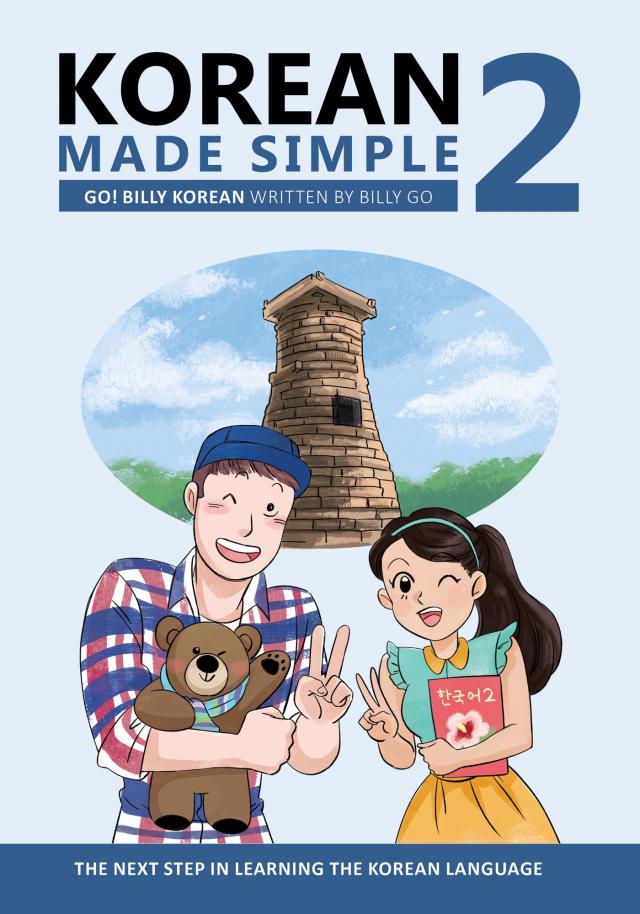


Korean Made Simple 2: The next step in learning the Korean language
Volume 2, Edition 1
Written by: Billy Go
Edited by: Sohyun Sohn and Patricia Brooks
Published by: GO! Billy Korean
Audio files for this book are available for free download from gobillykorean.com.
Cover and inside illustrations by: HeeJin Park (heejindraws.tumblr.com)
Copyright © 2014 GO! Billy Korean
http://www.gobillykorean.com
All rights reserved
Smashwords Edition, License Notes
This ebook is licensed for your personal enjoyment only. This ebook may not be re-sold or given away to other people. If you would like to share this book with another person, please purchase an additional copy for each recipient. If you’re reading this book and did not purchase it, or it was not purchased for your use only, then please return to your favorite ebook retailer and purchase your own copy. Thank you for respecting the hard work of this author.
TABLE OF CONTENTS
Preface
Chapter 1: Progressive Tense
Chapter 2: If and When
Chapter 3: Future Tense
Chapter 4: Complex Sentences
Chapter 5: More Complex Sentences
Chapter 6: Adverbs
Chapter 7: Comparisons
Chapter 8: Honorifics
Chapter 9: Verb Endings
Chapter 10: Introduction to Casual Korean
Chapter 11: Shall We?
Chapter 12: Let’s
Chapter 13: Doing and Asking Favors
Chapter 14: Don’t
Chapter 15: More Negative Sentences
Chapter 16: Have to Do
Chapter 17: Try to Do
Chapter 18: Have Ever
Chapter 19: Verbs to Nouns
Chapter 20: While
Answer Keys
Appendix A. – Introduction to Idioms
Appendix B. – Major Korean Holidays
Appendix C. – Reading Practice
Special Thanks
Glossary
Preface
Welcome back! Or for those of you who are new to this series, welcome! If this is your first time seeing “Korean Made Simple,” I’d highly recommend scanning through the first book and making sure that you have a strong understanding of each concept before continuing. This book will follow in the footsteps of “Korean Made Simple,” and will strive to explain Korean concepts as simply as possible. Opening up this book means that you’ve decided to continue your journey toward mastering the Korean language. Congratulations, and good luck!
About this Sequel
Nobody likes a sequel that doesn’t add something new. The major difference between this book and the previous one is that while the previous book focused on building a foundation for studying the Korean language, this book is geared toward increasing your communication skills. Also, while the previous book focused more on themes and common, day-to-day situations – including introducing yourself, shopping, and telling the time – this book will focus more on grammatical concepts.
There is also no need for additional introductory lessons in this book, as the basic introductory concepts were covered in the previous book, so we’ll have more space to learn the essential grammar that you’ll need to progress toward the next level. I’ll be teaching everything just as simply as in the first book, so you should have no trouble keeping up.
We will be covering more serious, key topics through this book. Expect to learn a lot, and to be able to express yourself better and in more detail than you could before. After all, the previous book ended right after teaching past tense! Surely, we will need to learn more if we want to progress toward more natural Korean. What about future tense? Yes, we’ll be learning this, and a whole lot more.
Just as with the previous book, do not expect to be speaking fluent Korean by the end, as there is simply too much that needs to be covered before you will be able to converse in Korean without any difficulties. However, I promise that you will gain an even more extensive introductory knowledge of the Korean language through this book, building on the foundation laid by the first “Korean Made Simple.”
Buckle up. Turn on your headlights. Check your airbag. Wait – bad analogies. We’re not going to crash. We’re going to cruise. We’re going to expand our Korean knowledge and learn how to read, write, speak and understand real Korean.
And like before, I’ll be there every step of the way guiding you along.
Before Reading This Book
You should be able to read and write the Korean alphabet (한글) before beginning this book. The previous book completely covers how to learn it. Using this book without having read the previous one can be acceptable as a review, but know that you might have missed important vocabulary and grammar that were covered in the first book. You also might have missed advanced language and cultural notes, depending on how in-depth you studied. I recommend keeping a dictionary handy if you choose to read this book without having read the first one, and consulting additional sources to make sure that you understand everything along the way.
If you have already read the previous book, I would also strongly recommend reading all of the “Advanced Notes” before beginning this book (if you haven’t done so already).
How to Use This Book
Just like “Korean Made Simple,” this book builds upon itself with each chapter. I recommend that you take your time going through each lesson in order and avoid skipping any sections. If you’re in a rush – “I’m leaving to Korea tomorrow to give a speech in Korean to the President of Korea!” – then complete all of the lessons but skip the Practice sections. Know that you’ll only be able to improve when you combine studying with practice, so the best way to use this book is by completing every section, including the Practice sections.
If you notice a grammar form that you are not yet familiar with, you may have skipped it in a previous chapter. There’s no need to rush through the basics of Korean; If you find something that you missed, I recommend that you read through the book more slowly. Later on you will be able to learn new concepts more quickly, but it’s important to take things slowly and carefully in the beginning.
The first time you go through this book, read each “Culture Notes” section along the way, but skip the “Advanced Notes” sections. Save the “Advanced Notes” for your second or third reading of this book, as they were designed to provide additional information that can be confusing if you don’t yet understand the overall concepts first.
Take notes along the way as you complete each chapter. Write down your own example sentences using the concepts that you’re learning. You know best which concepts are the most difficult to you, and taking notes will help you to remember and master those concepts more efficiently.
Practice reading, writing, and speaking the language as much as possible. It will also be extremely beneficial if you have a friend with whom you can practice speaking and listening Korean. If you live in an area where it is difficult to meet native Koreans – such as most areas outside of Korea – try to find an online penpal. There are numerous simple websites where you can do this, so I won’t name any specifically here.
About the Answer Keys
The more Korean you know, the more “right answers” there will be when speaking the language. While completing each Practice section, don’t be surprised if your answers are different from what the Answer Keys section shows. You’ll learn many new forms of speech in this book, including honorific speech and casual speech, as well as new vocabulary words and grammar forms. Compare your answers with the ones in this book and learn from them, but know that they might not match what you’ve written – and know that this is perfectly fine.
For your first time, I would recommend focusing on using the 요 form when completing the Practice sections, unless it’s specified that you should use another form. The 요 form is the most commonly used form in Korea, and it will greatly benefit you to have a strong understanding of how to use it.
About the Vocabulary
I’ve taken special care when selecting each word that appears in these books, choosing the most important ones for you to know when beginning to learn Korean.
Every vocabulary word added to this book was picked for a good reason. I’d recommend learning as much of the vocabulary contained in this book and the previous book as possible.
As you complete this book, refer to the vocabulary list at the end of each chapter whenever you find words that you’re not familiar with. Since this is the second book in the “Korean Made Simple” series, if you run into any vocabulary words that are not in the vocabulary lists or Glossary section, know that these words were covered in the first book. For this reason, if you have a copy of the first book, I’d recommend keeping it handy while studying. Or, you can also use a dictionary to look up words with which you are unfamiliar.
How to Memorize Vocabulary
There are many methods for memorizing vocabulary, and many of them will work fine. I recommend trying multiple ways to find out which method works best for you and then studying as often as you can using that method.
I’d also like to point out a few effective methods for memorizing vocabulary. Some of these were mentioned in the previous book, and others are new.
1. Quiz yourself frequently on words you are learning, or have somebody else quiz you.
2. Force yourself to create sentences using the words (and grammar forms) that you ar e learning.
3. Write vocabulary words that you’re learning on sticky notes and place them over objects and places that they correspond to. For example, you can write the Korean word for “pencil” on your favorite pencil, or the word for “pretty” on your girlfriend’s face (or boyfriend’s face, if you have a pretty boyfriend. I’m not going to judge.).
4. Associate funny and odd ideas with Korean words; sometimes a nonsensical phrase can make memorizing a difficult word much simpler. For example, you can remember that the word 열쇠 means “key” by thinking of someone saying, “You’ll say where the key is.” At the risk of ruining this entire book I’m not going to list any other odd sentences, but feel free to use whatever random ideas you’d like.
5. Flash cards are still a popular yet traditional way of learning large amounts of words. If using flash cards, I recommend saying the word in Korean out loud while writing the English side, and saying the word out loud in English while writing the Korean side. This way you can become familiar with speaking the word, hearing yourself say it, and writing and reading it all at once.
No matter which method you use to study vocabulary, pick one that you can see yourself doing frequently. Keep a regular study schedule – studying 30 minutes a day for 5 days a week will be more effective than trying to cram for 150 minutes at once.
Regarding Numbers
While the previous book spelled all numbers phonetically (일, 이, 삼, ...), this book uses only Arabic numerals (1, 2, 3, ...) as this is how Koreans write numbers. Of course, when introducing new counters, I’ll let you know whether to use Sino Korean or Pure Korean numbers with each one. As you go through the book, read each sentence out loud to yourself. This will help you to adjust to reading numbers in Korean while looking at the number in Arabic numerals.
A Few Speaking Tips
Here’s a tip for sounding a bit more natural when speaking Korean. When you’re just starting out, it’ll be difficult to put together complete sentences quickly enough to hold a conversation. You might feel like you’re stumbling to compose each sentence, and may become frustrated that what you’re saying isn’t anything like what you wanted to express. But don’t worry at all. Unless you were born in South Korea, everyone is like this at first when learning Korean. I remember that I was like this too!
Keep your sentences short and to the point. I’m not saying “Don’t try to express yourself fully because you’re still a beginner” at all. Express yourself in the simplest, most compact form that you can, because it will help you to sound more natural while you’re still learning the language. This is a real tip for sounding more natural when speaking. Koreans prefer sentences that get to the point much more than English speakers do. If your sentences are only a few words, you’re doing fine. If some of your sentences are just one word, you’re right on track as well. In fact, even as you improve, keep your sentences short and to the point. Long sentences are for later, when you want to have a discussion about a topic in much more detail.
As a beginner, it’s much easier to create short, simple sentences than long, drawn-out ones that run on. Making short sentences is easier, and will also sound more natural to the average Korean. It’s a win-win scenario. Keep your sentences simpler, and your Korean will sound better.
Good Luck
I’m not trying to scare you by making the title of this section “Good Luck.” The Korean language, just like English or any other language can be easy at times and difficult at other times. It’s just a language, and there will be times where you will feel frustrated learning a concept or feel like you might want to give up. While good quality books and teachers can help make the process much easier, even using the best teachers and books you are likely to still have times that frustrate you with learning Korean. I’ve been there before, and I want to let you know that it does get better.
The secret to becoming fluent in Korean is to keep studying and practicing Korean. Just like running a marathon, if your goal is to finish the marathon, you will never get to the end if you give up half way. You need to keep going until you’ve reached the mark that you’re looking at.
I understand exactly how difficult learning Korean can be, especially when transitioning from basic phrases (“Hello! Goodbye!”) to more complex grammar and concepts. I also know many people who’ve gone through this process too, and the only thing that they all have in common is that they never gave up learning the language. I also hope that whatever your goals for Korean are, whether they be fluency, basic conversation, or anything, that you will keep going until you’ve reached them, because I truly believe that anyone can learn Korean with study and practice. Good luck in your studies. I’ll be here for you if you need me.
Conversation
Chapter 1: Progressive Tense
Conversation
정윤원: 지금 뭐해요?
강신애: 숙제를 하고 있어요.
정윤원: 그래요? 무슨 숙제요?
강신애: 수학 숙제요. 너무 지루해요. 정말 하고 싶지 않아요.
정윤원: 하하. 저는 심심해요.
강신애: 윤원 씨는 공부하고 있지 않아요? 시험 준비를 안 하고 있어요?
정윤원: 시험이요?
강신애: 네, 내일 수학 시험이 있어요. 몰랐어요?
정윤원: ….
In the final chapter of the previous book, we learned how to use the past tense to express events that happened in, well… the past. But what if you want to express something that’s happening right now? So far, we’ve been able to do this by simply conjugating the verb in the present tense. In fact, this is the most common way to express that something’s happening now.
저는 지금 공부해요.
“I’m studying now.”
This -ing ending on verbs, which shows that something is currently happening, is what we call the progressive tense in English. In Korean, as we previously learned, we can simply use the present tense to express this -ing meaning most of the time. However, in some situations we will need to use the progressive tense, as we will soon see.
First, let’s go over how to make the progressive tense in Korean. Then we’ll learn how and when to use it.
Verb Stem + 고 있다
Take a verb stem (a verb minus the 다 at the end) and attach 고. Then add the verb 있다 and conjugate it. Here are a few examples:
하다 → 하 + 고
→ 하고 있다
이미 하고 있어요.
“I’m already doing it.”
마시다 → 마시 + 고
→ 마시고 있다
김 씨는 술을 마시고 있어요.
“Mr. Kim is drinking alcohol.”
공부하다 → 공부하 + 고
→ 공부하고 있다
저는 지금 공부하고 있어요.
“I’m studying now.”
Although this might seem the same as using the regular present tense, we can use the progressive tense to emphasize that something is currently happening. Because of this, the progressive tense can be used to clarify when an action is happening – specifically, that it’s currently happening. This difference might not always translate into English, so it’s important to be aware of its meaning in Korean.
As we learned before, the present tense can be used for things that are currently happening, or for things that happen in general, without specifying the time:






