Ambush trail, p.1
Ambush Trail, page 1
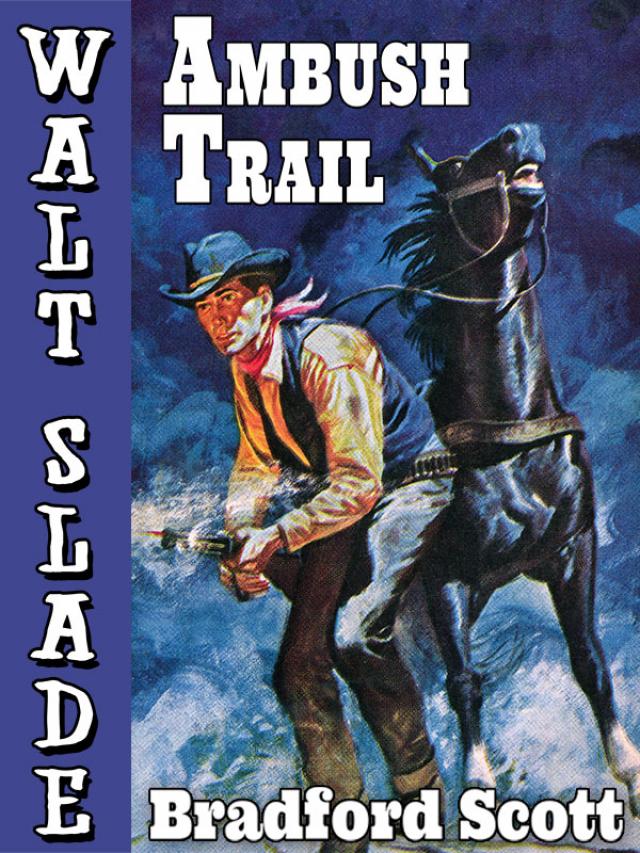


AMBUSH TRAIL
A Walt Slade Western
Bradford Scott
Table of Contents
AMBUSH TRAIL
COPYRIGHT INFORMATION
ONE
TWO
THREE
FOUR
FIVE
SIX
SEVEN
EIGHT
NINE
TEN
ELEVEN
TWELVE
THIRTEEN
FOURTEEN
FIFTEEN
SIXTEEN
SEVENTEEN
EIGHTEEN
NINETEEN
TWENTY
COPYRIGHT INFORMATION
Copyright © 1960 by Bradford Scott.
All rights reserved.
Published by Wildside Press LLC.
wildsidepress.com | bcmystery.com
ONE
“SHADOW, IT SMELLS like somebody is cooking somewhere up that crack in the hills.”
Ranger Walt Slade, whom the peons of the Mexican river villages named El Halcon—The Hawk—sniffed with appreciation the aroma drifting down the narrow brush-grown valley, more enticing to a hungry man than the perfume of roses, the fragrance of frying meat and steaming coffee.
“And seeing as the provision poke is empty and I can’t subsist on vegetation like you can, you old grass burner, we’ll just mosey up there and see if there’s a chance to share pot luck with those gents, whoever they are,” he continued to his tall black horse. Shadow snorted what was apparently acquiescence to the proposal and Slade sent him pacing forward through the red blaze of the low lying afternoon sun.
Slade’s saddle pouches were devoid of anything to eat, the last scrap having been washed down with brook water some twenty hours before, most of which hours had been spent in the saddle. So it was not unnatural that El Halcon craved a substantial “surrounding,” rangeland parlance for a square meal.
Slade rode at a fair pace but did not push his horse over the rough ground, for the trail he followed up the valley was really nothing but a game track fringed on each side by brush. He had covered something better than a mile when to his ears came the sound of voices, and he slowed Shadow a trifle. This was wild land between the Quitman Mountains and the Finlay Range, with the verdant Middle Valley of the Rio Grande to the west. Of late the section had been plagued by an outlaw bunch that appeared to be working steadily westward, which was why Walt Slade was in the vicinity.
Slowing his mount still more, Slade tried to catch snatches of the conversation going on beyond the screen of tall brush. He was somewhat reassured by the cheerful timbre of the voices and the frequent laughter. Neither was of the nature of talk usually indulged in by men who know that a peace officer and his posse might well be on their trail. There was no attempt to keep the voices down and they sounded carefree.
Still, Slade took no chances. He could be mistaken in his estimate of whoever was camped ahead. Shadow was proceeding at a slow walk with the split reins looped and hanging on his neck, and Slade’s hands were close to the black butts of the heavy guns protruding from their carefully worked and oiled cut-out holsters when the growth thinned and the camp came into view.
Grouped around a fire were seven men in cowhand garb, their shirts and overalls and boots splashed with mud and dust. They were fresh-faced young fellows with one grizzled exception. Slade pulled up and waved his hand.
The group around the fire saw a tall man, broad of shoulder and deep of chest, with a lean, deeply-bronzed face dominated by long black-lashed eyes of pale gray. Cold, reckless eyes that nevertheless had little devils of laughter dancing in their clear depths. He had a rather wide mouth, grin-quirked at the corners, that relieved somewhat the sternness, almost fierceness, evinced by the prominent high-bridged nose above and the powerful jaw and chin beneath. He wore the homely garb of the rangeland in a manner that lent distinction to faded levis, soft blue shirt and well scuffed half-boots. A vivid handkerchief was looped about his throat, double cartridge belts encircled his sinewy waist and his pushed-back “J.B.” revealed thick hair so black a blue shadow seemed to lie upon it. He sat his magnificent black horse with the easy grace of a lifetime in the saddle.
The men about the fire were evidently satisfied with what they saw, for they shouted a greeting.
“Light off, feller, and feed your tapeworm,” one called. “Just getting ready to sit down. Got a helpin’ of oats for the cayuse—Blazes! but he’s a beauty!”
Hungry enough to chew cactus spines, Slade was not slow in accepting the invitation. He got the rig off Shadow so the big horse could feed and roll in comfort and without delay went to work on the loaded plate and steaming cup handed him.
“Eat hearty, feller, we got plenty of chuck,” said the one oldster of the group. “Laid in a good supply before we moseyed into this crack.”
“Funny place for a bunch of waddies to be squatting,” Slade commented smilingly.
“Uh-huh,” said the other, while his companions chuckled. “But you see, feller, we’re on the run from the Law.”
The others ducked their heads in sober agreement.
Somehow, Slade was not particularly impressed by this frank confession of wrong-doing.
“How come?” he asked.
“It’s a short story but a sad one,” the oldtimer sighed. “Us fellers all work for the Cross-in-a-Box, a good spread. Or did. Over to Vanton we had a little disagreement with some poker-playing gents after we caught a tinhorn cold-decking the game. Nobody got hurt much, but before the arg’fyin’ was finished, nearly every table and chair in the joint was busted, the bar was turned over and the back-bar lookin’ glass shot to hash. As it happens, the sheriff owns a half-interest in the place and we knew he’d be a mite wrathy. Fact is, we got word he was coming after us and figured to throw us in the calaboose and keep us there till we tripped over our whiskers. That didn’t sound so good.”
“I can appreciate your feelings in the matter,” Slade smiled. The oldster nodded gravely.
“So,” he said, “we figured it would be a good notion to trail our twine and hole up a while till the sheriff got over his peeve. We stuffed our pouches with chuck and headed west. We come to this crack in the hills and it looked favorable. So we slid into it. That was six weeks ago and we’ve been here ever since, except for one or two of us sneaking out for a fresh supply of eatin’ matter now and then.”
“You mean to say the sheriff is still on the prod against you?” Slade asked in surprise.
“Oh, guess he’s got over his mad spell,” the oldtimer replied. “Not that it matters over much; we can buy him a whole new saloon if we take a notion.”
“And that old coot is to blame for everything,” another puncher broke in. “We were poor and happy when we landed here, and if it wasn’t for his loco notions we’d still be poor and happy. Because of him we’re rich and got responsibilities and may have to turn plumb respectable.”
“And now what in blazes are you talking about?” Slade asked wonderingly.
“It’s like this,” said the cowboy. “That old coot, while he was out of jail for a while, did some placer mining over in California.”
“A heck of a lot of it,” the old waddie interjected. “Before I went loco and took to following a cow’s tail.”
“So he says,” said the other. “Well, he moseyed around in this valley and got real excited. Swore it was perfect placer-mining country and that we’d oughta try our hand at a bit of digging. We weren’t over-interested, but he kept yammering about it until we agreed to give it a whirl, just to shut him up.”
“Well?” Slade remarked.
“Darned if the old hellion wasn’t right,” said the cowboy. “The valley is a real placer section and we’ve dug up a hefty passel of nuggets and dust—in those pokes over there.”
Slade glanced at the stack of plump sacks and nodded thoughtfully. The cowboy shot a meaningful look at his companions, who nodded their heads. He turned back to Slade.
“Feller, you look to be a right sort,” he said, “so we’re invitin’ you to stick around a spell and do a little digging on your own account. Won’t take you but a couple of weeks to root out more’n you could tie onto at ‘forty-per’ in a month of Sundays. What do you say?”
“Gracias,” Slade replied. “A heap of thanks, but I’ve got to be on my way in the morning.”
He little thought he was destined to spend quite a few days in the valley.
“Well, if you can’t, you can’t,” the oldtimer said cheerfully, “but you’re plumb welcome.”
Night had fallen as they sat eating and talking. Overhead the stars blazed golden in a sky of blue velvet. The night was very still, the silence broken only by the purl and ripple of the little stream that flowed nearby. The cowboys lounged around the fire, joking and chaffing one another, anticipating the high times they would enjoy when they should go back to town and convert their gold into money that would itch to be spent.
A thick chaparral growth hemmed the camp on three sides, and under the spreading branches the shadows were black as the mouth of a cave. Shadow, grazing nearby, suddenly lifted his head and blew softly through his nose. Slade, sensitive to all the moods of his horse, was starting to rise when from the black “cave mouth” spurted lances of flame. The hills rocked to a roar of gunfire.
Four of the seven punchers went down at that first murderous volley. The others jerked their guns and fought back at the hidden drygulchers.
Walt Slade, shot through the body and creased along the forehead
TWO
IT WAS DAYLIGHT when Slade recovered consciousness. He was sick, weak, for he had lost a great deal of blood. There was a hot throb in his left side; his head ached abominably. For some time he lay in a haze of discomfort, dazedly trying to figure just what had happened. Gathering a little strength, he managed to examine his wounds.
The bullet scrape along his forehead was of little consequence, but the wound in his side was a different matter. Although it was bad enough, he was thankful to learn by various symptoms that while the bullet had gone clean through a few inches below the heart, it was well to the left and hadn’t injured any vital organs. Exhausted by his efforts, he relaxed for another period. Then he began to wonder how he happened to be alive at all and made shift to inspect his surroundings.
He found he was lying in a deep hollow that had been cut under the creek bank by high water. Brush and creepers grew down over the bank and hung across the hole into which he had tumbled, so that in the darkness nothing could be seen of the hollow from the outside. To which he knew he owed his almost miraculous preservation. Had the drygulchers discovered him when they searched for him, as he figured they must have, he would certainly not have been numbered among the living.
Painfully, slowly he crawled out of the hole and up the bank. His side burned like fire and a bubbly mist floated before his eyes. Finally he made it to the crest and peered cautiously through a final fringe of growth.
The site was quiet and peaceful, with the peace and quiet of death. The horses grazed in the little clearing, all except Shadow, who stood with ears pricked, staring toward the brush behind which Slade crouched. Slade watched him for a moment or two, but the horse did not turn his head, and did not blow through his nose. Also, he remained out in the open, which he would not have done if somebody were holed up in the growth nearby.
“Gone, all right,” Slade muttered. “Guess it’s safe to get from under cover.” He eased through the brush, walking slowly, his body rigid. The camp was a scene of horror.
All seven of the cowboys were dead, tumbled this way and that. A glance told him that the sacked gold was gone. However, the rigs had not been bothered, nor the plenitude of provisions, so far as he could see. Moving carefully so as not to start his wounds bleeding afresh, he drew a roll of bandage and a pot of antiseptic ointment from his own untouched saddle pouches. He worked off his shirt and proceeded to pad and strap his injured side. This done, he sat down beside the ashes of the dead fire, very weak and again feeling sick. He got the fire going and heated some left-over coffee which he drank as hot as he could swallow it. Although he did not feel much like eating, he cooked a meal and ate slowly, downing as much as he could. Then with fingers that trembled woefully, he rolled a cigarette.
While he smoked, he contemplated the bodies strewn about and decided he could do nothing for them at the moment; but he did manage to drag some of the food off a ways and make a new camp. Then he stretched out on a blanket in the shade of an overhang and was almost instantly asleep.
The next thing Slade knew, it was getting dark. His side was painfully sore and he was still very weak, but his iron constitution was throwing off the effects of his injuries and his strength was returning. He cooked and ate again, and again went to sleep. He awoke with the dawn feeling much better. The two openings of the wound were already closing and in that clean, dry air he had little fear of complications.
He felt so much better that, after cooking and eating his breakfast, he resolved to bury the bodies of the slain cowboys. Working slowly, with frequent rest periods, he dug a wide and shallow grave in which he placed the bodies. Finished, he stood for a moment gazing across the low mound that would be brown and bare until the new grass was grown. His face was bleak, his eyes cold.
El Halcon was not given to dramatics; he merely bowed his black head a moment, then turned away. But those who knew him would not have traded places with that outlaw bunch for all the gold the valley might produce.
Slade remained in the valley for three more days, until his strength was fully recovered and there was no longer any serious danger of breaking open the wounds. Getting the rig on Shadow, now fully fed and rested, he rode from the valley and turned the big black’s nose west, the direction he was confident the owlhoot band had taken. He settled himself in the saddle, spoke to Shadow and the horse quickened his pace. Slade’s eyes swept the far distant horizon that kept receding in time with the beat of Shadow’s hoofs. El Halcon was riding the vengeance trail.
Slade knew there was a railroad way station only a few miles ahead, and that a telegraph operator would be on duty there. Reaching the station, he dismounted and entered the shack. From a concealed secret pocket in his broad leather belt he slipped out something and laid it on the operator’s table. It was a gleaming silver star set on a silver circle, the feared and honored badge of the Texas Rangers.
The operator glanced at the star and ducked his head respectfully.
“What can I do for you, Ranger?” he asked.
Slade wrote out a terse message and handed it to the operator. It was addressed to Captain Jim McNelty, the famed Commander of the Border Batallion, and read:
It happened in Texas. I’m riding west.
“Should be an answer in an hour or so, if Captain Jim is at Post Headquarters, as he is likely to be,” Slade told the operator. “I’ll wait.”
In less than an hour the answer came, which caused the operator to stare and Slade to chuckle:
Ride to the Pacific Ocean if necessary, blast you. Then bridge it and keep going.
Still chuckling, Slade left the station. He knew the cryptic message meant that he had Captain Jim’s approval of whatever he might do and all the time he might require in which to do it. Next thing was to pick up the trail of the outlaws, the same band, he was convinced, that he had been trailing from east of Van Horn.
The first day of easy riding brought no results. But the evening of the second he learned what confirmed his belief that the bunch was heading west, very likely into the mountain country of New Mexico, unless they decided to circle about and re-enter the wilder fastnesses of the Texas Big Bend. Slade was of the opinion, however, that the outlaws were leaving Texas, which was the reason for his sending the telegram to Captain McNelty.
Already into the Middle Valley of the Rio Grande, with sunset not far off, Slade paused at the house of a gent who combined ranching with grape growing, the section having for years been famous for its grapes and the golden wine made from them. A hospitable invitation to cool his saddle and spend the night was accepted gratefully and, after the evening meal, Slade drew the owner into conversation, adroity steering the talk into certain channels.
“Yep, we get visitors every now and then,” the rancher replied to an indirect question. “Most of ’em are okay, but once in a while some show up we could do without, although nobody has ever made us any trouble. About a week ago, a bunch stopped here that sort of gave me the creeps, though they were civil enough. Salty looking jiggers, for fair. One carried his arm in a sling. Said a steer’s horn punched a hole in it. Maybe, but I figure that ‘horn’ had a lead tip with gunpowder back of it. Another one limped bad. He said his horse pitched him, but I noticed there were a couple of holes in the leg of his overalls that sure weren’t made by cigarette ashes. They’d been in a ruckus, all right, no doubt about it.”