The winds of change, p.1
The Winds of Change, page 1
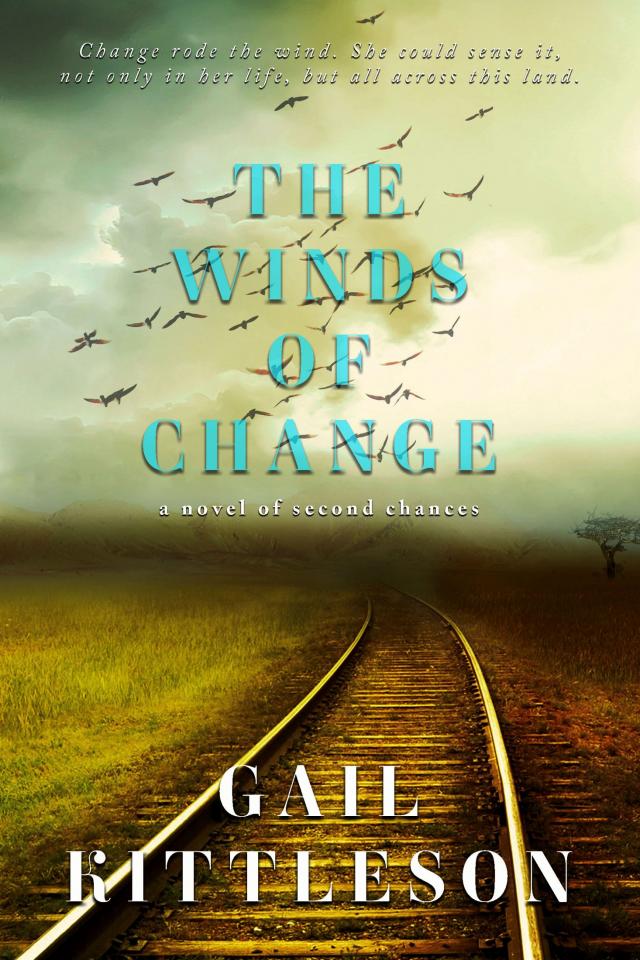


The Winds of Change
Praise for Gail Kittleson
Following the death of her husband and the loss of a son in WWII, Dottie finds comfort, but little happiness, in the daily routine at her home in small-town Iowa. Then slowly her life begins to change as she confronts her feelings for Al, the husband of her deceased friend. As romance grows, Al encourages Dottie to confront her fears, move outside her comfort zone and take chances. Along the way, Dottie and Al find not just contentment but joy, happiness and purpose.
Gail Kittleson’s latest novel, The Winds of Change, is the heartwarming story of an older couple who make the most of a second chance. Sidebars include the changing role of women in society and the mistreatment of Japanese immigrants during the war.
The author weaves timeless themes throughout the story. Love outshines hate. Diversity makes us stronger. Good things happen when we put our differences aside and treat each other with kindness and decency. The Winds of Change delivers a message of hope and civility sorely needed in the contentious world we live in.
Michael Barr
This extraordinary story classically captures the mindset of the 1940s. Addie and her friend Kate reflect the voices women hear as they face confusing dilemmas 75 years later—my first read kept me up into the wee hours. I will refer my readers to In Times Like These!
Patricia Evans, author of
The Verbally Abusive Relationship,
Controlling People,
and other books listed at www.VerbalAbuse.com
Wartime brings out the best and the worst in people. I loved the way Addie and Kate, each in her own way, dug down inside to become more than either had ever dreamed. With Each New Dawn will inspire you toward resilience and personal growth even as it keeps you riveted with each page turn.
Sonia C. Solomonson, freelance writer and life coach
Way2Grow Coaching
In Times Like These clearly portrays the difficulties for women during WW2. First, there are the challenges of raising food, preserving it, making money stretch, wisely using ration cards and just plain living in fear of the war. But then the overlay of Addie’s controlling husband made me instantly empathize with the main character. His verbally abusive and cold treatment of Addie unfortunately is not just a problem from another era. God’s provision for her was intriguing. The value of faith, friendship and compassion are evident in this book. I personally enjoyed the food tips and recipes, as well as vivid descriptions of farm life. This may be my favorite book by Gail Kittleson. It is the first in the mini-series, Women of the Heartland. Be sure to read the books in order.
Cleo Lampos
Gail Kittleson introduces us to a small town community, under the strains of World War II. The everyday lives of the town folks unfolding their thoughts and concern for the husbands and brothers fighting for their country. The family and friends dynamics in this story keeps the reader wanting to turn page after page. The author knows how to keep the reader engaged. Looking forward to Ms. Kittleson’s next book.
K Currie
Kittleson’s writing style fosters instant empathy as her quiet heroine, Addie, struggles through daily living in Iowa during WW2. Readers are introduced to Addie through patriotism, friendship, and self-realization. “I’ve spent my whole life in fear instead of living each day,” highlights Addie’s growth in overcoming an emotionally abusive husband. Highest recommendation.
Carolyn Cobb
…the pages almost turned themselves. Great period piece exploring family dynamics and interpersonal relationships as well as the growth of self-esteem and the importance of friendship.
Lisa Lickel
Kittleson deftly writes strong female characters facing heartbreaking tragedies. Until Then features two: Marian, caught in the Blitz, and Dorothy, a surgical nurse whose work with the 11th Evacuation Hospital has taken her to North Africa, through Sicily and into France. Their stories intertwine in a narrative that touches then heals the soul. Highly, highly recommended!
Literary Soirée
Also by Gail Kittleson
Women of the Heartland Series
With Each New Dawn
A Purpose True
All for the Cause
Until Then
&
Kiss Me Once Again
A Mystery on Church Street
Land That I Love
Secondhand Sunsets
Catching Up With Daylight
The
Winds
of
Change
a novel of second chances
gail kittleson
The Winds of Change, although a work of fiction, is based on actual events. The author has endeavored to be respectful to all persons, places, and events presented in this novel, and attempted to be as accurate as possible. Still, this is a novel, and all references to persons, places and events are fictitious or used fictitiously.
The Winds of Change
originally published as In This Together
Copyright © 2015
Gail Kittleson
Hardback ISBN: 978-1-962218-00-9
Paperback ISBN: 978-1-962218-01-6
Cover concept and design by Mike Parker.
All rights reserved. No part of this book may be reproduced, stored in a retrieval system, or transmitted in any form or by any means—electronic, mechanical, photocopy, recording or otherwise—without the prior written permission of the publisher. The only exception is brief quotations for review purposes.
Published by WordCrafts Press
Cody, Wyoming 82414
www.wordcrafts.net
To all of the Gold Star mothers in this old hurting world.
Contents
Chapter One
Chapter Two
Chapter Three
Chapter Four
Chapter Five
Chapter Six
Chapter Seven
Chapter Eight
Chapter Nine
Chapter Ten
Chapter Eleven
Chapter Twelve
Chapter Thirteen
Chapter Fourteen
Chapter Fifteen
Chapter Sixteen
Chapter Seventeen
Chapter Eighteen
Chapter Nineteen
Chapter Twenty
Chapter Twenty-one
Chapter Twenty-two
Chapter Twenty-three
Chapter Twenty-four
Chapter Twenty-five
Chapter Twenty-six
Chapter Twenty-seven
Chapter Twenty-eight
Chapter Twenty-nine
Chapter Thirty
Chapter Thirty-one
Chapter Thirty-two
About the Author
Chapter One
O
n certain Sunday mornings, Dottie could step through the door of First Methodist Church without visualizing her husband Owen’s casket near the altar rail. But not this Sunday. Memories of two recent funerals assailed her, though there hadn’t even been a casket when their son Bill died.
The friendly hum of children and Sunday School teachers spurred her to the basement. Through the serving window, she counted heads and cut sixteen pieces of chocolate cake.
A while later, a chair scraped on the cement floor, and the primary teacher caught Dottie’s eye—time to serve the cake. She placed forks on the plates and handed them across the countertop.
“Watch your step, children. Take your time. And remember your manners. What do you tell Mrs. Kyle?”
Fifteen versions of “Thank you, Mrs. Kyle” descended and Dottie gave each child a smile. Ina added her own gratitude before she left.
“What would we do without you, Dottie? You’re as faithful as irises in April. Sure you don’t need some help?”
“Thanks, but I can manage. And you’ve got family coming for dinner.”
When the basement lay quiet, Dottie boiled water on the stove, filled the dishpan, and went for the broom. But in the corner near the cleaning closet, a slight movement gave her a start.
Who was that small figure clinging to the dank stone wall? Peering closer, Dottie noted frosting on little Sammy Jorgensen’s face and dark brown goo spewing from his two front pockets.
Stooping to his height sent a twinge through her bum knee. She let it pass and lowered even more, until she could look into his glinting eyes.
“Sammy, did you want some more cake?” He nodded as she reached for the wastebasket. “Let’s get you cleaned up as best we can. Now, pull the insides of your pockets out.”
Still as pooled water, Sammy’s dark eyes watched her pare some Fels Naptha soap into a small tin bowl of hot water. Then she rubbed the once-white insides of Sammy’s Sunday trouser pockets with a damp rag.
“You gonna tell my mommy?”
Dottie wiped crumbs from his mouth and patted his shoulder. “She’ll see it, honey. We can’t get these stains out, but your mommy loves you, you know that.”
Absorbed in her ministrations, Sammy failed to notice Mrs. Jorgensen slip into the kitchen, a sleeping baby in one arm, Sammy’s coat draped over the other.
“Sammy? I’ve been looking for you.”
He covere d his mouth with both palms.
“What have you done?”
“Mommy, I…Missus Kyle bringed us treats and…”
“From the looks of your shirt, you decided to take some home?”
Sammy’s bottom lip curled toward his chin.
“He was trying to help, I think, when I was busy gathering up the dishes.” Dottie’s words did little to ease the lines on Myra Jorgensen’s forehead.
“Look at this floor—cake tracks everywhere. You made more work for Mrs. Kyle, after all the nice things she does for our Sunday school. Tell her you’re sorry.”
Sammy’s whisper penetrated Dottie’s heart, and she pulled him close. Warm chocolaty breath tickled her nose.
“It’s all right. I once had a little boy who looked a lot like you. Believe me, I found plenty of bugs and baby toads in his pockets.” Dottie caught Myra’s eyes. “Seems like only yesterday Bill was that size.”
The beginning of a smile worked its way across the weary young mother’s lips. Dottie helped Sammy into his coat and patted his warm head.
“Come along, then.” Myra reached for the little fellow’s hand.
“You have a nice afternoon, now.”
Sammy gave Dottie a wave and swished toward the door. Stiff pant legs—Myra might add a bit less starch to her hand washing next time.
“That boy never stops. Dottie, some days…”
Dottie patted Myra’s arm. “Let me get the door for you. I’d be glad to have Sammy over for a few hours this afternoon so you can take a nap.”
“That’s so thoughtful, but we’re going to a family reunion out at the farm. Gotta hurry home to check on my chicken, frost a cake, and get everything loaded up.”
“Ma…maa.” Myra’s petite bundle let out a wail, but Myra took time to squeeze Dottie’s hand.
“I hope you know how much we appreciate your work around here.” Her forehead creased. “I don’t know how you made it through losing Bill and then Owen, too. You’re such a strong woman.”
“We do what we have to do. The war was hard on everybody.”
Elbows spread wide, Myra called to Sammy. Dottie watched until she had him safely in the automobile, thinking of Cora, her youngest, out in California. Her arms bulged with a baby and a two-year old right now, too—such precious cargo.
Hopefully she wasn’t driving around by herself, though. These days, you never knew what young mothers might attempt.
Letting the old wooden door shut behind her, Dottie retraced the stairs to the kitchen. From the very back of the shelf below the sink, she retrieved a two-inch wiry square cut from a large scouring pad. Smelled like it still had a little soap left, so she ran it around the faucet edge and rinsed off the residue before she swept up the crumbs and wet mopped the well-worn linoleum.
The Sunday school room smelled of recently opened crayon boxes, dusty hymnals, and the mothball tinge of Sunday best clothes. She straightened the shelves, pushed child-sized red chairs under the low table, and took one last look around the kitchen before turning off the lights.
The uneven floor, slanted toward a central drain, tripped her up, but she caught herself on the countertop. Something about the sight of a few more red-brown crumbs and the little-boy breath still hovering in the air buckled her knees.
A cry rose from some unearthly place inside her as she sank to the cool floor. “My son and my husband—Dear God, did you have to take them both?”
Her fists pummeled the cracked linoleum’s surface. “If only I could see Cora’s little ones—oh, why does she have to live so far away?”
Her complaint echoed in the dim eerie quiet. From the shadows, Myra’s description mocked her—Such a strong woman.
Through it all, she’d set her mind and plowed on, but what choice did she have? At this moment, though, she might not even find the strength to get up off the floor.
•
An old aluminum pail banged against Dottie’s thigh en route to the third bedroom on the right. The hallway clock marked each moment. Well, George Hanson would simply have to jiggle his foot on the front porch for a few more minutes.
At least he could go outside in this warm weather instead of tapping his foot in the boarding house dining room. Feather duster in hand, Dottie opened his window to let in the breeze and worked around George’s few belongings. A bright circus flyer decorated his desk.
Ringling Brothers and Barnum Bailey
Combined shows coming to the Hippodrome
Waterloo, Iowa—August 30, 1946
Over a week ago. If George took the train down to Waterloo that day, she hadn’t even noticed. But then, like the other three boarders, he kept to himself, and most days she hardly stuck her head out of the kitchen except to do the washing in the basement.
Back on his closet shelf, something metal caught her eye. She slid his desk chair and climbed atop it, groaning at the impact on her sore knee. But Helene wanted everything dusted thoroughly.
Dottie swept her duster around the engraved tin box, most likely George’s money stash. He hired out for farmers during the busy season. That was all she knew about him. She wielded her duster as far back as she could, but without warning, the closet door slammed shut behind her.
She grabbed at the suffocating sensation threatening her throat, but calmed herself enough to fumble for the knob and push open the door. For a moment, she held her moist forehead.
Close to the closet, a desk’s solid edge helped her ease to the floor. She took a deep breath, finished her cleaning, and went out into the hallway. No sound from the kitchen where she had left her boss checking the cupboards for supper ingredients.
Good. That meant she had a few minutes alone, because Helene had driven down to the butcher shop.
A kick sent the dirty clothes pile closer to the steps, where Dottie shoved it over the edge with her toe, a method Helene frowned upon. But it saved a trip up the stairs for the cleaning supplies.
The entire bundle splatted on the landing—a perfect pitch. Halfway down, another well-placed kick produced equally successful results. Maybe all those years of watching Bill kick the football had taught her something.
At the bottom of the stairs, Dottie bent to pick up the laundry, but instead of splotched green and white linoleum swirls, a woman’s black patent leather shoes greeted her. Shapely legs led to a pair of dimpled knees and a bright flowered dress. Standing tall, Dottie stared into a redhead’s flagrant green eyes.
Finally, she sputtered, “Why Bonnie Mae Ingersoll, is that you?”
The lanky girl chawed her gum. Her bemused half-smile rang a bell way back in Dottie’s memory.
“Well, I’ll be—someone remembered my name.” Bonnie Mae scratched the back of her head with long fingernails painted as red as her lips. She looked Dottie up and down. “Fancy meeting you, too. Don’t recall your name, though I do remember that amazing coal black hair.”
“Dottie. Dottie Kyle—but the coal black has turned to charcoal, I’m afraid.”
Bonnie Mae’s squint could have meant anything. “Where’s Helene? She told me to come at ten.”
“Probably buying meat for supper. Would you like to leave her a message?” Dottie’s neck spewed heat like the ramshackle building’s ancient coal stoker.
Bonnie Mae twirled a strand of flaming hair around her forefinger and cracked her gum. Near her mouth and eyes, telltale age lines marked time’s passage—probably twenty years.
“Nope. This is my first day of work. I’ll just look around.” She flounced her skirt like Maureen O’Hara in The Hunchback of Notre Dame and headed into the parlor.
Helene hired Bonnie Mae to work here? A niggling sensation just below Dottie’s collarbone warned her to put up her guard.
Whatever it was, she’d have to set the past aside, that’s all. Like her mother used to say, “The past is past—it wasn’t meant to last.” Funny how Mama’s advice lived on, even though she passed so many years ago.
The dining room door still swung from Bonnie Mae’s passage. Dottie drew back her good leg, launched the laundry down the basement stairs, and flung up a prayer. “You’ve seen me through a whole lot worse than this. Here we go again.”
•
The screen door fought Dottie. Tired and cold, she wrenched the handle free from its moorings.