

Luda, p.1
Luda, page 1


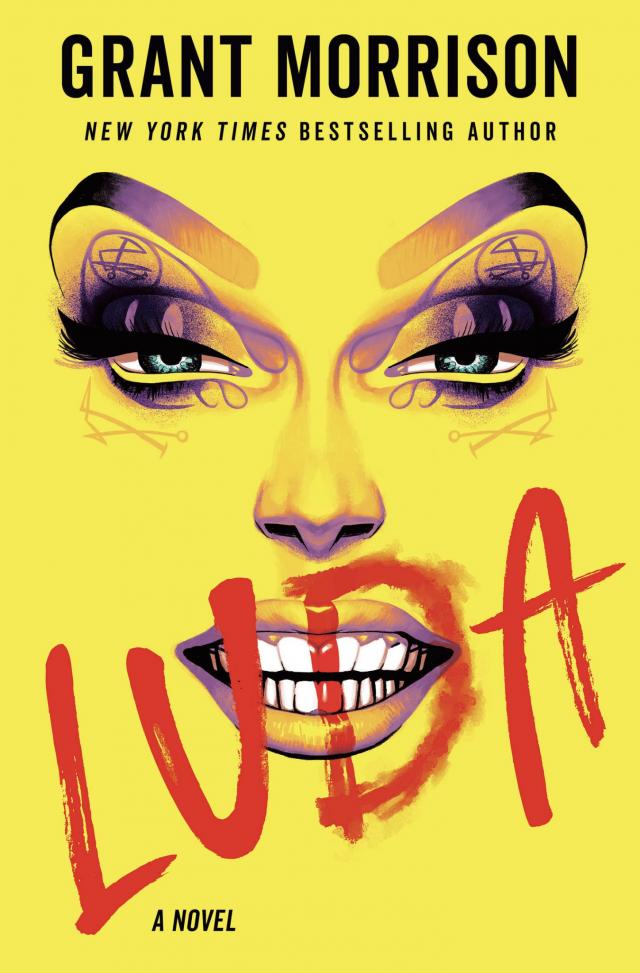
Luda is a work of fiction. Names, places, and incidents either are products of the author’s imagination or are used fictitiously. Any resemblance to actual events, locales, or persons, living or dead, is entirely coincidental.
Copyright © 2022 by Supergods Ltd.
All rights reserved.
Published in the United States by Del Rey, an imprint of Random House, a division of Penguin Random House LLC, New York.
Del Rey and the Circle colophon are registered trademarks of Penguin Random House LLC.
Library of Congress Cataloging-in-Publication Data
Names: Morrison, Grant, author.
Title: Luda / Grant Morrison.
Description: New York, NY: Del Rey, [2022]
Identifiers: LCCN 2022004243 (print) | LCCN 2022004244 (ebook) | ISBN 9780593355305 (hardcover) | ISBN 9780593355312 (ebook)
Subjects: LCSH: Drag queens—Fiction. | Musicals—Fiction. | Magic—Fiction. | LCGFT: Paranormal fiction. | Fantasy fiction.
Classification: LCC PR6113.O7886 L83 2022 (print) | LCC PR6113.O7886 (ebook) | DDC 823/.92—dc23/eng/20220304
LC record available at https://lccn.loc.gov/2022004243
LC ebook record available at https://lccn.loc.gov/2022004244
Ebook ISBN 9780593355312
randomhousebooks.com
Book design by Edwin Vazquez, adapted for ebook
Cover illustration: © 2022 by Chad Sell
Cover design: Regina Flath
ep_prh_6.0_140822100_c0_r0
Ф
Then crying “I have made his glory mine!”
And shrieking out “O fool,” the harlot leaped
Adown the forest, and the thicket closed
Behind her and the forest echoed “fool.”
—Tennyson, Idylls of the King
Contents
Cover
Title Page
Copyright
Epigraph
Chapter 1: The Phantom
Chapter 10: Principal Boy
Chapter 11: The Square Root of 5
Chapter 100: The Cave of Jewels
Chapter 101: Mystery City
Chapter 110: The Glamour
Chapter 111: Flat Detectives
Chapter 1000: Irrational Numbers
Chapter 1001: Wednesday’s Children
Chapter 1010: Vultures and Crows
Chapter 1011: New Lamps for Old
Chapter 1100: Golden Dames
Chapter 1101: Devil Woman
Chapter 1111: Black Widow Twankey
Chapter 10001: Curtains
Dedication
Acknowledgments
About the Author
Where to begin?
That’s the big question, I hope you’ll agree.
You. Me. Where do any of us “begin”?
Face it. An ill-judged wink across a crowded dance floor invites a lifetime of school bills. An inebriated fumble in the dark, on the playing field, in the cloakroom, gets the same job done just as well.
Even you, hearing this, you might be the product of a case of mistaken identity that wound up in the maternity ward.
I’m not judging.
Judging is your job. You’ll have to reach a verdict after all the evidence in the case has been presented. That’s how it works.
Off we go; the pistol cracks, jump-starting a spirited, high-heeled lunge from the starting blocks as we jostle for position in the “Human Race”; digging in for the long haul; and what starts as a spirited marathon sprint, winds down over decades until it’s a hundred-meter medicated crawl to the finish line.
That’s what you’d say if you were trying to be clever, I suppose.
Lucky me, I don’t have to try. I’ve got the front stalls and balcony eating out of my handbag most nights. I can bat an eye, purse my lips, and bring the house down like a drone strike any night of the week.
“Tonight” happens to be a Wednesday. Like yours truly, it can go one way or the other on a Wednesday but the weather’s rotten outside, as my dripping, demoralized umbrella will confirm, and that’s generally enough to guarantee a packed hall from the orchestra pit to the gods and nosebleeds.
So, if you ask me, and on the clear understanding there’s nobody else here in the dressing room, you may as well take the plunge: It doesn’t matter where we begin, does it, babes?
When all’s said and done, we start off with nothing. You and me both, and all the rest. Hardly matters what happens in between; we arrive with nothing and we finish with nothing, am I right?
Zip. Zilch. Nada. Naught. Nil.
What better place to “commence my narrative” than here, with nothing at all?
At Ground Zero.
What makes me so certain I’ve got nothing? you may ask.
I can tell you it’s because I know for sure I’ve got nothing to lose.
If you’re already asking yourself, How long can she go on and on about nothing, settle in, I’ve only just gotten started.
Nothing is a blank canvas, you see. Nothing is a mirror waiting patiently for an anticipated reflection to show up. A lonely-looking glass in an Oscar Wilde fairy tale, aching for that special face to drift into view, bringing purpose to its blank existence.
Which returns me to me, unsurprisingly, looking in a glass like that one in the story Oscar forgot to write. Me and the wicked queen from Snow White.
Honestly, if I could sum up my whole life in one image, there’s a mirror on the wall and there’s me, looking in, or looking out, it’s hard to tell with mirrors.
If anyone ever asks, I describe myself as an artist, and an artist needs a carte blanche to get started.
This tabula rasa I call my face has, for quite a long time, been every bit as vacant as it gets: symmetrical, bland, uninhabited, you could say. A halfhearted sketch for a grand, abandoned project. Even these reluctantly accumulated lines and folds and cracks appear to me as if they’d much rather be somewhere else; livening up an Etruscan vase in a museum or adding texture to some moth-eaten rolled medieval tapestry.
Faced with that crumpled imprecision, the only reasonable response is to sanction a scorched-earth policy. Vietnam. The Gulf. Afghanistan. Agent Orange. Edit out the errors, blitz the flaws, illuminate the trenches with color and contour.
Let scarlet poppies bloom on the graveyard pillows of my lips, soldier dear!
Come to think of it, you could say I’ve been touching myself up my whole life if you wanted to lead with a blue note.
As if to prove my point, having prepped the canvas with Derma Shield, the foundation goes on first—and these days, I might as well layer it on with a trowel, or a bulldozer. My sponge has to work harder than a navvy spreading tarmac on a highway surface pitted with artillery potholes.
I dip two fingers in the pot to scoop up a generous cool blob of W5 Kryolan pancake base before rubbing my palms together nice and slow, so the emulsion squishes through my fingers in creamy prayer. Then, placing the tips either side of the bridge of my nose, I draw my digits down in a tribal chevron.
It’ll take as long as it always takes, time enough to say everything that needs to be said. If Luci LaBang is ready when it’s curtains up, everything else is secondary.
She’s on her way, floating up from the depths to the mirror’s surface to replace my vacant features, Narcissus in middle age, in all her airbrushed Hollywood splendor.
Soon, she’ll shatter the surface tension of the glass. She’ll float up through the bulrushes, like Lizzie Siddal doing Ophelia, and screen-print herself onto my skull.
* * *
—
No matter how smooth your skin is, how good your diet’s been, how “young you still look” for your age; no matter how much Botox you reluctantly forked out for three months ago, at Luda’s request; there’s no escaping fifty years of age. It’s that five-knuckle rap on the door you can’t put off answering. That sinister, long-anticipated stranger, sidling up to whisper a bedtime horror story you’d rather not hear, let alone live through. Until you’re left with no choice.
Mine is the character arc, mine the “journey,” no one would choose to take: hot young Drag Princess with a weekly show on TV to aging Pantomime Dame in the blink of a mascara-clotted false eyelash.
As for Luda, we’ll get back to that soon enough.
Some of you may require a sympathetic context for my howls of outrage, so allow me to digress briefly on the pantomime, an arcane form of art so coarse and lowbrow it wasn’t deemed fit to share a pigsty on Noah’s Ark, let alone passage to the Americas in the company of Charlie Chaplin and the first rollicking wave of music hall immigrants.
While the Little Fellow invented the idea of global stardom, pantomime elected to stay behind in the old country, determined to continue its backward Bedlam scuttle down the theatrical tree of life, aiming, you might think, for some simplified one-celled form of entertainment, and ultimately merciful oblivion.
The show began, historians insist, as commedia dell’arte, with Pierrot, Columbine, and Harlequin doing their three-way satirical ménage for libertines and proles alike. Soon, following some process of reverse evolution, commedia dell’arte turned tail and slithered back into ancestral swampland there to wind up squatting in the mangroves
The word itself was coined in 1717 for an ad in The Daily Courant, I looked it up. But it wasn’t until 1860 that anything we’d recognize as a traditional “pantomime” came along—that brash, shambling steam engine of profanity, song, and gender meltdown that runs year in, year out. Summer seasons in the resort towns, winter in the cities.
I was thirty-six when I did my first one. At a time when I needed something new in my so-called life, I spotted a niche.
You could say I identified a neglected area of the Arts where no one seemed to be experimenting or innovating. After the success I’d scored being the prettiest one in the Troupe—as we’d decided to call ourselves in that search for a post-ironic sweet spot between Warhol’s Factory, the Manson Family, and Monty Python—I could see my face becoming more angular and, quite frankly, more Cubist with every passing month.
Fresh creases put my red lips in ironic double parentheses every time I smiled. A murder of crow’s-feet trampled through the sooty ovals gathered round my eyes. These signs of time’s creepy crawl were not so much as to ruin the effect, especially when I was done with my kit, just enough to remind me of mortality and the no-longer-Romantic brevity of youth and beauty. As if anyone needs reminding.
Am I right?
I needed a new frame for this changing face; if TV’s hi-fidelity microscopic scrutiny was guaranteed to reveal way too much in the close-ups, I’d stage a retreat to the theater, where everything happened in longshot. I belonged in a house of ill repute where the men were girls and the girls were boys 24/7 and no one called the authorities.
Pantomime fit the bill.
Little did I know I was entering my prime, like Miss Jean Brodie. Pantomime was the crown and I was the jewels. I’d found my vocation.
Prime, it goes without saying, comes before a Fall.
* * *
—
My first big splash came with the Prague Millennium production of Cinderella. I’d decided to play both Ugly Sisters at the same time as a “schizophrenic” having surreal, obscene conversations between her contending dual personae, or whatever it is they’ve got going on. We didn’t do a lot of research into the issues around neurodiversity, I’m ashamed to say.
I’d designed a costume split down the middle with one sister on the left wearing shredded punk vinyl, all chains and razors, and her twin on the right wrapped in trashy clinging Lycra Day-Glo bimbo Flamingo sugar-pinks and acid-drop yellows; a death-dealing lollipop in the shape of a person.
It looked fantastic onstage, but I can imagine how offensive it might come across these days so it’s the kind of experimentation I tend to shy away from.
I prefer to trigger laughter not PTSD.
Those were different days, a raw-meat decade sandwiched between transient periods of political correctness, so it’s no surprise the audience went feral for my Ugly Sisters.
Playing my own comic foil meant I could time each joke to perfection, something that’s not always the case when your straight man is some half-witted clot of hair and spray tan off a soap or a reality show.
My toes roll up like witches’ slippers when I think about the parade of boy-band rejects or popular bloggers I’ve had to witness—hauled blinking into the footlights as Buttons or Wishee-Washee, effortlessly translating their lack of talent in one area of the arts to a fresh platform of humiliation.
I’ve watched more naturally gifted entertainers at a chimpanzees’ tea party, pelting one another with feces and fairy cakes.
Forget it, Jake, I used to say—it’s pantomime.
Which brings me right back here to where it started. Dragged high-kicking and screaming in falsetto toward the black-hole spiral sink of the world-famous Vallhambra Theatre. Downtown Gasglow. Down and down am I dragged.
And re-dragged.
Fortunately for us all, I’m something of an expert when it comes to drag.
The so-called Grand Duchess of Gasglow Music Halls, the Vallhambra was designed by visionary architect and spectacular suicide Murdo McCloudie, in that amazing Deco-coco style that reminds me of cover paintings on old science-fiction paperbacks, yellowing into nostalgia in the windows of used bookstores, back when used bookstores and books were a thing.
After a suspicious blaze that left it hollowed, all façade and nothing behind, like a Hollywood stage set, or a pop star, the building ascended Phoenix-like, shaking cinders from its gilded plumage.
During the ten years that followed, the Vallhambra was lovingly and painstakingly restored—if by “lovingly restored” you mean glammed up like a resurrected temple whore from ancient Egypt.
A bit like myself in that regard: struggling to stay sexy, remain relevant, and cheat the wrecker’s balls long past the glory days.
West of Circle Station and north of the river Dare, you’ll find the happening part of town they call Gasglow’s Broadway, a mile and a half of strip and glitter and trashy, flashing come-ons.
The theater’s situated near the intersection of Gargoyle and Charity in the guts of the city of Gasglow, opposite the Sugar Shack pole dance club, sandwiched in a vile spit-roast between the Emperor, catering to devotees of big musical productions like Nixon! The Satanic Bible and Papa Zombi! and the Pandromo, which specializes in stand-up comedy tours and variety shows.
Gasglow, where the rain it raineth 330 days of the year, and horizontal sleet accounts for the days when even rain is too dispirited to fall. Gasglow, where six months of perpetual gloom incubate monstrous genre mashups.
Supernatural romance. Sex noir. Comedy Gothic. It’s all on the menu.
* * *
—
The high priests of meteorology have predicted a near-hurricane for tonight, the third “named storm” in the last month. This one christened Storm Ingmar for sins yet to be announced.
I wouldn’t blame Ingmar for lashing out. Who’d want to be called “Ingmar”? The competition’s too fierce. With Ingmar on the rampage, the Vallhambra offered its patrons sanctuary from the tyranny of Nordic Fimbul-weather.
We could be relied upon for shelter and community. We dispensed firelit visions of the Middle East and far Cathay. Man-made magic hours. Indoor summer. Sunshine and laughter guaranteed.
We had no time for stuffy ballet or strident opera on bright West Gee. You could get all that any day of the week at the top end of town—the Dramakademie doing Euripides or the Oresteia. Down on Gargoyle, the fun cathedrals offered light entertainment for the masses; dancing men and hot clever girls who knew how to make you laugh. Jokes. Songs. Sing-alongs. Spectacle and breathtaking illusion assured.
Once through the revolving doors of the Vall, it was Aladdin’s cave inside. And I should know—I’ve been in and out of Aladdin’s cave every night for the last six months.
I wish, listeners! Stay tuned for more on those headlines!
Which brings us back to where I am right now. In front of a mirror, with my face in its own bulb-edged comic-book panel, preparing to put my makeup on…
Don’t fret, I can tell the whole story while I’m getting done up.
For tonight, ladies and gentlemen, boys and girls, and all the rest, I intend to vanish behind the florid features of wily Chinese washerwoman Widow Twankey, the comedy “Dame” role in a production of Aladdin, itself framed within a larger—let’s give the thing more respect than it deserves and call it “post-modern”—narrative driven by bloody revenge, black magic, and dodgy philosophy, then titled The Phantom of the Pantomime, which is, to all intents and purposes, the plot of The Phantom of the Opera drugged, kidnapped, and rehoused in the ghetto of Irony.
The Phantom of the Pantomime tells the story of a theater troupe rehearsing a production of Aladdin that’s struck by a series of inexplicable accidents and deaths.
Inexplicable that is until the introduction of the titular Phantom—a disfigured actor who’s been orchestrating the production’s misfortunes.









