Bridge of lies, p.1
Bridge of Lies, page 1
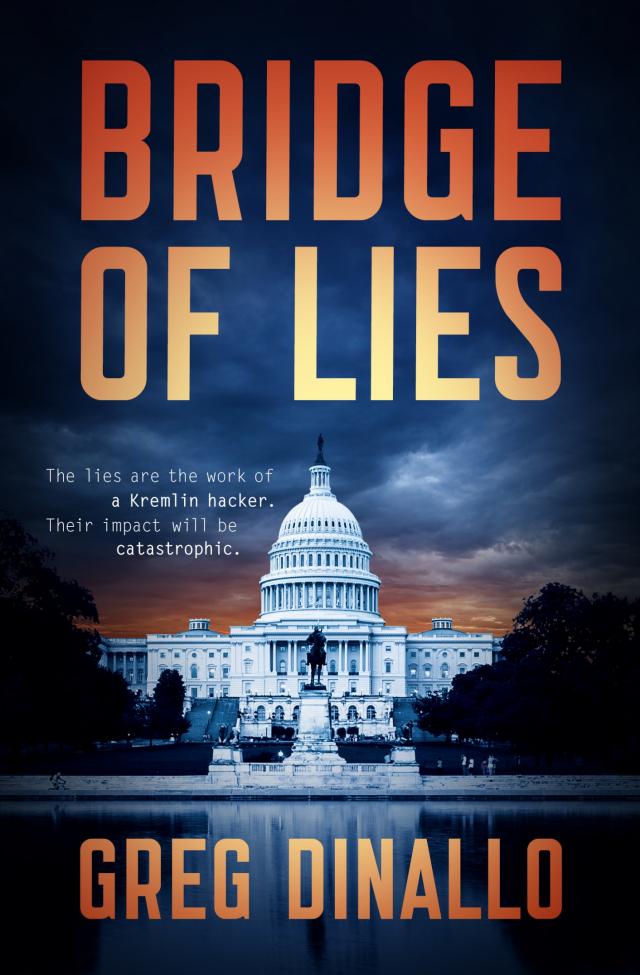


Bridge of Lies
Greg Dinallo
For my wife Gloria, the love and center of my life for sixty-four
incredible years. I miss her terribly.
Prologue
“Let’s talk Vladimir Putin,” the president said as he swept into the Oval Office, joining several members of his staff. He dropped his copy of the day’s National Security Briefing on his desk and settled in, framed by the bulletproof windows that overlooked the wintry Rose Garden. “For years he’s been covering Assad’s ass and blocking resolutions condemning Syria’s government for war crimes. When I slammed him at the summit for Russia’s aggression in Ukraine and the Crimea, he changed the subject to Syria. Shortly thereafter he authorizes airstrikes on Syrian rebels. Why? What’s his strategy?”
Chief of Staff McDonough’s chiseled features were taut with frustration. “He’s spoiling for a fight, sir. A top Russian think tank just released a report that states: The main goal of Putin’s foreign policy is to make an enemy of the United States.”
“You left out the part about him openly despising me,” the president said with a wry smile.
“He’s desperate,” McDonough went on. “The political opposition is relentless, The Economist is beating him up on a weekly basis, and the price of oil’s in the toilet and taking the ruble and the economy down with it. He feels frustrated, irrelevant …”
The president nodded in amused reflection. “I can empathize.”
CIA Director Brennan smiled thinly. “Furthermore, unemployment is so high he’s using pension funds to build infrastructure to create jobs, and he’s pressuring the oligarchs to divest from global markets in case push comes to shove with the West—which it will, thanks to the mess in Ukraine and the Crimea. Not to mention Merkel thinks he’s delusional. She really has his number.” He chuckled at a thought. “Though I hear his Lab had hers the other day.”
The president arched a brow. “His Lab?”
The DCI nodded. “She was scolding Vlad for the airstrikes when the animal came bounding into his office and earned its crotch-hound merit badge.”
The president smiled and glanced over at the family dog curled next to his chair. “Don’t think Bo’s got the chops for it. So, where we going with this?”
“The key to this guy is his psychology,” National Security Adviser Rice replied. “The more insecure he feels, the more he lashes out: The crackdowns on gays and intellectuals, the Pussy Riot thing, political prosecutions, taking control of the media …”
“Tell me about it,” the DCI said. “The man has a massive ego. It’s not about foreign policy, it’s about him, about lost power, lost empire, lost glory. He’s a Cold War warrior driven to restore the influence once wielded by the Soviet Union. That, and the fact that he despises Clinton, is what drove him to dump Medvedev and trash the reset.”
“Bull’s-eye,” the president said decisively. “He’s operating from a position of weakness. NATO makes him feel especially vulnerable. Way I see it, his support of Syria is sleight of hand, a diversion to shift our focus from Ukraine, Crimea, and the Baltics, where it should be.”
The NSA nodded. Her voice took on an edgy rasp. “The pressure to act is on us, sir. I’m forced to ask, what is the appropriate response?”
“Proceed with the G20. Ratchet up economic sanctions. Cancel round two of the London talks,” the president replied without missing a beat. The latter referred to meetings between the secretary of defense and his Russian counterpart to coordinate military actions in Syrian war zones. “And …” the president added, “I appreciate that no one uttered the phrase ‘no-fly zone’ preceded by the adjective ‘Syrian.’”
McDonough glanced at his watch. “Putin’s in Sochi. If I place the call now—”
The president’s brows went up. “No. He may have made it to the top of the ladder at the UN, but we’re going to keep him on a lower rung. Let John handle it,” he said. The secretary of state. “Anything else?”
“Well, today is Terror Tuesday, sir,” the DCI replied, reminding the president that on the second Tuesday of every month he decided which of the terrorists tracked down by the National Counterterrorism Center would be targeted by drone strikes. “I have the kill list here,” Brennan went on, slipping a folder from his briefcase.
The president waved him off. “We’ll get there.” He came out from behind his desk and dropped into one of the side chairs. “State of the Union on that punch list?”
“Yes, sir. Hemingway’s working on a draft,” McDonough replied. The president’s bearded speechwriter. “I’ll book you some face time.”
“Good. My favorite speech of the year. I really enjoyed teaching constitutional law to my students, but I love teaching it to the Supremes.”
The assembled staffers broke into laughter.
“Anything else?” the president asked again, signaling he wanted to move on.
McDonough nodded. “Two items: You’re proclaiming today National Pearl Harbor Remembrance Day, and one of our Joint Task Force people got a heads-up on a story by the Russian journalist Nina Grafinskaya that’s running in Novaya Gazeta tomorrow.”
“Grafinskaya. She blew the whistle on Serdyukov, didn’t she?” the president said, referring to Russia’s former defense minister who perpetrated a $230 million tax fraud.
“Yes, sir. She and a colleague named Katkov have exposed many cases of government corruption. She’s blowing the whistle on Putin now. According to her sources, despite forcing the oligarchs to bring the bacon back home, the Kremlin is planning to invest heavily in our financial markets instead of their own.”
The president’s brows went up. “Assuming Ms. Grafinskaya’s sources are right, do we know which sectors the Kremlin is targeting and why?”
“No sir. Our people are trying to establish an encrypted email connection with Ms. Grafinskaya before asking for more details.”
“Keep me posted,” the president said, shifting his look to the kill list atop the DCI’s briefcase. “Okay, John, who’s in the cross hairs this week?”
“A number of high-value targets, sir—one of particular interest in Yemen.”
A short time later, at Villa Bocharov Ruchey in Sochi, Vladimir Putin finished the last of his twenty laps and pulled himself from the pool. His dacha, high above the Black Sea, had docking facilities, a helipad, a tennis court, and two swimming pools. He used the saltwater one daily under the watchful eyes of armed bodyguards, one of whom handed him a towel that he used to dry his Botox-smoothed face. He slipped into a robe, then noticed an aide standing at a respectful distance. “You have that look, Sergey.”
Foreign Minister Lavrov nodded. A thin smile tugged at the corners of his mouth. “I’ve just had a call from Kerry.”
“Sanctions are being tightened. The London talks are off,” Putin said. It was a statement, not a question.
“Yes sir, as you predicted.”
Putin allowed himself a self-satisfied smile. A short time later, showered and zipped into a Sochi Winter Olympics jogging suit, he joined Lavrov and a group of aides in the dacha’s conference room. It had several large flat-screen televisions, an oval table encircled by plush armchairs, and a view of the sea “So, we’re rid of the Americans, their meddling president, and his Reset button for the foreseeable future …”
Lavrov lit a cigarette, seeming to preen. “The conventional wisdom is his foreign policy is a total failure. Mother Russia won’t be a priority for the rest of his term.”
Putin’s eyes flared with contempt. “That won’t stop them from treating the Motherland like a second-rate power! I vowed to end her humiliation and restore her dominance, and I will. Ukraine has been destabilized, NATO is rattled, and when we start building that bridge to the Crimean Peninsula, they’ll get the message.”
“If I may, sir …” Mikhail Patrushev began in a deferential tone. The deputy chief of the FSB, which took over where the KGB left off, had thoughtful eyes and a narrow face topped by a shock of gray hair. “I understand there is a gambit in play that suggests it might be wise at this time to refrain from any further such provocations, and allow the brilliant masterstrokes you just referenced, along with our great triumphs in Sochi, to continue to enhance our global image while lulling the Americans into—”
“Lulling?!” Putin erupted. “I’m not interested in lulling, I’m interested in dominating! In stopping the Americans in their tracks. Not for a month or a year but forever!” Putin’s eyes hardened in bitter reflection. “9/11 was the real Christmas gift, not Snowden. But we wasted it. We need to create another such opportunity.” He glanced to an ascetic-looking man at the far end of the table. Alexie Bortnikov, chief of the FSB, was Patrushev’s boss. “I don’t mean to wake you Alexie, but I expect you to take the lead on such matters.”
“I prefer to listen before I leap, sir,” Bortnikov said with an amused glance at Patrushev. “I believe Nikolai Misha was about to report Directorate-S has developed a covert operation with the potential to achieve your goals. We refer to it internally as the Adamov Op.”
“Your disarming tribute is much appreciated, Alexie,” Putin said, acknowledging that Adamov was a cover name he’d used as a KGB agent in Berlin in the 1980s. He let Bortnikov bask in it for a moment, then erupted. “But I can be contacted via email, snail mail, cell phone, text, and courier. Have I been deleted from your distribution list?!”
“No, sir. We wanted to be
“Yakunin?” Putin interrupted, looking puzzled. “He makes the trains run on time. Are you saying this gambit, that will stop the Americans, is his?”
“Yes sir,” Bortnikov replied coolly. “And it’s a very good one—a time-sensitive plan—that could destabilize the American government for a very long time. Despite that debacle in 2010 when the CIA rolled up our sleepers, one highly skilled asset, embedded in their national security apparatus, eluded the dragnet and has been working on it. But at the moment, it’s in danger of being compromised.”
“By whom?” Putin asked in a concerned hiss.
Bortnikov slipped a printout from a folder and handed it to him. “The front-page story in tomorrow’s Novaya Gazeta, sir.”
“Grafinskaya?” Putin groaned on seeing the journalist’s byline. “Again?”
The FSB chief nodded. “She claims, that despite pressuring the oligarchs to bring their wealth home, you’re planning to secretly invest billions of pension assets in the United States.”
“She’s right,” Putin said sharply. “And I’m fully committed to making it happen, but I’m tired of her accusations, her efforts to demean the Motherland, her … her treasonous diatribes. She’s dangerous and must be stopped.”
“Sir, just to be clear, are you suggesting—”
“I’m suggesting you do what’s good for your country,” Putin interrupted. He paused, letting his chest fill with pride. “You recall my speech on Russia Day?”
“Yes, sir. It was stirring.”
“You recall what I said of the Western powers?”
“You said, ‘Either we will beat them, or they will beat us.’”
Putin smiled. “You have your answer.” His head cocked in thought. “You said this Adamov Op, as you call it, is time sensitive. How sensitive?”
“Within sixty days, sir,” Bortnikov replied. “At which time America will be in turmoil, and Mother Russia will be garnering the international respect and acclaim she deserves. The details are highly compartmentalized. I can be more specific in private.”
Putin shook his head no. “I need deniability, not details,” he snapped. “Total, absolute, irrefutable deniability. Destroy, destabilize, incapacitate the United States government? Yes. Start World War Three? No. This cannot, I repeat, cannot be connected to the Motherland or to me in any way. If you can’t guarantee it, pull the plug now. Right now.”
“The cell executing the op is staffed with some of our most accomplished, skilled, and dedicated operatives, sir. They would fall on their swords to protect you and Mother Russia.”
“As will you, if you’re wrong.” Putin burned him with a look and added. “No progress reports. We will not speak of this again. Is that clear?”
“Yes, sir. We won’t disappoint you.”
Putin nodded smartly. His eyes shifted and locked onto Lavrov’s with a decisive glint. “We must change our strategy, Sergey. And, as Deputy Patrushev has so wisely suggested, for the next sixty days, our entire approach to the Americans must be, dare I say, reset. While SVR is executing the Adamov Op, we will be enhancing our global image—and attending to more pressing matters at home.” A wolfish grin curled a corner of his mouth, then his eyes hardened and found Bortnikov’s. “Grafinskaya …”
The FSB chief nodded, getting the message.
“And her sources,” Putin added, eyeing him and the others with suspicion.
Chapter One
Moscow, that same day …
Nikolai Katkov had four women in his life whom he loved with selfless abandon: His mother, a caring educator, whose eighty-six years under Soviet rule had taught her that the path to hell was paved with good intentions—a painful lesson that failed to temper her son’s zeal for investigative journalism. His ex-wife, Alexa, a physician, whom he met while being treated for wounds inflicted by KGB thugs at an anti-Brezhnev rally and whose career became endangered by his muckraking and radical politics, putting an end to their marriage. His girlfriend Vera, a militia dispatcher who alerted him to crackdowns on organized crime, political corruption, and the acts of violence they spawned, helping him to break such stories. And Nina Grafinskaya, his star student at his alma mater Moscow State University. Katkov recognized her writing skills, penetrating intelligence, and fearless determination to dig out a story were equal to his, and he brought her to Novaya Gazeta as his protégée. In contrast to his rumpled weariness, Grafinskaya was tailored and intense. Like many chic Moscow women, she lived in designer jeans, T-shirts, and Tods, and wore her hair pulled back, emphasizing her striking profile and eyes that always seemed to be in search of something.
Everything about Grafinskaya was chic, right down to the Williams-Sonoma apron she wore when tending her roof garden that was replete with vine-covered trellises and a glass-enclosed greenhouse, but she loved the feel of the soil between her slender fingers, fingers that could type 125 words per minute and shunned work gloves, presenting her manicurist with a daunting challenge. Indeed, the earth was considered sacred to Russians. Emigrants took small pots of soil with them to their adopted countries. Those who left for the cities kept them in their apartments, and the rich, black soil in Grafinskaya’s planting beds had come from the family farm on the outskirts of Nizhny Novgorod 150 miles east of Moscow, where her parents had lived their entire lives and were now buried side by side.
On this morning, as she often did before leaving for work, Grafinskaya moved between the rows of planters in her climate-controlled greenhouse, cutting stems with her forged English pruners, and it wasn’t long before she was clutching a bouquet of Russian sage, the luminous light-blue perennial that continues to bloom outdoors into October and well into winter indoors.
Novaya Gazeta’s headquarters were at Number 3 Potapovsky Pereulok, a five-story concrete building opposite a fenced park about a mile from the Kremlin. Grafinskaya unlocked the door to her office and ran a finger over the mezuzah affixed to the jamb. Its ornate metal housing was well burnished by the ritual. She set her briefcase and flowers aside, discarded the wilting ones on her desk, and headed for the ladies’ room with a vase for fresh water. She returned to find Katkov slouched in a side chair, reviewing a hard-copy draft of her story that claimed the Kremlin was secretly planning to invest billions of Russian pension funds in American financial markets. It would run the following morning, and he was playing devil’s advocate as they had been doing for each other for nearly two decades.
“Is it airtight?” Katkov challenged. “You have a source you can trust?”
“Sources,” Grafinskaya replied as she set the vase on the desk and began arranging the flowers. “One in Bortnikov’s inner circle and the other someone close to Yakunin at RZD.”
“Bortnikov?” Katkov said, his brows arching in tribute. “That’s as airtight as it gets. But Yakunin?” he prompted, sounding puzzled. “He thinks free enterprise is voodoo economics. He’s been banging Beijing’s state-capitalism drum for ages.”
“Tell me about it,” Grafinskaya said. “But RZD just paid a billion for controlling interest in GEFCO, a French freight logistics company. What I don’t get is American railroads are off-limits, right? It’s national security stuff. I’m wondering what the hell the Kremlin’s up to.”
“Makes two of us. I think you need more before you can use the RZD angle.”
“I know. I know. Two independent sources. Got one. Waiting on the other to confirm.”
“Good call,” Katkov grunted, scanning the pages through graying curls that tumbled onto his wire-framed glasses. “This para about shell corporations is a little thin.”
Grafinskaya nodded, toying with the flowers. “I agree, but rumor has it a Canadian billionaire of French-Russian extraction is the front man.”
“Grusha …” Katkov hissed, using an affectionate nickname for her. “If you’re right about this …” he went on, moving closer to the electric heater. “You have hard data? Proof?”
“You should know better,” Grafinskaya scolded playfully, flicking drops of water from the vase at him. She settled at her computer and, after several mouse clicks, turned the monitor so he could see it. “Email exchanges between directorates.”