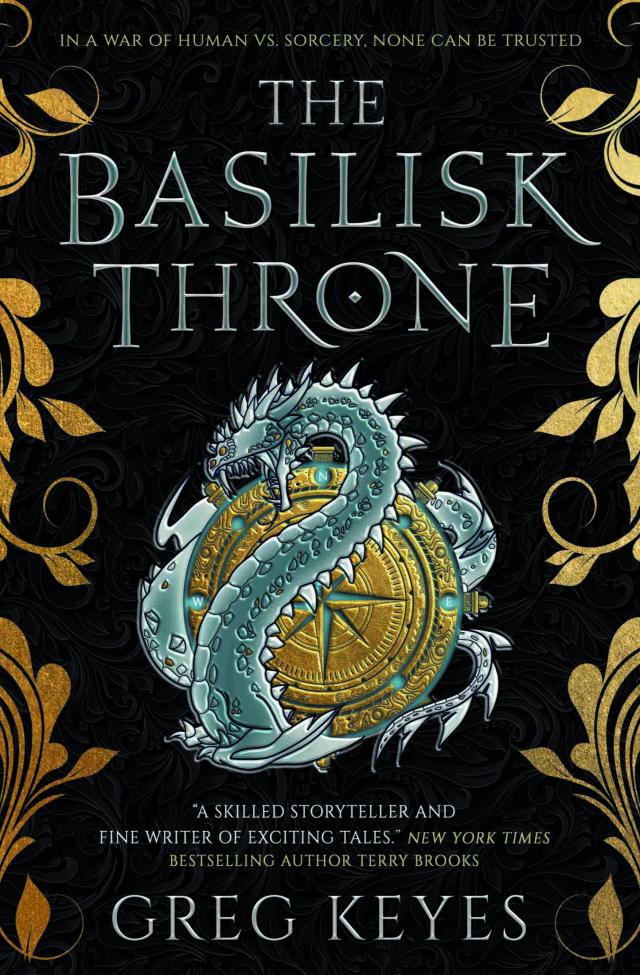
The basilisk throne, p.1
The Basilisk Throne, page 1


Contents
Cover
Title Page
Leave us a Review
Copyright
Dedication
The Battle of the Expiry
Book One: The Cost of Sugar
Chapter One
Chapter Two
Chapter Three
Chapter Four
Chapter Five
Chapter Six
Chapter Seven
Chapter Eight
Chapter Nine
Chapter Ten
Chapter Eleven
Book Two: The Price of Passage
Chapter One
Chapter Two
Chapter Three
Chapter Four
Chapter Five
Chapter Six
Chapter Seven
Chapter Eight
Chapter Nine
Chapter Ten
Chapter Eleven
Chapter Twelve
Book Three: The Terms of Exchange
Chapter One
Chapter Two
Chapter Three
Chapter Four
Chapter Five
Chapter Six
Chapter Seven
Chapter Eight
Chapter Nine
Chapter Ten
Chapter Eleven
Chapter Twelve
Chapter Thirteen
Book Four: The Dues of Treason
Chapter One
Chapter Two
Chapter Three
Chapter Four
Chapter Five
Chapter Six
Chapter Seven
Chapter Eight
Chapter Nine
Chapter Ten
Acknowledgements
About the Author
Praise for Greg Keyes
“Keyes mixes cultures, religions, institutions and languages with rare skill… the rewards [are] enormously worthwhile.”
Publishers Weekly (starred review)
“Here is a high fantasy novel that has the grit of secular combat and the heart of one of the great romances.”
Fantasy and Science Fiction Magazine
“Recommended… Keyes’s talent for world crafting and storytelling make this series opener a strong addition to fantasy collections.”
Library Journal
“Keyes takes all the genre’s conventions and, while never overstepping their boundaries, breathes new life into them.”
Kirkus Reviews
“Keyes is a master of world building and of quirky characters who grow into their relationships in unexpected ways.”
Booklist
“Greg Keyes has always been both a skilled storyteller and fine writer of exciting tales.”
Terry Brooks, author of The Sword of Shannara
“Starts in the realm of normalcy and quickly descends into the favorably bizarre and surprising… there was not one character that was uninteresting. The world building is epic.”
Koeur’s Book Reviews
“Strong world building and superior storytelling.”
Library Journal
“[A] sophisticated and intelligent high fantasy epic.”
Publishers Weekly
“A graceful, artful tale from a master storyteller.”
Elizabeth Haydon, bestselling author of Prophesy: Child of Earth,
“The characters in The Briar King absolutely brim with life… Keyes hooked me from the first page.”
Charles de Lint, award-winning author of Forests of the Heart and The Onion Girl
Also by Greg Keyes
Kingdoms of Thorn and Bone:
The Briar King
The Charnel Prince
The Blood Knight
The Born Queen
The Age of Unreason:
Newton’s Cannon
A Calculus of Angels
Empire of Unreason
The Shadows of God
The High and Faraway:
The Reign of the Departed
The Kingdoms of the Cursed
The Realm of the Deathless
Interstellar
Godzilla: King of Monsters
Godzilla vs. Kong
Dawn of the Planet of the Apes: Firestorm
War for the Planet of the Apes: Revelations
Marvel’s Avengers: The Extinction Key
Pacific Rim
LEAVE US A REVIEW
We hope you enjoy this book – if you did we would really appreciate it if you can write a short review. Your ratings really make a difference for the authors, helping the books you love reach more people.
You can rate this book, or leave a short review here:
Amazon.com,
Amazon.co.uk,
Goodreads,
Barnes & Noble,
Waterstones,
or your preferred retailer.
The Basilisk Throne
Print edition ISBN: 9781789095487
E-book edition ISBN: 9781789095494
Published by Titan Books
A division of Titan Publishing Group Ltd
144 Southwark Street, London SE1 0UP
www.titanbooks.com
First edition: April 2023
1 3 5 7 9 10 8 6 4 2
This is a work of fiction. Names, characters, places, and incidents either are the product of the author’s imagination or are used fictitiously, and any resemblance to actual persons, living or dead (except for satirical purposes), is entirely coincidental. The publisher does not have control over and does not assume any responsibility for author or third-party websites or their content.
Greg Keyes asserts the moral right to be identified as the author of this work.
Copyright © 2023 Greg Keyes. All rights reserved.
No part of this publication may be reproduced, stored in a retrieval system, or transmitted, in any form or by any means without the prior written permission of the publisher, nor be otherwise circulated in any form of binding or cover other than that in which it is published and without a similar condition being imposed on the subsequent purchaser.
A CIP catalogue record for this title is available from the British Library.
For Sandra Baxter
THE BATTLE OF THE EXPIRY
988 E.N.
“HARD ABOUT!” Captain Salemon shouted, as half of their prow disintegrated into a cloud of wooden shards. Sailors fell screaming as splinters pierced them. As Alastor watched, his friend Danyel covered his eyes with both hands, stumbling as blood leaked through his fingers.
The Laros rocked under a second impact, so jarring that Alastor nearly lost his grip on the rigging. Flames erupted, spreading across the deck like a liquid.
“Christ of Ophion,” Jax yelped. Alastor saw his fellow navior holding on by one hand, dangling twenty feet above the deck below. He reached out and grabbed Jax by his shirt, pulling him closer so he could double his grip.
“Captain, if we turn, we cannot engage,” Lieutenant Captain La Treille snapped. “Our orders—”
“We are two hundred yards from being at the outside of our range,” Salemon returned. “We’ll be fish food long before we cover the distance.”
Even Alastor, as green as he was, could see the truth in that. Every ship on their line had been hit, and several were sinking, while the Drehhu vessels remained untouched in the distance. Whatever demonic weapons they were using, they had a far greater range then the spear-flinging quilaines with which the Laros was armed. The fleet was being chewed to pieces, and they hadn’t yet fired a shot.
“They are demons,” Jax said.
“Come on,” Alastor said. “We’ve got to get the sails up.”
They were going against the wind, so they had dropped sail and put the rowers to work. The ship was turning, but very slowly.
“Ah, merde,” Jax said. “The captain’s put us broadside.”
The mainmast exploded in flame; what was left of it went up like a torch. The ship lurched as her babord side was slammed repeatedly by the invisible weapons of the Drehhu. La Treille twisted at the waist and kept turning, as his body tore apart and caught fire at the same time.
“We’re done,” Jax said. He groaned, and Alastor saw his friend had a splinter of the mast as long as an arm sticking out of his chest. Then Jax let go and plummeted to the flaming deck.
As the ship foundered, Alastor clung to the rigging. When it tipped to the side, he let go and fell into the sea. The Drehhu flames ran across the surface of the water. Swimming furiously as the fire swept toward him, he felt heavier with each stroke as the woolen clothing that had kept him warm during their cold passage to this battle became a sodden weight pulling him down. His breath rasped in his chest. His arms and legs stopped burning with exertion and began to grow numb for the chill in the water.
Alastor’s head dipped below the surface and salt stung his nose. If not for the many hours of his boyhood spent swimming, he would already be sunken in the gray depths. These were not the warm, sunny waters of the Coste de Sucre, however. He had escaped the fire, but even so he knew he didn’t have long to live.
He spied some floating wreckage and bore toward it, grasping with fingers he could no longer feel, and pulling his arms around it. It wasn’t much, not enough to pull himself fully out of the water, but it kept him afloat. He rested a moment, eyes closed, drawing in breath before opening them once more to look around.
* * *
IN THE distance, it looked as if the whole fleet was burning. Forty-five ships of war, turned to scrap in under an hour. Agains
The fleet of Ophion had never had a chance, here on the open sea.
The flames on the waves flickered and died away until only a few ghostly blue vapors remained. It was strangely beautiful, and then they too were gone, leaving only the iron-colored swells.
Another survivor began swimming his way.
“Do you mind?” the fellow asked, gasping as he drew near. He was a freckle-faced man with auburn hair.
“Come aboard,” Alastor said. “I’m Alastor Nevelon, from the Laros.” He helped the man find his grip on the flotsam and then waited for him to gather enough air to speak again.
“Henri Vallet,” the other navior finally said. “Late of the Delphis.”
“Charmed,” Alastor said. “With the two of us pushing this thing, we might be able to join up with that bit of debris over there.” He gestured.
“Ah, and have a proper boat,” Vallet said. “I’m for that.” They set out, kicking hard and navigating their piece of wreckage, and had some luck. Their prize was part of a mast that had some rope on it. It seemed like hours before they managed to lash together enough of a raft that they were able to draw themselves out of the water, and the overcast sky was little help in telling time. Once above the life-leaching sea they both sat silently, rubbing swollen hands. Alastor had torn out three nails, but didn’t feel it yet due to the cold.
“Where from, Nevelon?” Vallet asked, after a time.
“Mesembria,” he replied. “A place called Port Bellship.”
Vallet nodded. “On the Coste de Sucre. Nice little place.”
“And you?”
“Ophion Magne,” the man said. “From the city. Not the nice part of it, though.”
They fell silent. Other survivors could be seen, and more could be heard. Alastor turned his head slowly, surveying the horizon in all directions. The Drehhu ships were visible amongst the ruins of the center of the fleet, but none yet headed their way.
To the west, there was no horizon, only a strange grayness, like a wall of cloud.
“That’s it, isn’t it?”
“The Expiry,” Vallet confirmed.
“We never had a chance,” Alastor sighed. “What madness drove the admiral to this?”
“This wasn’t the plan,” Vallet said. “You must know that. The plan was to slip up into their port of Agath, and launch the assault in the harbor. We would have had twice their number, plus the advantage of surprise. That’s why we swung out so far—so close to the edge of the world—to avoid being noticed until we were there. But the Drehhu found out and met us here, with our backs to the Expiry, so we had no choice but to fight.”
“I hadn’t heard any of that,” Alastor said.
“Only the officers knew,” Vallet replied.
“You’re an officer?” Alastor stared at him. He wasn’t wearing a coat or hat. “Sir,” he added.
“Does it matter now?” Vallet said. “Shall I be captain of our little craft, for as long as it lasts? Be easy, Nevelon.” They fell silent for a time, then Vallet spoke. “Tell me about Port Bellship. Did you grow up there?”
Alastor nodded. “My family has a sugar plantation.”
“Really? And you chose to join the Navy rather than stay home and drink rum?”
“I thought I might see something of the world. Serve my emperor. Later, perhaps become a merchant sailor.” He glanced at the Expiry. He was certain now.
The current was taking them toward it.
Vallet noticed. “Yes,” he said, acknowledging the obvious. He didn’t sound afraid, or even worried. Just tired. “This is as close as I’ve ever been.”
“They say it cuts the world in half.”
“It runs from farthest north to farthest south, that much we know to be true,” Vallet said, “but whether or not the other half of the world lies beyond it, who can say?” He nodded toward the gray wall of mist that stretched as far as they could see in either direction. “No one who has ever crossed into that has ever come back. It might well be the edge of the world. It might be a wall between us and Hell.”
“I fear we shall find out,” Alastor said, although he also felt too exhausted to properly dread their fate.
Vallet glanced toward the Drehhu ships.
Two were moving in their direction.
“We know what the alternative is,” Vallet said. “If the Drehhu do not kill us, they will enslave us.”
Up ahead, from the direction of the Expiry, Alastor heard a single unholy shriek, followed quickly by another, then more, until there was a chorus of them.
“That doesn’t sound promising.”
The wall of mist loomed over them, filling their vision so that it was impossible to tell how distant it was, or how near. Not far off were four naviors on another makeshift raft. They vanished into it, and he expected to hear them scream, but there was no sound. A moment later he thought he heard something, but it might have been his imagination. The sky grew darker, and the approaching Drehhu ships became shadows in the distance.
They heard more shrieks of despair, and then other sounds—deep, stuttering clicks and weird, glissando wails, rising and falling in pitch from a high keening to tones so low he felt more than heard them. And a faint shushing, like an inconstant wind but also like distant whispering in an unknown language.
As full night came on, he thought he saw faint, shifting colors in the darkness.
“When will it happen?” Alastor asked.
“Perhaps we are already within,” Vallet replied.
“It does not feel different.” But even as he said it, he began to experience a prickling on his flesh, and his heart beat faster. It felt as something was shining on the side of him—the one that seemed to be facing the Expiry. A light his eyes could not perceive.
There was another strange noise: a grinding, churning sort of sound.
“Damn!” Vallet suddenly shouted. “Behind us.”
Alastor turned. He saw lights and the outline of a ship. A Drehhu ship. The awful noise was coming from it. A lantern of some sort turned toward them, and the beam fell on their makeshift raft. The enemy ship began to turn, then came directly toward them.
In that light, Alastor could see the Expiry, no more than ten yards away.
“We could swim,” he said. “Deny them their prize.”
“A slave can escape,” Vallet said. “He can escape and return to his home and drink rum in the evenings.” He nodded at the wall of mist. “From that, there is no return.”
Alastor nodded. He could see figures moving on the ship now. Not human. Bigger, with broader shoulders. They had four limbs like men, but those were long and spindly, and they made him think more of spiders than of people.
“A slave can escape,” Alastor agreed.
CHAPTER ONE
AMMOLITE
1009 E.N.
THE FIRST time Ammolite looked in a mirror, she was sixteen.
She vomited.
Ammolite was a slave. She did not remember her mother selling her, but Veulkh assured her that it had happened.
“A silver bar and a necklace of glass gems,” he informed her. “That was your price.”
Of course, that was after he began talking to her.
Her earliest memories were of wandering the opalescent, faintly glowing halls of his manse, of standing alone on stone balconies, traveling her gaze over the snow-covered peaks that surely held up the sky. Down the almost sheer rock face into which the manse was built, to the mysterious green valley far below. She left bits of food on the balcony for the birds, and over time some would take their treats from her fingers. She fancied they were her friends and gave them names.
A woman came each day to feed her, read to her, and later teach her to read, but Ammolite never knew her name. No sentiment developed between them. The woman did her job, and hardly spoke a word to her that was not written in a book. Once Ammolite could read passably, the woman showed her the library, and thereafter did not come again.
A new woman brought her meals and did not speak at all. None of the other servants talked to her, either, and she came to realize that some of them were not even capable of speech.
She read and she stared from the balconies, moving through her world almost like a ghost, and though she knew she had a master—and that his name was Veulkh—she never saw him.