

How to get over the end.., p.1
How to Get over the End of the World, page 1


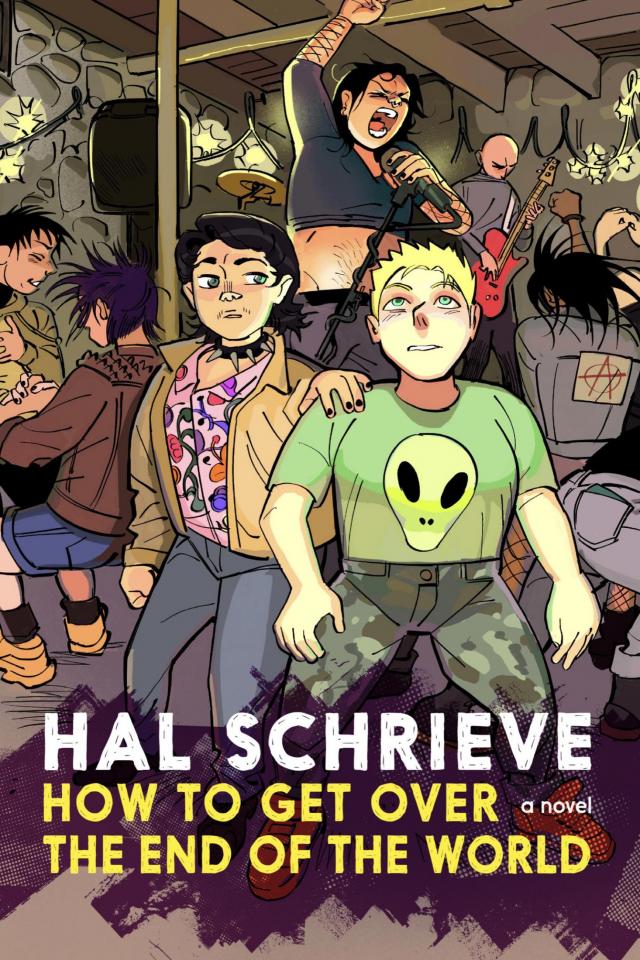
“Growing up and being trans and aliens, oh my! How to Get over the End of the World is one of those rare novels that combines razor-sharp wit with a courageous and tender heart. With pitch-perfect accuracy and fearless honesty, Hal Schrieve evokes the raw wild magic of queer and trans adolescence with characters that are at once astoundingly realistic and delightfully larger than life. Ferociously intelligent and relentlessly authentic, this book has all the makings of a queer cult classic.”
—KAI CHENG THOM, author of Fierce Femmes and Notorious Liars: A Dangerous Trans Girl’s Confabulous Memoir
“Hal Schrieve has proven hirself a virtuoso of vital, immediate trans storytelling. How to Get over the End of the World is a brave salvo against anodyne trans YA, richly populated by messy, earnest, colorful characters. You’ll love them, loathe them, and fall in love with them all over again. Trans kids are under attack. How to Get over the End of World will show them how to fight back.”
—PEYTON THOMAS, award-winning author of Both Sides Now
“How to Get over the End of the World would have been phenomenal and necessary even without the science-magic: queer and trans teens, playing in bands, falling in love, raising hell, fighting and friending and living radical lives. But, there is science-magic. Aliens and telepathy and vibes. This is the book we need right now.”
—MICHELLE TEA, author of Black Wave
“How to Get over the End of the World feels wholly original—a punk rock opera that finds a way to blend sci-fi, coming-of-age, and inspiration that maybe we can fix this messed up world. No one writes the contemporary teen voice better than Hal Schrieve.”
—COLLEEN AF VENABLE, author of the National Book Award–longlisted Kiss Number 8
“A story exploding with voice and vulnerability, How to Get over the End of the World is electric and soft and honest and powerful and left me buzzing. I’ve never read such a raw depiction and reflection of my trans and queer identities, and I’m beyond excited for young readers who’ll get to read this book and feel seen by Hal’s words. Simply magical. Very gay.”
—KACEN CALLENDER, author of the National Book Award–winning King and the Dragonflies and the bestselling novel Felix Ever After
HOW TO GET OVER THE END OF THE WORLD
a novel
HAL SCHRIEVE
seven stories press
new york • oakland • london
Copyright © 2023 by Hal Schrieve
A Seven Stories Press First Edition
All rights reserved. No part of this book may be reproduced, stored in a retrieval system, or transmitted in any form or by any means, including mechanical, electronic, photocopying, recording, or otherwise, without the prior written permission of the publisher.
Lyrics from The Transfused (page 89) written by Nomy Lamm & the Need. Reprinted by permission.
Seven Stories Press
140 Watts Street
New York, NY 10013
www.sevenstories.com
College professors and high school and middle school teachers may order free examination copies of Seven Stories Press titles. Visit https://www.sevenstories.com/pg/resources-academics or email academic@sevenstories.com.
Library of Congress Cataloging-in-Publication Data
Names: Schrieve, Hal, author.
Title: How to get over the end of the world : a novel / by Hal Schrieve.
Description: New York : Seven Stories Press, Triangle Square Books for
Young Readers, 2023. | Audience: Ages 13-17. | Audience: Grades 7-9.
Identifiers: LCCN 2022059331 | ISBN 9781644213018 (hardcover) | ISBN
9781644213025 (ebook)
Subjects: CYAC: Interpersonal relations--Fiction. | Telepathy--Fiction. |
Visions--Fiction. | End of the world--Fiction. | LGBTQ+ people--Fiction.
| LCGFT: Novels.
Classification: LCC PZ7.1.S336544 Ho 2023 | DDC [Fic]--dc23
LC record available at https://lccn.loc.gov/2022059331
Printed in the USA
9 8 7 6 5 4 3 2 1
Chapter 1: ORSINO
The ship is spherical, like a pink pearl in black space. It flashes in and out of my dreams. The dreams have been happening for two years, and they’re getting more frequent, which Robin is worried about. It feels as if the aliens are getting closer.
Tonight, they were talking to me.
I was on their ship, but I was also in the middle of a forest fire.
The forest burned. I could hear the goats behind me, screaming. They weren’t burning yet, but they could smell the smoke too. I couldn’t save them.
The ship was broadcasting a message.
You are a sentient terrestrial being sensitive to psychic speech. If you understand this message, please indicate an affirmative.
It flashed like a caption over me in symbols I didn’t recognize, but then the meaning came across in these drifts.
It’s not like reading.
I couldn’t indicate an affirmative, because I can’t control anything in dreams.
The smoke was making it hard to breathe. I was running toward the road. I couldn’t see the big blue car in the driveway. In the dream, my dog-mind registered emergency. The car was supposed to be there.
We are transmitting data to your stardate.
The long wormlike bodies of the beings in the ship crawled across my field of vision, obscuring the driveway. They had lots of eyes; they operated their screens with their long, flexible tails. I could see them inside the fleshlike walls of their ship at the same time as I felt the hot earth scalding the bottoms of my feet.
The underbrush was alight.
Ferns, grasses, old logs, new saplings. Trees fell, bringing with them fresh waves of towering flame. My fucked-up cracked paws hit the ground painfully as I ran toward the line of warm asphalt.
Blood was leaking from my mouth.
We split time to speak to you, because you have the sensitivity needed to listen. We need you.
I wasn’t outside anymore. I was in a house and the walls had come down on me. A huge block of cement was on my back, pushing me into something sharp. I could smell smoke again.
You are our forerunner. We need you to change time. We need you to live.
Saltwater stung my tongue. I was on a beach. I had come there from the road, from the farm. The sand was slick with oil. I looked down and on the rocks were dozens, hundreds of dead fish, dead birds black with it. Their eyes rotted inward.
We are where you will be. We need to speak to you. Do you understand?
The pink ship flashed, and the worms’ tails made noises, and screens flashed the unreadable text. I couldn’t tell if I was still a dog or a person. My feet were stuck in the mud and the tide was rising. Plastic bags pushed against my face and eyes. My heart jerked, pounded hard, and my hands slipped. I was looking at the surface of a planet under a smoky, red sky. My head was pressed against metal.
Do you understand?
The voice was too loud, too close. My throat was dry, but I screamed.
“Shut up!”
The plastic bags weren’t there anymore.
The wormlike being with many eyes looked up at me. I felt sure that the being could see me.
We were floating far above the earth, orbiting the moon.
“Orsino, bro,” Jukebox said. “Wake up.”
The light was off, but the hall light shone through. Jukebox was standing in the door, their shadow stretching towards me across the thin carpet. They were wearing a pair of my sister Robin’s underwear; their scarred, tattooed chest was bare. Their hair stood up on end. I was half-on and half-off my mattress, my face pressed into the carpet.
“Hey,” I croaked.
“Thought you might need help,” Jukebox said. “It’s four in the morning.”
“Did I wake you up?”
“I’ve been up trying to write. I heard you screaming.”
“Sorry,” I said. My neck felt weird.
“I wasn’t writing anyway.”
Jukebox came over and sat on the end of my bed. The colored ink on their chest was purple and blurry in the dark, but I could still see the wolf tattoo on their arm staring at me as they handed me a cold washcloth with their other hand.
“You’re here. You’re okay. It’s not real.”
I shut my eyes again and saw the ship recede into the distance, the dog running through the fire, paws hitting hot ground.
“I think it is,” I said. I pressed the washcloth to my face. I was surprised I could even talk. I still felt my cracked paws and bloody teeth, felt the plastic in the water over my face and the men with knives cutting me. My heart was beating in my ears. I felt electricity crackling, everywhere. Same as last night, and the night before. I felt an urge to look outside. I knew that something was happening to the sky.
“This kinda stuff feels real,” Jukebox said.
I shut my eyes again and saw the shadows shake, the spaceship descend and ascend towards me. “It doesn’t go away.”
“I dream about Ghost Ship every night,” Jukebox said. “The fire going up. People screaming. It feels really really there, really close. But it’s over. Even if it doesn’t feel over. Your stuff with your dad and the dog and the . . . well, the spaceship.”<
“I still think my stuff is really the future. There’s Agatha, but there’s this fire too,” I said.
Jukebox’s face was half-dark, half-lit-up from the light in the hall. They nodded at me.
“They told me that they need me,” I said. “There are these beings, this light, and they’re showing me that there’s a bad past and a bad present, and a bad future coming too, where the fires just grow and there’s death and floods and plague and then . . .” I stopped. “This . . .” I couldn’t speak any more. “They said they need me to change it. I don’t know how.”
“I’d take a cold shower if I were you. You dunk all the way under the water, real cold, and it slows your heart rate way down.”
“Thanks,” I said.
“If that doesn’t work, I have weed.”
I rolled over onto my mattress and pushed myself up, staring at the floor for a second as my vision spun. I nodded at Jukebox, to show that I heard them. I pressed my face into the washcloth again. It was cold and smelled a little bit mildewy.
Jukebox and I stood up at the same time, and they looked for a second like they were going to hug me. Instead they slapped me on the back. “I hope you get more sleep, bro,” they said as they left. “If you want any weed, let me know.”
I heard Jukebox murmuring something to my sister in the next room as I went down the hall past my mom’s door. I could see the yellow light on in the kitchen down the hall. Mom must still be working on her chemistry homework. I hit the light switch in the bathroom fast, not wanting to see shapes in the dark. The tub’s never been caulked, because our landlord’s cheap; in the three months we’ve lived here, a little ring of mold has grown up around the edge. I wiped at it with a tissue to get the moisture up before I ran the water. I sat in the tub and turned on the shower head so the water ran cold. I could still see the fire when I closed my eyes. My jaw was still chattering. I ran my hands over my belly, felt the hair growing there, touched my feet. I didn’t touch my chest.
I looked up out of the bathroom window and saw that the sky outside was a bright, unearthly violet. It shone like the wall of a tent being lit from the other side by an enormous purple light. I blinked; it did not go away.
I looked away from the window. I stood in the cold water and scrubbed myself down with the thin washcloth. My body was wrong; the ways it was wrong were various, but one of the main ones was that I wasn’t a dog. In my room, I dug through my drawer and found my ROSWELL shirt with the bleach stains and the pants I had cut with kitchen scissors.
“Oh, you made coffee,” my mom said when I set the cup down next to her on top of her textbook. “Thank you.” She had on her scrubs already—these were ones printed with cats in different colors. “How did you sleep?”
“Fine,” I said. I looked toward the window.
She looked at me. “I can hear you, you know.”
“It wasn’t any worse than usual.” I wondered why Jukebox was the one to wake me up and give me a washcloth, if Mom had heard me too.
“We have got to figure out some meds for you. They have to make something that’s gonna calm you down.” She chugged her coffee and ran her hands through her hair, trying to make it lay on one side. She cut her hair the week we moved to Tacoma. It’s turning gray, but not super fast. You just see it on the edges. “And we gotta get you a new therapist. It’s been three months since Dorothea retired, and I can tell it’s getting worse for you. For a while there I thought things might be getting better.”
“Jukebox said maybe weed would help,” I said. “Some people use it for trauma stuff.”
Mom sighed. “Yeah, I mean, if it works, that’s one thing. But I don’t want you just dependent on weed forever. I mean, look at Jukebox.”
I rose to the bait. “What’s that supposed to mean?”
My mom gave me a no-bullshit-here look. “Hey. I’ve done a lot of fucked-up stuff, said bad stuff, I know. But you can’t look at that girl and say everything’s all right with her.”
“Them,” I said.
“Them, whatever. My brother was kind of like that, you know. Up and down, all hyper and then all depressed. They got a lot going on. I think they need therapy or stabilizers or something, not just weed. You, too.”
I shrugged. “Maybe I can get a white noise machine. Then you won’t get woken up when I yell.”
“That’s a horrible solution,” my mom said. “That’s a non-solution.” She sighed. “You’re going to do your online homework today, right?”
“Yeah,” I said.
My mom left to go to her nursing residency at the hospital, and I took a minute and checked my phone. My latest piece had gotten 970 likes. I looked at some pictures of pit bulls at a local shelter that had wide silly heads and big eyes and sketched a couple; my next picture was going to be a bunch of them in a circle, like the Matisse of the women dancing. I sent a couple sketches to Robin so she would see them when she woke up.
Robin texted me back right away. She must have been awake already, staring at her phone in her bed. Thanks for dog pics, they rule! Remember, show tonight. We need ur help hauling J’s gear soon so we can get back to their house and set up.
I remember, I said. Gonna go collecting rn.
There was a pause. Jukebox says can you get a possum skull for their altar, Robin texted.
I didn’t text back. I could imagine the way they would say it aloud to my sister, in my sister’s bed, the pillow half covering their face, smiling crookedly.
I checked my notes again; someone had asked me to draw their boyfriend’s snakesona. It wasn’t porn stuff, so I messaged back saying okay. I could make a living just drawing stuff like this, if I wanted to.
I threw on a coat and pulled on the sneakers that had started fraying at the top, then grabbed trash bags from under the sink. The sun was still barely up as I locked the door behind me. The sky was no longer purple.
When I was little, our dad would try to take us hunting. I was bad at holding the gun steady. I only killed a deer like, twice. But when my dad killed something, I would always help him clean it, cut it up, cure the meat, hang it. My dad would save deer skins. There were people who made stuff out of deer leather that he could sell them to. He cleaned and kept the bones of a lot of deer. He taught me to clean the bones too. It was a slow, exact process, and I liked knowing it. I liked watching as all the layers of stuff that made a creature alive were stripped away, and you could see each layer, and see the stuff inside changing. Part of the way he taught me involved letting the animal’s body—or its head, if it was big—soak in a bucket on the edge of our property, sealed in so other animals couldn’t eat it. You’d open the bucket and this enormous stench would come out, and you would see if the skin was ready to come off.
When I was eleven or twelve, I started looking for roadkill and dead animals in the woods, and I’d take off the meat and clean those bones, too, to keep. You learn a lot about animals by seeing the way they work inside. Since we lived next to a long stretch of rural road in southern Washington, there was a lot of roadkill. I started making art out of the bones. I would paint pictures of them, then paint the skulls themselves, then take them to a spot in the woods I liked, and hang them up. My dad helped with the bigger animals.
Now I do it for myself.
Tacoma is spread out over industrial areas and downtown and the residential towns around it, so the wild animals congregate along certain fault lines, near strips of green. There’s a hill near our apartment covered in trees, overlooking the Sound and the warehouses. The hill was too steep to level as they built the highway. It goes down and then there’s a little drop and you hit the road. I find animals near there. The roadkill is mainly stuff like raccoons, dogs, cats, squirrels. Some rats. I like the rat skulls. I hide them in a box now because Jukebox’s bandmate Stacey asked me if I would make a necklace of them for her, and I think that’s gross. The rat box has some little blue rhinestones glued to the top, so my mom knows it’s special and doesn’t throw it out. When it’s full, I don’t know what I’ll do with it. I can’t hoard bones in our apartment forever.
When I collect, I walk around with rubber gloves and two bags. One for trash, and one for animals. A couple times people have gotten freaked out seeing me putting just animals into bags, so I make sure to do trash too, and take it up to the dumpsters. That way I’m serving the community or whatever.






