

Treadmill, p.1
Treadmill, page 1


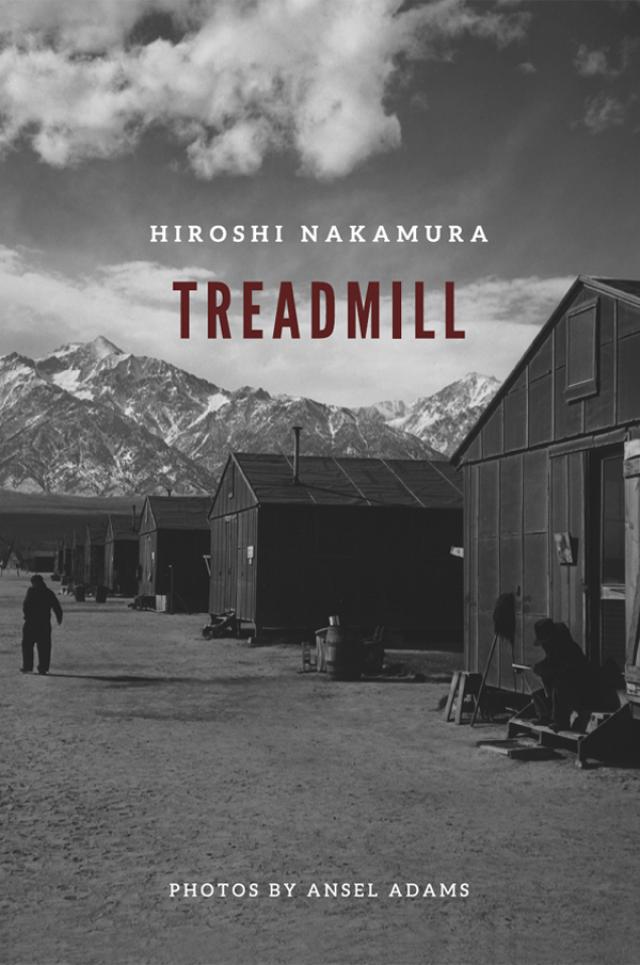
TREADMILL
A NOVEL
TREADMILL
A NOVEL
BY
HIROSHI NAKAMURA
Library and Archives Canada Cataloguing in Publication
Nakamura, Hiroshi, 1915-1973, author
Treadmill : a novel / Hiroshi Nakamura ; photographs by Ansel Adams.
Previously published: Oakville, Ont.: Mosaic Press, 1996.
Issued in print and electronic formats.
ISBN 978-1-77161-210-4 (paperback).--ISBN 978-1-77161-211-1 (html).--ISBN 978-1-77161-212-8 (pdf)
I. Adams, Ansel, 1902-, photographer
II. Title.
PS3564.A35T742016 813’.54 C2016-904351-7
C2016-904352-5
No part of this book may be reproduced or transmitted in any form, by any means, electronic or mechanical, including photocopying and recording, information storage and retrieval systems, without permission in writing from the publisher, except by a reviewer who may quote a brief passage in a review.
Published by Mosaic Press, Oakville, Ontario, Canada, 2021. www.mosaic-press.com MOSAIC PRESS, Publishers
Copyright © Hiroshi Nakamura, 1996. Revised second edition © 2021
Cover photo and all photos by Ansel Adams Library of Congress, Prints and Photograph Division, reprinted with permission.
Printed and Bound in Canada
MOSAIC PRESS 1252
Speers Road, Units 1 & 2
Oakville, Ontario L6L 5N9
phone: (905) 825-2130
info@mosaic-press.com
www.mosaic-press.com
Original neg. no.: LC-A351-3-M-13
Monument in cemetery
Manzanar Relocation Center, California
Original neg. no.: LC-A351-3-M-27
Manzanar street scene, spring
Manzanar Relocation Center, California
Original neg. no.: LC-A351-3-M-4-Ax
Manzanar Relocation Center from tower
Manzanar Relocation Center, California
Original neg. no.: LC-A351-3-M-28
Entrance to Manzanar
Manzanar Relocation Center, California
Original neg. no.: LC-A351-T01-3-M-23-B
Line crew at work in Manzanar
Manzanar Relocation Center, California
Original neg. no.: LC-A35-6-M-22
Mess line, noon
Manzanar Relocation Center, California
Original neg. no.: LC-A351-3-M-6
Baseball game
Manzanar Relocation Center, California
Original neg. no.: LC-A351-3-M-14
Roy Takeno, editor, and group reading paper in front of office
Manzanar Relocation Center, California
Original neg. no.: LC-A35-5-M-19
Choir, general group
Manzanar Relocation Center, California
Original neg. no.: LC-A351-3-M-38
Mr. and Mrs. Henry J. Tsurutani and baby Bruce
Manzanar Relocation Center, California
Original neg. no.: LC-A35-6-M-79
Winter storm
Manzanar Relocation Center, California
Original neg. no.: LC-A351-3-M-10
View south from Manzanar to Alabama Hills
Manzanar Relocation Center, California
Original neg. no.: LC-A351-3-M-14
Farm, farm workers, Mt. Williamson in background
Manzanar Relocation Center, California
Original neg. no.: LC-A351-3-M-15-A
Guayule Field
Manzanar Relocation Center, California
Original neg. no.: LC-A351-3-M-25
Manzanar street scene, winter
Manzanar Relocation Center, California
DEDICATION
Dr. Peter J. Suzuki (1929-2016), retired professor of University Nebraska at Omaha, whose selfless efforts made publication of Treadmill possible. His perseverance in finding Hiroshi Nakamura’s heirs to obtain agreement to get this novel published and diligence in finding a worthy publisher are unprecedented. The Nakamura and Sato families are so thankful for his bringing Treadmill to fruition.
PREFACE
by Hiroshi Nakamura
This is the story of Teru Noguchi, American daughter of Japanese ancestry. This is the record of a people in bewilderment, forsaken by their land of adoption.
We were forced from our homes. We were herded into confinement as a demonstration of loyalty. Yet we were denied the rights of loyal men. Not understanding why nor knowing where, with the whole of our worldly goods clutched tightly in our hands and trying desperately to keep together the ties of blood, we stumbled wearily through shocking heat and stifling dust - without liberty, without home, with uncertain future. We cheered in the darkness on the dregs of disillusionment, of bitterness, of hopelessness; we cheated, we lied, we were honest, we were brave, we stood on the hot burning sands and made our decisions, each according to his conscience. We were different, we were humans. Even as you.
HIROSHI NAKAMURA, 1915-1973
by Mary Sato Nakamura
and Isami Nakamura
By his brother Isami Nakamura
Hiroshi Nakamura was born in Gilroy, California, on March 7, 1915. Interestingly, he was born the third son of a third son of a third son, which, in Japanese lore means great expectations. He was the third child in a family of five brothers and two sisters of parents who had come from the Hiroshima Prefecture, Japan, in 1907. Our Father came in 1907 while our Mother came in 1908. Our parents ran a pool hall in Gilroy just prior to world war II.
Hiroshi was imbued with the three “C”s: courage, conviction, and creativity. Because he was blessed with a near photographic memory, school was easy for him. At age 15, he was graduated from Gilroy High School, where he was the top student with a straight “A” grade-point-average for four years.
Upon graduation, he commuted by train to San Jose State College for a year. He then transferred to the University of California at Berkeley, where he earned his room and board working. Dissatisfied with school, he purchased a bicycle with plans to tour the United States: he wanted to see what the country and the people were like. Heated arguments with his father folllowed because of these plans. A compromise was reached whereby Hiroshi would eventually return to school and get his degree, and his father would no longer stand in the way of his plans.
Because he was a temporary drop-out, Hiroshi did not graduate from UC Berkeley until 1937, with a degree in zoology and a journalism minor. Unable to find work in his field, he went to Los Angeles, where he got a job as a clerk in a Japanese drug store. That was a time when many Nisei college graduates were working in the produce markets.
His first good break came when the English editor of a large Tokyo newspaper offered him a job writing copy translating English to Japanese and Japanese to English. A few months later, he was transferred to the Manchurian branch office where he worked until looming war clouds predicated a sane and prudent return to the States. He was in the photography business until it was cut short by Pearl Harbor.
The Salinas Assembly Center, Salinas, California, was the first of the internment camps where he and his family members were incarcerated. The Poston camp in Arizona then followed. The final camp experience was at Tule Lake, California, where he completed Treadmill while working for its Community Analysis Section.
By his wife Mary (Sato) Nakamura
Hiroshi and I were married in Tule Lake on July 29, 1944. I originally was from the Imperial Valley farming community of Brawley, California and had been interned in Poston. Many of the residents in the Imperial Valley were not sent to assembly centers but were sent directly to relocation camps. It was the one good thing that came out of our camp experiences. As his typist for Treadmill, I remember using our battered but serviceable old portable nightly to type the manuscript in our camp room (“apartment”).
Previous to Treadmill, Hiroshi had written several short stories under the pseudonym of Allen Middleton - Middleton being a literal translation of Nakamura. He felt that using a caucasian surname would improve the chances of publisher acceptance. Sadly, none of his stories were published.
After we left camp, we settled in Los Angeles. Our daughter, Dorothy, was born shortly thereafter interestingly enough, on the third day of the third month of 1946. Unable to find employment, we and several of our siblings started a “Pop and Mom” grocery store. Our son Ed was born around this time (1948). Soon after, we opened a slightly larger store.
After the store was sold, Hiroshi decided to try sharecropping for strawberries in Betteravia, California. Three years later, in the early 50s, we moved back to Los Angeles and started another small grocery store. Wanting to try still another type of business, Hiroshi then went into the coin-operated washer/dryer business, placing machines in apartment buildings. In 1972 he contracted stomach cancer and died November 4, 1973, at age 58.
Shortly after the war while in Los Angeles, he sent the Treadmill manuscript to several publishers; obviously one copy of the manuscript - whose existence I did not know about - ended up in the National Archives. Unfortunately, he did not get encouraging responses. Several publishers liked Treadmill but wrote to him that they could not publish it because they feared publishing it could damage their reputation. They were probably afraid of being considered a pro- Japanese publishing house because of the pervasive anti-Japanese sentiment throughout the nation at that time.
Treadmill, in part, is based on Hiroshi’s personal experiences. The novel is also based, to a large extent, on his own observatio
The characters in Treadmill are composites of persons he had known, met, or heard about. For example, Teru, the main character, is modeled somewhat on his younger sister. Like Teru in the novel, she was academically the best student in her graduating class but was not recognized by the administrtion of Gilroy High as the class valedictorian because of racial discrimination.
INTRODUCTION TO REVISED
SECOND EDITION
by Tara Fickle
Many readers who come across Treadmill will already have some knowledge of the historical events which are its focus. They will probably know, for example, that following the Japanese bombing of the Pearl Harbor military base in Hawaii on December 7, 1941, more than 110,000 Japanese civilians living along the West coast (62% of whom were American citizens) were incarcerated in hastily-constfucted, barbed-wire enclosed camps in some of the most barren deserts and harshest climates the United States had to offer. One could know these facts and figures, however, and still have only the barest sense of the human costs of the internment: of the deep and lasting damage inflicted upon the hearts and minds of hundreds of thousands of men, women, children, and old people long after their bodies were released from camp. That humanity is what Hiroshi Nakamura’s Treadmill restores to those individuals, and to us as readers.
As a historical document, Treadmill provides an invaluable insider’s account of the internment camps, particularly of the massive bureaucracy that governed internee’s daily lives, making even the smallest of tasks – like locating a broom or toilet paper – into a tedious, paperwork-filled nightmare. Yet the book’s meticulous depiction of these impersonal institutional mechanisms is softened and enhanced by the equally careful attention it pays to the individual human beings terrorized by them. Exposing the reader to a diverse choir of voices and cast of characters, each with their own unique hopes, fears, and circumstances, Treadmill fights back against the stereotypes that were responsible for the internment in the first place: the deeply-held assumption that, in the infamous words of General John DeWitt, the man behind the evacuation plan, “a Jap’s a Jap” regardless of age, birthplace, or even citizenship.
Hiroshi Nakamura was born in Gilroy, California in 1915 to immigrant parents from Hiroshima, Japan. A college graduate with a minor in journalism, he was working as a translator for a large Tokyo newspaper when World War II broke out. Upon returning to California, he and his parents and siblings were incarcerated first at Salinas Assembly Center before being moved to internment camps in Poston, Arizona, and eventually Tule Lake, California. After the war, Hiroshi and his wife Mary moved to Los Angeles; he sent the manuscript of Treadmill to several publishers, but despite their recognition of its merits, the rampantly anti-Japanese postwar environment led them to decline. After pursuing several different career paths, including running a grocery store, sharecropping, and installing coin-operated washers and dryers, Hiroshi Nakamura passed away of stomach cancer in 1973 at the age of 58.
Although it was never published during Nakamura’s lifetime, a copy of the Treadmill manuscript found its way to the National Archives in Washington, D.C., where it was discovered in 1974 by anthropologist Peter Suzuki shortly before he became a professor at the University of Nebraska in Omaha. The book, which Suzuki transcribed himself using a microfilm copy of the original (itself typed by Hiroshi’s wife Mary), was first published by Mosaic Press in 1996.
As Suzuki rightly notes in his introduction to the inaugural 1996 printing, Treadmill is a unique book, being the only known novel to be written during the internment itself. The immediacy of the experience partially accounts for the vivid, detailed descriptions of camp life, which according to Nakamura’s widow Mary are based on a combination of first-hand experience and careful observation. Although the book is not a memoir - narrated instead through the perspective of Teru Noguchi, a young Nisei (second-generation Japanese American) woman – neither are the characters entirely fictional creations. According to Mary Nakamura, many of them, particularly the members of the Noguchi family, are “composites of persons [Hiroshi] had known, met, or heard about”; it is a testament to what Suzuki calls Nakamura’s “keen ethnographic eye” that the author was able to transform even third-hand knowledge into such compelling, lively portraits. We meet the Noguchi family on the eve of internment; the book traces their difficult journey along the same route Nakamura himself took, beginning in Salinas, California and ending, just after the war, in Tule Lake, where Teru, her parents, and younger brother await repatriation to Japan.
The significance of Treadmill lies not only in its historical but its literary value, which is evident even from its name. Many readers may find themselves a bit puzzled by the title: what after all, could a fitness machine have in common with one of the greatest civil rights violations in recent American history? To be clear, the treadmill Nakamura is referring to is not exactly the conveyor-belt style exercise device most of us are familiar with, but to a machine invented first to harness the power of humans and animals for agricultural and construction work, and later implemented as a form of prison discipline. Often used interchangeably with the term “treadwheel,” the earliest treadmills, which were already in extensive use by the time of the Greeks and Romans, were similar in appearance to water wheels, used mainly for raising water, grinding grain, and powering early earth-moving and lifting machines. In the early 1800s, they were introduced into British prisons by Sir William Cubitt, an English engineer and son of a miller. Inmates were forced to climb the “Everlasting Staircase” for upwards of six hours a day, sometimes as a form of penal labor but also simply as punishment.
Nakamura’s choice of title is thus an inspired and grimly appropriate symbol for the exploitative mechanisms of the internment camps, in which inmates were forced to labor endlessly and for the most meager of wages in order to power the very war machine responsible for their incarceration: to, for example, plant and harvest food or weave camouflage nets not meant for their consumption or protection, but the army’s. At the same time, the image of the treadmill captures the more subtle psychological anguish of daily life in the internment camps, which the book as a whole takes pains to shed light on. Not only do scorching heat, inadequate shelter, medical care, and rations leave the inmates physically exhausted; in some cases, as with Ayame Noguchi, Teru’s mother, the endless struggle simply to survive begins to take its toll on their mental state as well. Faced with the loss of her home, the imprisonment of her family, and the FBI’s seizure of her husband, Ayame’s mind begins to falter, her slipping grasp of reality linked to the broader incomprehensibility of the U.S. Government’s decision to imprison its own citizens. Failing to see the purpose of performing basic chores like cleaning, bathing, or even eating because, as she points out, they will only need to be done again and again, Ayame becomes a tragic testament to the internment’s crushing psychological effect, which at its most extreme leads to a grim perspective on life itself as a futile exercise.
The subtitle of the book – “A Documentary Novel” – further attests to Nakamura’s aesthetic vision. Like its titular image, the notion of a “documentary novel” might initially seem a strange, if not flatly contradictory, formulation. After all, we tend to think of the two genres as natural opposites: the documentary as a non-biased, informative account of “true” events, the novel as a carefully crafted narrative of fictional ones. Nakamura, however, ambitiously seeks to marry the two. Although much of the book is narrated from Teru’s point of view, it frequently switches between various characters and “camera angles,” deftly balancing allegiance to an “objective” historical perspective which showed the internment “as it really was” with a literary impulse to turn that body of facts into a coherent and meaningful story.
This novel combination of genres is one innovative strategy Nakamura uses to emphasize that the Japanese American population was not an undifferentiated, homogeneous group but possessed countless internal distinctions and divisions which had a profound impact on internees’ daily lives, emotions, and actions. Some of Nakamura’s most ambitious literary experiments result from this effort to capture and reconcile individual and collective perspectives. At times, he employs the first-person plural point of view (“we”), a perspective rarely used in either novels or historical non-fiction, in order to communicate common experiences or shared perspectives among internees. At other times, he deftly takes on the perspective of a documentary videographer, switching rapidly between multiple first-person singular (“I”) perspectives and omitting the usual formal conventions - like quotation marks or the prefatory “so-and-so said” - to heighten the effect. In the following passages, which take place during the relocation to the camps and a later camp protest, respectively, he powerfully experiments with the potential of a pronoun like “they” to both unite and divide:






