Mm9, p.1
MM9, page 1


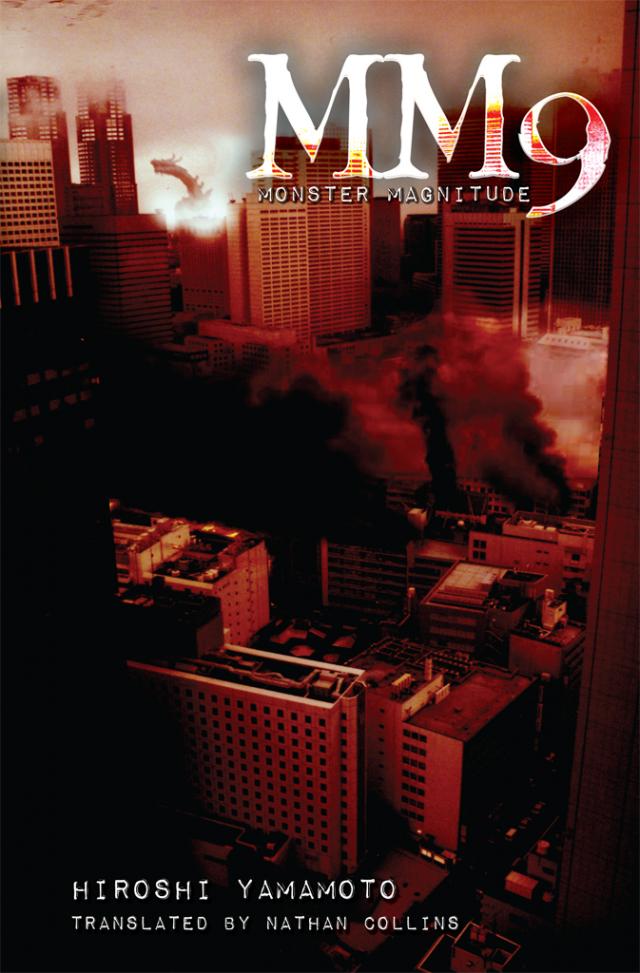
MM9
© 2007 by Hiroshi Yamamoto
English translation rights arranged with TOKYO SOGENSHA CO., LTD.
through Japan UNI Agency, Inc., Tokyo
English translation © 2012 VIZ Media, LLC
Cover photo and design by Izumi Evers
All rights reserved.
No portion of this book may be reproduced or transmitted in any form or by any means without written permission from the copyright holders.
HAIKASORU
Published by VIZ Media, LLC
295 Bay Street
San Francisco, CA 94133
www.haikasoru.com
Library of Congress Cataloging-in-Publication Data
Yamamoto, Hiroshi, 1956-
[MM9. English]
MM9 / by Hiroshi Yamamoto ; translation by Nathan Collins.
p. cm.
ISBN 978-1-4215-4089-4
1. Yamamoto, Hiroshi, 1956—Translations into English. I. Collins, Nathan. II. Title.
PL877.5.A46M6113 2011
895.6'36--dc23
2011042037
The rights of the author of the work in this publication to be so identified have been asserted in accordance with the Copyright, Designs and Patents Act 1988. A CIP catalogue record for this book is available from the British Library.
Haikasoru eBook edition
ISBN: 978-1-4215-4289-8
Japan Meteorological Agency
Monsterological Measures Department (MMD)
Ryo Haida …… Mobile Unit
Sakura Fujisawa …… Mobile Unit, Vehicles and Transportation
Asaya Koide …… Mobile Unit, Photography and Communications
Kiichi Awashima …… Mobile Unit
Yojiro Muromachi …… Mobile Unit, Director
Toshio Yamagiwa …… Operator
Kensuke Sogabe …… Operator, Military Geek
Koichiro Morihashi …… Operator, New Hire
Yuri Anno …… Astrophysicist
Shoichi …… Kurihama Department Chief
Other
Ikki Anno …… Yuri’s Son, Third Grade
Mikio Izuno …… Astrophysicist
Eiko Hamaguchi …… Ryo’s Girlfriend
Crisis! Kaiju Alert!
9
Danger! Girl at Large!
43
Menace! Attack of the Flying Kaiju!
81
Scoop! Twenty-Four Hours with the MMD!
133
Arrival! The Colossal Kaiju of the Apocalypse!
179
May, 2005. Yokohama, Ishikawa Train Station—
At 6:53 PM, Ryo Haida’s cell phone rang. The ringtone— Mussorgsky’s Night on Bald Mountain—identified the caller: Yojiro Muromachi, head of the Mobile Unit.
Ryo scowled, said, “Oh, come on,” and took the cell from his pocket. He had just stepped through the station exit, headed for the coffee shop where his date awaited. It was just past sunset, but the sky was overcast, the city painted with the vivid colors of neon lights.
“This is Ryo,” he said. Early in his childhood, he learned never to give his full name over the phone. With part of his name meaning “yes” in Japanese, “This is Haida Ryo,” could also mean, “Yes, this is Daryo,” and often elicited the same confused—and tiresome—response, “Your name is Daryo?”
“It’s me,” Yojiro said, his words coming like rapid fire. As usual, he didn’t waste any time getting to the point. “Thirty minutes ago, a JMSDF submarine near the Ogasa Islands collided with an unknown. Our estimates—”
“No, wait, hang on there. I’m meeting up with a date.”
“You’ll have to cancel.”
“You’re killing me here. This is that college girl. The future starlet? You don’t know how hard I’ve worked just to get this far. Can’t you ask Kiichi or somebody—anybody else?”
“He’s in Kumamoto on business. And I’m not asking just you. We’re all hands on deck for this one.”
That gave Ryo pause. Now that Yojiro mentioned it, Ryo could hear Chief Kurihama in the background hurriedly shouting out orders.
“Is this a big one?”
“Our estimates put it at MM8. Maybe even nine.”
Ryo gasped. “Off Ogasa, you said?”
“And heading north at forty klicks. The SDF is already on alert.”
“Understood. I’ll head back to the office.”
“Where are you now?”
“Yokohama.”
“Then go straight to Atsugi. The JMSDF is readying an S-1 helicopter to take you to the site. Asaya and Sakura have already left here with the equipment. You can rendezvous with them at the Atsugi air base.”
“What about you?”
“I’ll be gathering data here for the time being. We’re still pulling everyone back in from the holiday, and it’s chaos here. I’ll leave the site to you guys for now. I might join you by helicopter if I can get away.”
“Understood. Can I grab a taxi?”
“Hold on.”
Ryo could hear Yojiro say, “Ryo is asking if he can take a taxi,” and Chief Kurihama reply, “I don’t give a damn! Just make sure he gets a receipt!”
“Did you hear that?” Yojiro asked.
“Got it.” Ryo raised his hand to catch the attention of a passing taxi. “By the way, what type of kaiju is it?”
“Unknown. We don’t know anything beyond its size and speed. I’ll send you everything we have on it when I have a moment.”
“Got it.”
Ryo hung up his phone, climbed in the taxi, and said, “Ayase. And step on it.”
As soon as they were moving, Ryo called his date to apologize.
The storm broke, and raindrops dotted the car windows.
A few minutes later, Ryo received an email with the full report.
First contact was made by the Japan Maritime Self-Defense Force SS571 Amashio (2,450 tons standard surface displacement) with the 2nd Submarine Squadron. At 6:21 PM, the Amashio’s passive sonar system picked up an unknown entity swimming northward in the seas near the Osaga Island Group, south of Japan’s main island. In order to better determine its shape, crewmen sent out a number of active sonar pings, when the unknown suddenly changed course to head straight for the submarine. Evasive countermeasures were attempted but ultimately failed, and the unknown collided with the ship’s stern. The Amashio was spun around and received critical damage to its forward trim tank. The submarine was forced to make an emergency surfacing. There were no casualties. The unknown returned to its northerly heading. From the sonar’s echoes, the creature was estimated to be between eighty and one hundred meters in length. Because it swam at a steady depth, without bobbing up or sinking down, it likely possessed a density similar to that of the ocean water. A reptilian kaiju that size would displace anywhere from 1,400 to 4,200 tons of water.
Seated inside the taxi as it sped through the rain down Highway 16 toward Atsugi, Ryo murmured, “MM8 …”
“MM” was short for “Monster Magnitude,” a scale established in the late nineteenth century by an American kaiju researcher named Guthrie. He conceived it as a measure, based on size, for the potential destructive power of a particular monster—the number of people affected, the number of casualties and destroyed houses, the economic damages, etc.—with six distinct levels on a scale of zero to five. When he devised the scale, the greatest kaiju disaster in America to date had been in Minnesota in 1894, when a reptilian monster estimated to weigh one hundred tons destroyed over ten small towns and left six hundred dead. Guthrie accordingly set that at the top of the scale, with the lower end reserved for small-scale disasters with no more than one or two victims.
According to Guthrie, “With an increase in volume of a kaiju by a factor of 2.5, the amount of damage inflicted on a populated region will increase by a factor of up to 4.”
The thickness of kaiju skin was proportional to the cubic root of their total mass, and the thicker their skin, the less effect medium-caliber ammunition had. The number of injuries needed to put down the beasts was proportional to their volume. The amount of strength per unit of cross-sectional area of muscle and bone was proportional to the cubic root of their volume squared, and their land speed was proportional to their volume to the one-sixth power. Their destructive capabilities toward buildings was proportional to the cubic root of their volume to the fourth power. All those calculations combined to give the maximum amount of destruction that could spread within a populated region before the military—at least as it was then constituted in the United States—could destroy the kaiju.
The scale was expanded to MM8 in 1923, when 140,000 Japanese lost their lives in a single kaiju disaster, and in the time since, there had been several more revisions. At the present time, the monster magnitude was calculated by the water displacement equal to the kaiju’s volume. Kaiju of one ton or less rated at MM0, and each increase of a point on the scale was equivalent to a 2.5 times increase in volume.
Due to advances in military power and the prevalence of sturdy, high-rise buildings, Guthrie’s Law no longer held true. But his scale of monster magnitude continued to be used to estimate the destructive power of kaiju.
MM8 was the equivalent of 1,600 to 4,000 tons of water. In the case of the most common type of kaiju, bipedal reptili
And this one might be a 4,200-ton MM9.
“Is this happening?”
Ryo was on edge. The biggest kaiju on record was 3,600 tons—an MM8.9. Only ancient legends told of any kaiju on par with an MM9. All reports of modern-day appearances had boiled down to unreliable and unverifiable eyewitness accounts. Yet believers of the existence of MM9 kaiju remained—if only because no proof had surfaced to indicate otherwise.
If this one is an MM9—no, even an MM8—this is serious.
If their countermeasures failed, and the kaiju was permitted to reach land, there could be a repeat of the 1923 catastrophe that claimed 140,000 lives.
An announcement over the taxi radio snapped Ryo back from his thoughts.
“At 7:10 PM local Japan time, a kaiju warning was issued. Kaiju Three has been confirmed in the sea off the Ogasa Island Group, 26 degrees latitude and 139 degrees longitude, moving northward at a speed of forty kilometers per hour. Projections indicate a strong possibility of landfall tomorrow evening on the Pacific shore between central and eastern Japan. The monster magnitude has been estimated at eight. The Japan Meteorological Agency urges all seacraft in the area to exercise extreme caution, and—”
“Not again,” the driver said wearily. “Last time they said there’d be a huge one to hit Tanzawa, and they were wrong about that, weren’t they?”
“Huh? Oh, yeah, I guess so.” Inside, Ryo was chills and sweat.
“The Daisan Keihin was completely backed up with evacuees’ cars. It was horrible. Then the kaiju turned out to be a frickin’ three? The SDF just took it out with their rifles.”
“Yeah …”
Ryo felt ashamed. It was his unit that had estimated the underground kaiju at MM6 and advised the alert for western Kanagawa. It happened during the holidays and had cost the hot springs and amusement parks a lot of business. The Odawara Board of Tourism nearly sued the Monsterological Measures Department over it.
“The MMD’d better get something right,” the driver went on, “or nobody’ll believe them anymore. Like the boy who cried wolf in Grimm’s tales.”
That was Aesop, Ryo thought. But he didn’t feel like arguing. The man was right. The predictions of the Japan Meteorological Agency Monsterological Measures Department were wrong from time to time. Of course, they were right most of the time, but all people seemed to remember were the times their advisories and warnings struck out and the times of catastrophe when they failed to predict a kaiju.
A wrong prediction could put thousands, even tens of thousands of lives in danger or cause tens of millions of yen in economic damages. The men and women of the MMD shared a heavy responsibility. Despite that—or rather, because of it—their critics were severe. Although they saved many lives, few gave them recognition.
Theirs was a thankless job.
The radio announcer continued to read off the warning, “This warning covers the areas of Chiba, Tokyo, Kanagawa, Shizuoka, Aichi …”
Takebashi, Chiyoda Ward, Tokyo—
The head office of the Japan Meteorological Agency stood across from the Imperial Palace’s East Garden and its surrounding Ote Moat.
“Sorry I’m late!”
By the time Yuri Anno came dashing into the office, the Department of MMD was at battle stations. All around her, phones were ringing off the hook, and the staff were yelling at each other, “Have you reached them yet?” “I’ve got a call from the Ministry of Transportation!” “Where’s that data?” People rushed back and forth with armfuls of folders. A giant display of Japan occupied one wall, and on it the areas affected by the warning were lit orange.
“Hey,” said veteran operator Toshio Yamagiwa. He looked up at her from his computer screen with affable little eyes. “Is Ikki all right?”
“I left him with my mother-in-law.” Yuri removed her coat. “We had plans to go to the amusement park tomorrow, so he’s pretty mad at me.”
“It’s gonna rain anyway.”
His answer wasn’t much of a comfort, and she responded with a noncommittal smile. It’s a lousy mom who can’t be with her son on the weekend, she thought. But what could she do? The MMD had plenty of specialists in biology, environmental science, folklore, and so on, but she was the only astrophysicist. In the event of a major kaiju event, she had to rush to the office no matter what her circumstances.
There were few astrophysicists involved in the field in any nation. Until quite recently, quantum physics and cosmology were not thought to be useful in dealing with kaiju. Biology provided understanding of their ecology; geology, environmental science, oceanography, and the like detected kaiju wherever they dwelled; chemistry analyzed flames, poisons, and other chemicals emitted by the giant monsters; biomechanics estimated the effectiveness of bullets and missiles against them. Astrophysics held no similar purpose.
Many still doubted its place, and some even protested Yuri’s employment. But she had faith. She believed, even if the world at large didn’t, that astrophysics—the anthropic principle in particular—held the key to solving the mystery of kaiju. If she felt any other way, she wouldn’t have given up her associate professorship at the Meteorological College when she was scouted by the MMD.
Yuri turned to Chief Kurihama. “What’s the situation?”
“A JMSDF ship is keeping pace with the unknown, holding its distance beside it. Its heading and speed remain unchanged.”
Shoichi Kurihama fidgeted with his glasses, his countenance bitter. He headed the MMD but was never prideful about it. In the event of a kaiju-inflicted disaster, his was the unpleasant task of facing public criticism. He fervently hoped for a transfer to another department.
And this time, his responsibility was heavier than ever. The pressure had already caused his stomach to ache. He took his trusty medicine bottle from his desk drawer and shook out a pill into his palm.
“We still don’t have any clues about the nature of this kaiju,” the chief said. “Our best estimates from the sonar reading put it at just shy of one hundred meters long. Ryo and Asaya have already left to investigate.”
Suddenly, there was a loud noise. Chief Kurihama choked on the pill in his throat and coughed violently. The noise—like a strong rush of water mixed with popping bubbles—was similar to what a microphone might pick up when thrust out into a downpour on a rainy day.
“What the hell is that?”
“Sorry, Chief.” Koichiro Morihashi, a newly hired operator, scrambled to turn down the volume of his computer. “It’s a file just sent to us by the JMSDF ship—the sound of the kaiju’s swimming picked up by their passive sonar.”
Yuri listened. The rest of the staff stopped their work and gave their full attention to the recording.
Any creature as large as a kaiju would create sound just by passing through the water. Just as the propellers of different ships created different cavitation noise, each kaiju’s aquatic motion carried a distinct audio signature. Unlike the echo of an active sonar, this sound couldn’t give them a clear outline of the creature’s shape, but it was at least a clue toward the nature of the monster.
Yojiro Muromachi frowned. “There’s a lot of background noise.”
Yojiro had been with the Meteorological Agency for over twenty years. With a well-rounded knowledge including expertise in biology, folklore, and archaeology, he was a veritable specialist in kaiju prediction. He was forty-eight, the same age as Chief Kurihama, but in stark contrast with the chief’s narrow, bookish face, Yojiro’s build was akin to that of a mountain climber or a professional soccer player. He loathed keeping inside the office and preferred fieldwork—which is why he had been chosen to lead the Mobile Unit.
“The ship’s at quite a distance,” Koichiro explained, “and the current is strong, so they’re picking up a lot of interference. But I’ll see what I can do with it.”
Chief Kurihama grumbled, “This is just noise. Can’t they get any closer?”
“No, that would be dangerous,” Yojiro said. “We’re dealing with a big one here. It’s already taken out one submarine. That ship is out there alone, and one strike could incapacitate it.”