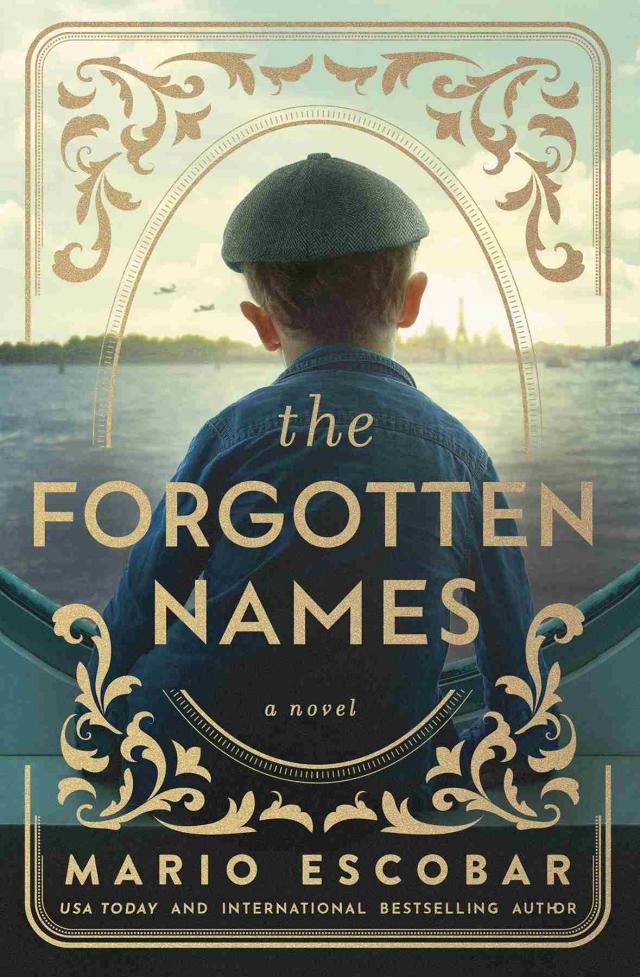
The forgotten names, p.1
The Forgotten Names, page 1


Information about External Hyperlinks in this ebook
Please note that the endnotes in this ebook may contain hyperlinks to external websites as part of bibliographic citations. These hyperlinks have not been activated by the publisher, who cannot verify the accuracy of these links beyond the date of publication
Dedication
To Elisabeth, Andrea, and Alejandra, who traveled to Lyon with me on this journey of memory, history, and passion for freedom.
To the 108 children—and countless others—who managed to escape the clutches of Nazism and who, with their very lives, pulled off the greatest possible act of rebellion against tyranny: being happy.
Epigraph
Sometimes it is only a single light door that keeps children out of the world that we call the real world, and a chance puff of wind may blow it open.
Stefan Zweig, The Burning Secret
Contents
Cover
Title Page
Dedication
Epigraph
Disclaimer
A Note from the Author
Prologue
Part I: A Small Inferno Chapter 1: Thesis
Chapter 2: A Perfect Morning
Chapter 3: The Shadow of Death
Chapter 4: Alexandre Glasberg
Chapter 5: Arrival
Chapter 6: Justus
Chapter 7: The Resistance and Deportation History Center
Chapter 8: A Place Best Forgotten
Chapter 9: Falsifications
Chapter 10: The Infirmary
Chapter 11: Sickness unto Life
Chapter 12: Survivor
Chapter 13: Good Old Klaus
Chapter 14: False Hope
Chapter 15: Opportune Confusion
Chapter 16: Compassion
Chapter 17: To Save Just One
Chapter 18: An Uncomfortable Meeting
Chapter 19: The Cardinal
Chapter 20: The Unthinkable
Part II: The Darkest Hour Chapter 21: Lili
Chapter 22: The Fixlers
Chapter 23: The Human Spirit
Chapter 24: Poison
Chapter 25: Eight Hundred Lives
Chapter 26: Orders
Chapter 27: The Longest Night
Chapter 28: Signing
Chapter 29: Blue Papers
Chapter 30: Mission
Chapter 31: The General
Chapter 32: Mary
Chapter 33: Lotte
Chapter 34: Georges
Chapter 35: Music and Love
Chapter 36: Temper
Chapter 37: Farewell
Chapter 38: Danger
Chapter 39: Escape
Chapter 40: Hiding Place
Chapter 41: A Mission
Chapter 42: Montée des Carmélites
Chapter 43: Episcopal Palace
Chapter 44: Love
Chapter 45: Hours of Anguish
Chapter 46: Convalescing
Chapter 47: One Hundred Hebrew Children
Chapter 48: Backup
Part III: Anonymous Faces Chapter 49: Eternal Words
Chapter 50: The Violin
Chapter 51: Gertrude
Chapter 52: Gilbert
Chapter 53: Final Hours
Chapter 54: Last Chances
Chapter 55: Blows
Chapter 56: Assault
Chapter 57: Miraculous Exit
Chapter 58: Valence
Chapter 59: Dinner
Chapter 60: Madeleine
Chapter 61: The Letter
Chapter 62: A Success
Chapter 63: The Faithful
Chapter 64: Fear
Chapter 65: The Leaflet
Chapter 66: Reencounter
Chapter 67: Margot, Maurice, Gabrielle
Chapter 68: Final Stops
Chapter 69: The Priest
Chapter 70: Another Paradise
Chapter 71: Élisabeth
Chapter 72: Saved
Chapter 73: Last Wishes
Epilogue
Clarifications from History
Timeline
Discussion Questions
References
About the Author
About the Translator
Acclaim for Mario Escobar
Also by Mario Escobar
Copyright
Disclaimer
Most of the characters in this novel are real historical people. Some details, including the order of some of the events, have been altered for the sake of the story’s development and to protect the privacy of the survivors and their families.
A Note from the Author
Writing a historical novel implies describing a part of the world that no longer exists, a part that has disappeared little by little and given way to something else. Someday the impetuous winds of time will buffet us until we, too, are history. The images engraved on our pupils, the sum of emotions and experiences that we all represent, will disappear forever. That futility of life makes us simultaneously giants and pygmies, believing the only way to prolong our existence is to perch atop the shoulders of the next generation and whisper a few phrases into their ears. At its core, that is what literature is: a whisper from people who are no longer. But why is it so crucial that books keep murmuring to us?
In his masterful Le Livre des Justes, French Jewish Resistance worker and author Lucien Lazare narrates how the rescue of a baby on the shores of a river changed the course of history. Pharaoh had ordered the extermination of all male Hebrew infants. One poor mother who could not bear to see her son die decided to stick her baby in a basket and float him down the dangerous waters of the Nile. The outcome seemed inevitable, but that very day, the daughter of Pharaoh—the author of one of the most large-scale genocides against children in recorded history—went down to the river to bathe. She saved the baby boy in the basket. That anonymous feat allowed the future legislator and liberator Moses to stay alive.
What is known about the majority of those called “Righteous Among the Nations”—non-Jewish men and women who risked their lives during the Holocaust to save their Jewish neighbors, friends, colleagues, and even strangers—has dissipated with the inevitable passing of time. These were largely anonymous heroes whose only goal was to do good and to act according to their consciences. Today, some four thousand French men and women are recognized by the international community as Righteous Among the Nations. Thanks to these Righteous, three-fourths of the Jews in occupied France did not die. The majority of these were children.
The Forgotten Names is the story of a heroic act without precedent in Nazi-occupied Europe. A network of institutions and people of different ideologies and beliefs came together to carry out one of the largest rescue operations organized during World War II. Cardinal Gerlier, Charles Lederman, Monsignor Saliège, Dr. Joseph Weill, the Protestant pastor Marc Boegner, Father Pierre Chaillet, and the social workers Élisabeth Hirsch, Hélène Lévy, and Maribel Semprún, among others, saved 108 children from the Vénissieux internment camp on the outskirts of Lyon. This novel recounts their experience as well as that of the French historian Valérie Portheret. At the age of twenty-three, Valérie began her riveting research into the rescue of the children of Vénissieux. After discovering a box with the children’s files, her research became a twenty-five-year journey to find those lost children and give them back their true identities.
I learned about Valérie Portheret’s story in an article in Le Monde while researching for my novel La casa de los niños. Valérie had been so gripped by the rescue operation that she spent over two decades of her life traveling Europe, Israel, and the Americas to find the children. The story gripped me as well. I was immediately compelled to keep alive the chain of memory. When that chain breaks, we are all left nameless.
In the summer of 2022 I walked the streets of Lyon and visited the Centre d’Histoire de la Résistance et de la Déportation, the Resistance and Deportation History Center. The center is housed in the former military medical school of Lyon-Bron, which was also the former headquarters of the Gestapo and where the infamous SS official Klaus Barbie tortured hundreds of people. The fear and desperation of all those fighting for freedom in those dark hours was palpable.
The Montée des Carmélites is a hill where the former Carmelite convent still stands. In that imposing building the children rescued from Vénissieux were hidden. I paused right where the French gendarmes crouched in waiting to charge the building and seize 108 innocents. That was a time when horror was lord and master of this worn-down city. Then I passed by the plaque that commemorates Vénissieux. The plaque, placed in 2012, is the only remaining vestige of the French internment camp. Time seems to have had its corrosive way with the footprints of all that pain. Yet with rapt concentration, something can still be heard: the stifled cries of the mothers being separated from their children forever, the screams of the children reaching out into the darkest night of the soul for their families. May this book serve as a tribute to them all.
Madrid, September 15, 2022
Prologue
Alba-la-Romaine
April 10, 1942
The violin was slung over Rachel’s back. The case was worn, and the black leather had begun to crack like her grandmother’s hands. The cracked hands were all that Rachel could recall of the grandmother she had not seen since she was three. The violin had traveled with Rachel’s father, Zelman, from Poland through Germany and to Belgium and later to Paris. By that time he had bequeathed it to his Belgian-born daughter. Their home in C
Zelman rented an attic room and the odd family of four survived on his work as a barber until France surrendered to Germany. They joined the hundreds of thousands of Parisians escaping along the crowded streets that led south. Most of those refugees were headed to Bordeaux, but Rachel’s family veered toward Valence and from there to the small, provincial Alba-la-Romaine. Bearing evidence of the Roman roots of the village were the stone bridge and the ancient theater, one of the best preserved in France. Rachel loved the solitude of the Roman ruins on the outskirts of the city, especially the theater, which had been witness to so much joy and sadness over the centuries.
That morning the girl was particularly sad. Gendarmes had come at dawn for her father. Things had been taking a turn for the worse in recent months. First, the authorities forbade Zelman from serving non-Jewish clients. Zelman took to going door-to-door, offering his barber services. Then he was forbidden from leaving their neighborhood. The winter was nearly unbearable for the disparate family. With no money for firewood or coal, blankets were their only defense against the cold. Finally, that morning Zelman was taken from them and made to work for the Nazi war machine.
Her father’s face had been etched with desolation as he was led away: eyes sunken in fear, face covered with a black beard that, strand by strand, had been softening into gray, and wrinkles that now overextended his forehead and seemed to shrink his dark, expressive eyes. His last words resounded in Rachel’s ear. “Don’t lose the violin. Keep playing. Every time you play, you’ll know I’m close.”
Yet Rachel felt so alone. Her classmates had stopped talking to her, including Ana, her once soulmate who had shared Rachel’s dreams of becoming a famous concert violinist.
Rachel drew out the instrument. It was still a bit big for her, despite her eight years. She nestled it under her chin and took her place on the steps where, hundreds of years before, the sound of peaceful harps and booming drums had marked the pace of comedies and dramas. Rachel closed her eyes and let the music transport her to someplace far away, where no one could hurt her. The wind-tossed notes became a prayer, a plea for her father, for all the fathers who had to leave their families. It was a wish for them to come home soon.
The music stole the magic from the surrounding birdsong, and Rachel’s closed eyelids were an insufficient barrier for her tears. Her mother once said that those who sowed the world with tears would someday reap with joy and return with jubilant shouts, and that there was a grief that led to joy, that made people stronger and allowed them to put themselves in the place of those who suffered. But someday was a long way away, and Rachel felt only infinite sadness and fear.
Part I
A Small Inferno
Chapter 1
Thesis
Lyon
September 20, 1992
Five years had passed since the highly publicized trial of Klaus Barbie, known by many as “the Butcher of Lyon,” and France wanted to forget it. The world was changing quickly. The iron curtain had come down three years prior, and the aged prison where the Nazi official had lived out his sentence was now free of its nuisance. With Barbie’s death the year before, many former collaborators breathed freely. The past could go back to where it belonged—oblivion.
Valérie headed for Jean Moulin Lyon 3 University. The monumental façade was darkened by soot. Despite bearing the name of a World War II French Resistance hero, everyone knew that the School of Law was a bastion of the extreme Right and anti-Semitism. Valérie planned to direct her research toward the deportation of Jews from Lyon. She vividly recalled the televised sessions of Barbie’s trial and itched to do something to recover the history of Jews expelled from Lyon to Germany.
She had an appointment with Jean-Dominique Durand, professor of contemporary history and a dedicated defender of preserving the historical memory of French Jews.
Valérie greeted the professor and took a seat at a table in the school’s cafeteria.
“Thank you so much for meeting me, Professor. I’m very interested in studying French Jews, but I can’t find anyone to advise me for my thesis.”
Jean-Dominique glanced around to see who might be listening. The extreme Right was on the rise, and the law school had become a hive for Fascists. “I’ll help you in any way I can,” he said.
“So, where should I start?” Valérie asked with a shrug and a smile. She had a beautiful face and dark, energetic eyes. Her slender frame was engulfed in baggy clothes.
“It’s a broad subject. You’ve got to narrow it down a bit.”
Valérie’s gaze wandered off as she thought. At first she had wanted to study Klaus Barbie and his role in the deportation of Jews from Lyon, but now, after several weeks of reading about the subject, she was more drawn to researching the suffering of Jewish children due to the deportations.
“The children . . .” she mused.
Durand’s forehead creased, trying to follow her train of thought. “Which children?”
“The Jewish children. They’re what really interests me. I cannot understand how a regime decides to exterminate innocent children.”
It was the professor’s turn to shrug. “Barbarism is the most primitive state of human beings. Hegel and other philosophers believed that humanity was headed for an era of goodwill and that progress was unstoppable. Marx and Darwin got on board with that positive view of progress, but after two world wars and several pandemics and economic crises, we can no longer say today that humanity is decisively marching toward progress. The narrative that spread through the Enlightenment isn’t sustainable, and Nazism and Soviet Communism are the best proof of that.”
Valérie nodded and said, “What do you think about studying what happened with the children of Lyon?”
“I’d recommend you start with Le Centre de Documentation sur la Déportation des Enfants juifs de Lyon. It’s an archive of documentation all about Jewish children and youth deported from Lyon. It was begun in 1987 during Barbie’s trial, to collect all existing data pertaining to child deportees from 1942 through 1944.”
Valérie jotted down the details. It was not much to start with, but she would surely find more to go on at the center. She sensed that the road ahead would not be easy. Too many people wanted to forget this most ignominious era of French history, but she was determined to make serious sacrifices to keep the memory of those children from dying out.
Chapter 2
A Perfect Morning
Vichy
July 2, 1942
Louis Darquier de Pellepoix slammed his fist down on the table. His broad forehead creased with wrinkles, and his cold eyes flashed. At forty-four, the frenzied anti-Semite had been named director of the Office of Jewish Affairs. He was impatient to get all the Jews out of France. Pierre Laval, who had just regained his title in government, now as prime minister, was less convinced of the wisdom of handing French Jews over to the Germans.
“We need the support of the church. Several bishops have expressed opposition to deporting the Jews, as have some of the Protestant leaders. Marshal Pétain is reticent to go against Cardinal Gerlier. They have long been friends,” Laval said.
Darquier swore and let loose a buckshot of saliva droplets over the orders on top of his desk. His colleagues on the cabinet eyed him and his fury fearfully.
“Well then, first expel the Jews that aren’t French nationals. Foreign Jewish dross have been basking in refugee status within our borders since 1933. If French Jews, with their libertine men of letters and decadent painters, have destroyed the ancient culture of our beloved nation, the degenerate foreign Jews have done nothing but speed up the process of social decay.”