Tangi, p.1
Tangi, page 1
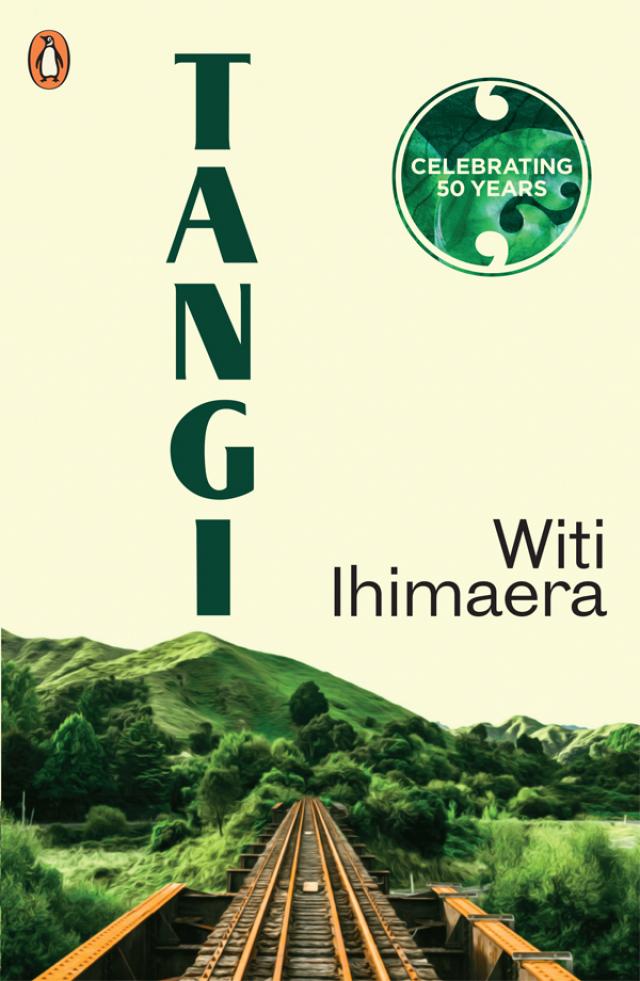


First released 50 years ago, Tangi was Witi Ihimaera’s debut novel and the first to be published by a Māori author. A landmark literary event, it went on to win the James Wattie Book of the Year Award. He was just 29 years old at the time.
At the centre of the novel is the story of a father and son set within a three-day tangihanga. Those who love Pounamu Pounamu will immediately recognise that already present are the hallmarks of classic Ihimaera storytelling.
Revisiting the text for this special anniversary edition, Ihimaera has added richer details and developed the nascent themes that have continued to preoccupy him over a lifetime of writing. Return with him to where it all began.
‘… this is what Witi has always done: tell us stories about ourselves. In novels like Tangi and The Matriarch, he was teaching and entertaining us at the same time, navigating the boundaries separating the worlds of Māori and Pākehā, as well as the increasingly disengaged worlds of rural and urban Māori.’
— PAULA MORRIS, ACADEMY OF NZ LITERATURE
Contents
Prologue: Morning
Chapter One
Part 1: And Time Begins to Spiral
Chapter Two
Chapter Three
Chapter Four
Chapter Five
Chapter Six
Chapter Seven
Part 2: Between Earth and Sky
Chapter Eight
Chapter Nine
Chapter Ten
Chapter Eleven
Chapter Twelve
Chapter Thirteen
Part 3: At the Same Time as the Spiral Goes Forward It Returns
Chapter Fourteen
Chapter Fifteen
Chapter Sixteen
Chapter Seventeen
Interlude: Obsidian Splinters
Chapter Eighteen
Part 4: Haere Mai ki ō Tātou Mate e
Chapter Nineteen
Chapter Twenty
Chapter Twenty-one
Part 5: Life, Come Again
Chapter Twenty-two
Chapter Twenty-three
Chapter Twenty-four
Chapter Twenty-five
Epilogue: My Mother was the Earth
Chapter Twenty-six
Author’s Note
About the Author
Other work by Witi Ihimaera
Follow Penguin Random House
My mother was the Earth.
My father was the Sky.
They were Ranginui and Papatūānuku, the first parents, who clasped each other so tightly that there was no day. Their children were born into darkness …
This is Tangi, a poetic drama in prose, about a young man and his father.
This is Tangi, an account of death, but also an affirmation of life.
This is Tangi, describing simply and sincerely the Māori values placed on life; and on aroha, love and sympathy for each other.
This is Tangi, a vivid expression of the village family unity of rural Māori life.
This is Tangi, written to ensure that such a life, and the values of that life, will never be lost.
This is Tangi, the 50th Anniversary edition of Witi Ihimaera’s 1973 debut novel, the first novel by a Māori author to be published.
To My Father
Te Haa O Rūhia (Tom) Ihimaera Smiler Jnr
Prologue
Morning
One
This is where it ends and begins. Here on the railway station, Gisborne, waiting for the train to Wellington. Here begins the first step into the future, the first pace from the past.
The platform is crowded with people. They gather in small groups talking to one another. A well-dressed woman, standing with her husband, smooths her dress and pats at her hair. Kissing his mother, a young boy looks around hoping nobody has seen. Laughing loudly, a group of young male apprentices tease the girls they are leaving behind. A child sits reading a storybook, tracing the lines with a finger and silently mouthing the words.
Rows of cars line the barrier to the station where a green pickup truck pulls to a halt. A father opens the back door to get his schoolboy son’s suitcase and together they rush to the booking office.
I watch from the car park, but soon I will make my way toward the milling crowd. I will step into my carriage when the express gets here, sit at the window and look out upon the platform. The train’s whistle will blow and people will start to shout farewell. The bell will ring and the well-dressed woman will wind down a window so that she can say goodbye to her husband on the platform. And then the train will move away, along the railway tracks as they cross the road from Waikanae Beach into Gisborne. Red lights will flicker on and off at the crossing and the traffic will stop:
Let the train pass.
I will journey away from Gisborne. But I will leave my heart here, to be reclaimed when I return. This is where my heart belongs.
This is where my life begins.
This day, too, is dawning. The morning is brisk with the wind. The sky is crystal clear and the air crisp with frost. The morning mist still lies low over the harbour but, rising above it, is Kaiti Hill.
Today the maunga incises a sharp edge into the sky and sparkles with a serenity not yet destroyed by the waking city below. The noise and haze of the business area and surrounding suburbs still lies close to the ground. However, although the strong sound of the sea still dominates, there’s no doubt that Gisborne is slowly awakening. Already, traffic bumps across the railway lines at the crossing and rushes toward the business district. A cyclist weaves amid the speeding cars and, along the pavement, office girls hasten to work. For them, today is like any other. Nothing will upset the tempo of their hours. But, for me, this day is the first. Tēnei rā to be lived alone and in sadness, and followed by inexorable others. Thousands of days to be touched, claimed and lived and, this one, beginning on a railway platform, is the first of them.
From afar, comes the roar of the express. On the platform I see the stationmaster usher people back from the edge of the track.
Amid billowing steam, kei te tata mai te tereina, the train arrives at the station.
Part 1
And Time Begins to Spiral
Two
Wellington, two weeks earlier, and I am at work. It is Tuesday, the second day of the week, and still morning. The usual schedule lies ahead when the telephone rings, clamouring for my attention.
Mr Mahana, the operator says. Waituhi calling, Mrs Rīpeka Kingi on the line.
Tama? Are you there?
We haven’t talked for a long time, so my sister’s voice fills me with happiness and brings joy to the day. Memories of Waituhi, my home so far from Wellington, rise to eddy and swirl in my mind. I see the mountain at one end and the old fortress at the other, protecting the people in between. The river, the Waipāoa, runs through the valley. And Rongopai, our painted meeting house, holds up the sky.
Yeah right. My cuzzies would tell me to get real. They’d say we’re just a bump in the road or a bend in it. Blink and you miss us.
Mōrena, Sis, I answer, laughing to myself. How are things at home? Kei te aha koe?
I wait for Rīpeka to answer but the phone is silent. A cold wind begins to blow through my memories, the clouds are tossed across the sky. When my sister tries to speak again her words break like driftwood splinters.
Quickly I look away, out the window of the freight office with its view across the harbour. A moment ago, the sea was the colour of lustrous greenstone, calm too. Now the waves are rippling and becoming white-tipped.
What’s wrong, Rīpeka? Sis, what is it?
I immediately think of Mum. She’s been sick all winter. I told her she should see a doctor; how many times have I asked her to ring him?
Why doesn’t she ever listen?
Why is it that when you receive a call that could be news you don’t want to hear, you think of the one you love most?
The wind rises, the waves rippling colder and colder. Then Rīpeka’s voice lifts above the waves.
It’s not Mum, she says. It’s Dad. He died this morning, kua mate tō tātou pāpā.
Her voice is clear, I haven’t misheard her words. But the world has dimmed, the light darkening in the office. The rain comes sweeping across the sea.
Did she say Dad has died?
I avert my eyes and gaze at the harbour again, as if looking away will ward off her news. Is that a small wooden waka being pushed before the wind?
Take your words back, Rīpeka, take them back.
Come home, brother. Hoki mai ki te wā kāinga.
Three
The loudspeaker on the railway station crackles with an announcement: The Wellington Express will be leaving Gisborne from Platform 9 in ten minutes.
The stationmaster is kidding. Gizzy’s not that big a city, being more like a large rural town. There’s only one set of traffic lights in the main drag, and only one platform to catch the train from. The announcer also has a merry eye on the young apprentices. Ten minutes please, he continues. So, kiss your girlfriends, boys, and get aboard if you all want to escape your shotgun wedding or, rather, weddings.
People on the platform smile at the teasing: boys will be boys.
Humour or no, there’s a large ornate clock midway above the platform that marks the inexorable minutes too. The hands on the dial circle forward through time, layering one event over another. The dial reminds me, however, that Māori have a concept of spiralling time: at the same moment as the spiral goes forward it is returning, at the same time as it goes ahead it is coming back.
Te tÅ
I tried to explain the concept to my Wellington flatmate, Jackson. He is a university student and I told him that, for us, past, present and future exist as a singularity.
Māori metaphysics eh? he said. Deep.
My mother, Huia, interrupts my thoughts. She’s come to the railway station with my immediate sisters, Rīpeka and Mere, to see me off. Hōne and Mārama, the youngest of the whānau, are running around somewhere, but they’ll return when the guard calls all the passengers aboard.
My other sister, Wiki, the fourth-born, has returned to work. And I told Hata and Koro, Rīpeka and Mere’s husbands, not to come because there was too much mahi to do on the farm. Dad’s death coincided with the lambing season and, well, ewes dropping their lambs still carries on.
How long will you be gone? Rīpeka asks me, folding her arms.
Her stance is tense and her words are reminding me to keep to the plan. Now that Dad’s died I’m supposed to stand where he did and take over as the head of the family.
Only a week, Sis, Mere answers for me crossly. Tama’s already told us that. And then he’ll be back.
My mother gives me a look. You better watch out, Son, she whispers. Rīpeka’s good at laying down an ambush. She might not let you leave at all.
Actually I had never told Mum that when Rīpeka telephoned me the first thought I had was that she was the one kua haere ki te pō.
What is worse: the loss of a mother or the passing of a father?
I suspect that if, in fact, Mum had been the one to die, I would probably have returned to Wellington to resume my job. Dad would have grieved over Mum but got back to running the farm. My sisters would have looked after him. Simple. Easy as.
When your mother is the surviving parent, however, and you are the eldest son, it’s different.
Then I see Hōne and Mārama return through the crowd. They still need reassurance that I am not going back to Wellington for good.
Mārama tugs my hand. Tama? she asks in her small voice. Why do you have to leave us?
These children and my family are my world now. They are who I am answerable to, not anybody else. Them … and Te Ao Māori. These other people waiting on the railway platform belong to Te Ao Pākehā, the outer world surrounding us. My iwi-whānau exists apart from them. We are strangers to each other and, today, I hold only one bond in common: that we will soon be travelling together. For each of us, the rest of life and other people are a kind of dream, a blurred remoteness. As I am to them and they are to me.
And so I bend down to my youngest brother and sister and answer to Mārama.
I’ve got to tell my boss I won’t be working for him anymore. All my clothes and belongings, they’re all in Wellington and I’m going to get them, pack up the flat and say goodbye to all my friends.
Among them is Laura, a girl I am seeing. Or was. We’ll have to talk.
But he’s coming back, Hōne tells Mārama. Aren’t you, Tama? You’re not going to stay in Wellington all the time, are you? Like you’ve done these last two years? You’re returning to look after us, eh?
That’s right, Hone. Home is here now.
He nudges Mārama. See, Mārama! I told you!
She pushes him away. Hōne thinks he’s the boss, she tells me.
Both of you are the chiefs while I’m away, I continue, cocking a beady eye. I don’t want you two to fight. You have to be good kids and help Mum. If she wants you to chop some wood, Hōne, you’ll have to try very hard to do it for her. And Mārama, if Mum’s sad, you cheer her up, eh? You sing her a song and make her happy.
I know lots of songs, Hōne cuts in. Oma rāpeti, oma rāpeti, oma, oma, oma …
It’s a song about a rabbit trying to escape a farmer with a shotgun. Hōne accompanies with movements mimicking a bunny as it hops away.
I’m sick of that song, Mum grumbles. Why is that farmer such a hopeless shot?
Playfully she pretends to level a rifle and press the trigger. She swivels the gun towards me.
Bang.
Four
Spiralling time takes me back to Wellington again, two weeks before, when a telephone call from Waituhi destroyed the calm of my world: Dad’s dead.
My eyes have surprised me. Me te kaiohia te roimata i ahau, like driving rain have come my tears. He puna wai kai ako kamo, the deep reservoir that held them has overflowed and they cannot be stopped. The tide of grief overwhelms me.
And guilt. Why am I still here?
Seaweed drifts upon the swelling waves, rimurimu, teretere, seaweed drifting.
And where has the small, derelict waka disappeared to? Capsized by the wind, it has gone down, down into the lamenting sea.
Auē, Rīpeka, how did it happen? I ask my sister.
She lives with Hata a few land blocks away, where they manage the Wauchop’s station.
We don’t know really, she begins. Mum got up at the usual time today, 5 am, to make Dad some breakfast. She looked out the window of the farmhouse and saw that instead of being dark the sky was glittering, and she realised snow was falling.
Te hukarere? We never get white-out in the back country.
Not often, Rīpeka answers. But the blizzard and the plummeting temperature were unseasonal enough for Dad to be worried about his ewes. And even though Mum lit the kitchen fire, it was really makariri. So, when Dad said he was going out in the weather, she replied, Kāore, e noho, stay home.
But he shook his head and told her, You know what it’s like during lambing season, Huia. Makes no difference to ewes whether it’s snowing or not. I’ve mustered them all together on the northern incline, where they have good shelter. But some are new mothers who might have multiple births. They could need my help.
And Mum replied, I’ll telephone Hata, he can go out and look after them, but Dad said no. And she laughed and said: Sometimes, Rongo, I think you love those girls more than you do me.
Then Mum said, I’ll come with you. But Dad answered, No, you better keep Hōne and Mārama home with you today and not send them to school.
The last time Mum saw Dad, around six, he had saddled up Blue Mist. The dogs were barking and leaping around him, and he was whistling at them, Settle down, Bruce! Get in behind, Peg! The dawn had risen and was reflecting off the snow like a mirror, blinding Mum. But she saw Dad give Blue Mist his head and, in a flash, he had disappeared into the storm, heading northwest.
At about eleven, she heard a jingling sound and she thought, Good, that stupid husband of mine has turned back. But it was Blue Mist out there, on his own, stamping his feet at the gate, the steam jetting fast from his nostrils.
Oh no.
She said to the kids, Look after each other.
She saddled the pinto and, pulling Blue Mist after her, went to find Dad. She forded the river, went across just below the swing-bridge, headed up the other side and over the gully onto the high flat. That’s when she heard Bruce and Peg barking.
She found Dad lying on the ground. Spangled in snow crystals.
Couldn’t you have waited, Darling, to say goodbye to me? she asked him.
How she managed to put his body on Blue Mist and bring him back to the farmhouse, Tama, I have no idea. But she rang me, telling me she had already contacted the doctor.
Me and Hata went straight out to her, to Waituhi. I’m ringing from the farmhouse. Dr Green thinks Dad had a heart attack. Apparently, only Mum and the doctor knew he had a congenital condition. The cold and the exertion of getting to the northern incline got to him. Anyway, she’s just come out of the bedroom where Dad is. I’ll put her on.
My sister’s voice breaks and, in my mind, a window glimmers. The curtains billow from it so that I can look in. I see my parents’ bedroom, soft and dim with morning light. Mum and Dad are lying together in the big bed which all us children would crawl into when winter was cold, to huddle together beneath the patchwork blankets. None of us ever wanted to get up on those cold mornings.
Hello, Son, my mother says.
How are you, Mum?
As soon as I saw Blue Mist standing there, I felt this very dark feeling like a depression and I knew your father had gone. Will you forgive me that I didn’t go with him today? He shouldn’t have rode out in this weather. And I know you and him haven’t spoken for a while …