Under the Waves: Diving in Deep Waters

Under the Waves: Diving in Deep Waters

R. M. Ballantyne

Fiction / Children's / Travel

Robert Michael Ballantyne (24 April 1825 – 8 February 1894) was a Scottish author of juvenile fiction who wrote more than 100 books. He was also an accomplished artist, and exhibited some of his water-colours at the Royal Scottish Academy Ballantyne was born in Edinburgh on 24 April 1825, the ninth of ten children and the youngest son, to Alexander Thomson Ballantyne (1776–1847) and his wife Anne (1786–1855). Alexander was a newspaper editor and printer in the family firm of "Ballantyne & Co" based at Paul\'s Works on the Canongate,[2] and Robert\'s uncle James Ballantyne (1772–1833) was the printer for Scottish author Sir Walter Scott.[3] In 1832-33 the family is known to have been living at 20 Fettes Row, in the northern New Town of Edinburgh.[2] A UK-wide banking crisis in 1825 resulted in the collapse of the Ballantyne printing business the following year with debts of £130,000, which led to a decline in the family\'s fortunes. Ballantyne went to Canada aged 16, and spent five years working for the Hudson\'s Bay Company. He traded with the local Native Americans for furs, which required him to travel by canoe and sleigh to the areas occupied by the modern-day provinces of Manitoba, Ontario, and Quebec, experiences that formed the basis of his novel Snowflakes and Sunbeams (1856).[3] His longing for family and home during that period impressed him to start writing letters to his mother. Ballantyne recalled in his autobiographical Personal Reminiscences in Book Making (1893) that "To this long-letter writing I attribute whatever small amount of facility in composition I may have acquired
Read online
  • 282
The Blue Dragon: A Tale of Recent Adventure in China

The Blue Dragon: A Tale of Recent Adventure in China

Kirk Munroe

Fiction / Childrens

The Blue Dragon / A Tale of Recent Adventure in China by Kirk Munroe : (full image Illustrated)The Blue Dragon, chosen as a title for this story, is the national emblem of China, adopted as such by a desire to flatter and propitiate that spirit of evil considered to be the most powerful. As the dragon is believed to be big enough and strong enough to overcome and devour all the other wicked genii who continually vex Chinese life, the wise men of the "Black-haired People" thought it best to have him on their side, and consequently accorded him the highest honor in their power to bestow. As we of America chose the eagle, strongest of visible air spirits, for our national emblem, so the Chinese chose the most powerful of invisible spirits in whose existence they believe as firmly as we do in the existence of things that we can see, hear, or feel.In the story thus entitled, I have endeavored to give an idea of what China has been, is, and may become through education and development, how she is regarded, and how her people are being treated by other nations, and what causes she has for resentment against those who are taking advantage of her feebleness to despoil her.While travelling in China, and trying to gain the Chinese point of view, I met so many charming people, so many men of intelligence and liberal education, honorable, broad-minded, and devoted to the uplifting of their unhappy country, that I became exceedingly interested in their cause, and anxious to aid it. With this object in view I am striving, through the medium of a story, to present it to those young Americans who, in the near future, will be called upon to decide the ultimate fate of the great Middle Kingdom. With them, more than with any other people, even including the Chinese themselves, will rest the decision, whether China shall remain a nation, open to the unobstructed commerce of the world, or become a series of petty colonial possessions devoted only to the interests of their several ruling powers. That my young readers may be guided to a wise and just solution of this great problem, is the sincere hope of their friend,Kirk Munroe.Biscayne Bay, Florida,January, 1904.CONTENTS1. A Stranger in a Strange Land2. America\'s Unfriendly Welcome3. Rob to the Rescue4. A Triumph for Jo\'s Enemies5. Threatened Violence6. The Sheriff Takes Prompt Measures7. The Sentence of the Court8. Jo\'s Enemies Prepare a Trap9. Jo Finds that He is Some One Else10. What Happened on the Way to China11. Accept a Kindness and Pass It Along12. From the Golden Gate to the Pearl River13. In the World\'s Most Marvellous City14. A Turn of Fortune\'s Tide15. In the Heart of Unknown China16. "Fists of Righteous Harmony"17. Leaping into Unknown Blackness18. A Supper of Sacred Eels19. An Exhibition of the Rain-God\'s Anger20. Rob Makes a Startling Discovery21. The Refugees of Cheng-Ting-Fu22. A Charge and a Race for Life23. Stealing a Locomotive24. The Timely Explosion of a Boiler25. In China\'s Capital City26. War Clouds27. China Defies the World28. Fighting Sixty Feet Above Ground29. Jo Heaps Coals of Fire30. The Capture of PekinILLUSTRATIONS"A HORSEMAN FLED BEFORE THEM"MAP SHOWING ROUTE FOLLOWED BY AUTHOR"AS POOR JO LOST HIS FOOTING AND FELL, ROB DASHED INTO THE MÊLÉE""HIS MADLY YELLING PURSUERS WERE NOW CLOSE UPON HIM""THE FUGITIVES MADE A CAUTIOUS ENTRY INTO THE SACRED PRECINCTS""HE WAS ABLE TO GAZE CALMLY AT HER WHEN THEY ONCE MORE WERE ESCORTED PAST THE CATHEDRAL""SO THEY DROVE ON, MILE AFTER MILE""THE SAVAGES FLED IN DISMAY BEFORE THAT CHARGE OF YELLING AMERICANS"
Read online
  • 279
Saved by the Lifeboat

Saved by the Lifeboat

R. M. Ballantyne

Fiction / Children's / Travel

The Scottish juvenile fiction writer R. M. Ballantyne was born into a famous family of publishers. Leaving home at age 16 he went to work for the Hudson\'s Bay Company; after returning home to Scotland R. M. Ballantyne published his first book "Hudson\'s Bay" detailing his experiences in Canada. Later Ballantyne would write about more of his experiences with Native Americans and the Fur trappers he met in the most remote regions of Canada. With his success as a writer he withdrew from the business world to become a full time writer for the rest of his life. With over a hundred different books he has become one of the most cherished juvenile fiction writers today. Along with his other exploits throughout his life he also was tremendously successful with his artwork as his water color paintings were displayed at the Royal Scottish Academy.
Read online
  • 259
Wild Kitty

Wild Kitty

L. T. Meade

Children's Books / Mystery / Fiction

Bessie! Bessie! "Yes, mother," replied Bessie Challoner. "You\'ll be late for school, child, if you are not quick." "Bessie!" shouted her father at the top of his voice from below stairs. "Bessie; late as usual." "I am really going, father; I am just ready," was the eager reply. Bessie caught up her sailor hat, shoved it carelessly over her mass of thick hair, and searched frantically round her untidy bedroom for the string bag which contained her schoolbooks. --This text refers to an alternate Paperback edition. --This text refers to an alternate Paperback edition.
Read online
  • 340
The Lifeboat

The Lifeboat

R. M. Ballantyne

Fiction / Children's / Travel

The Scottish juvenile fiction writer R. M. Ballantyne was born into a famous family of publishers. Leaving home at age 16 he went to work for the Hudson\'s Bay Company; after returning home to Scotland R. M. Ballantyne published his first book "Hudson\'s Bay" detailing his experiences in Canada. Later Ballantyne would write about more of his experiences with Native Americans and the Fur trappers he met in the most remote regions of Canada. With his success as a writer he withdrew from the business world to become a full time writer for the rest of his life. With over a hundred different books he has become one of the most cherished juvenile fiction writers today. Along with his other exploits throughout his life he also was tremendously successful with his artwork as his water color paintings were displayed at the Royal Scottish Academy.
Read online
  • 271
Erling the Bold

Erling the Bold

R. M. Ballantyne

Fiction / Children's / Travel

                                                                               A CLASH OF AXES, A SLASH OF SWORDSIt was a memorable duel. For hours, King Haldor of Horlingdal and King Ulf of Romsdal battled. But the axe of Haldor the Fierce split Ulf's shield, and slammed into his head, putting him into his bed for a full week. Thus did King Haldor win the contest prize of this Viking contest. Herfrida the Soft Eyed became his bride. Herfrida bore King Haldor a son named Erling. Ulf sired a daughter named Hilda. The Viking kings became friends and their progeny grew. Erling became a handsome young man and Hilda a beautiful young woman. But Erling the Bold's Viking destiny was not peace. For Erling the Bold and Hilda the Sunbeam met a hermit with a strange new faith. His name was Christian. He changed their fate forever.
Read online
  • 281
The Story of the Rock

The Story of the Rock

R. M. Ballantyne

Fiction / Children's / Travel

Wreck of Winstanley’s Lighthouse. “At mischief again, of course: always at it.” Mrs Potter said this angrily, and with much emphasis, as she seized her son by the arm and dragged him out of a pool of dirty water, into which he had tumbled. “Always at mischief of one sort or another, he is,” continued Mrs Potter, with increasing wrath, “morning, noon, and night—he is; tumblin’ about an’ smashin’ things for ever he does; he’ll break my heart at last—he will. There: take that!” “That,” which poor little Tommy was desired to take, was a sounding box on the ear, accompanied by a violent shake of the arm which would have drawn that limb out of its socket if the child’s bones and muscles had not been very tightly strung together. Mrs Potter was a woman of large body and small brain. In respect of reasoning power, she was little better than the wooden cuckoo which came out periodically from the interior of the clock that stood over her own fireplace and announced the hours. She entertained settled convictions on a few subjects, in regard to which she resembled a musical box. If you set her going on any of these, she would harp away until she had played the tune out, and then begin over again; but she never varied. Reasons, however good, or facts, however weighty, were utterly powerless to penetrate her skull: her “settled convictions” were not to be unsettled by any such means. Men might change their minds; philosophers might see fit to alter their opinions; weaklings of both sexes and all ages might trim their sails in accordance with the gales of advancing knowledge, but Mrs Potter—no: never! her colours were nailed to the mast. Like most people who unite a strong will with an empty head, she was “wiser in her own conceit than eleven men that can render a reason:” in brief, she was obstinate. One of her settled convictions was that her little son Tommy was “as full of mischief as a hegg is full of meat.” Another of these convictions was that children of all ages are tough; that it does them good to pull them about in a violent manner, at the risk even of dislocating their joints. It mattered nothing to Mrs Potter that many of her female friends and acquaintances held a different opinion. Some of these friends suggested to her that the hearts of the poor little things were tender, as well as their muscles and bones and sinews; that children were delicate flowers, or rather buds, which required careful tending and gentle nursing. Mrs Potter’s reply was invariably, “Fiddlesticks!” she knew better. They were obstinate and self-willed little brats that required constant banging. She knew how to train ’em up, she did; and it was of no manner of use, it wasn’t, to talk to her upon that point. She was right. It was of no use. As well might one have talked to the wooden cuckoo, already referred to, in Mrs Potter’s timepiece. “Come, Martha,” said a tall, broad-shouldered, deep-voiced man at her elbow, “don’t wop the poor cheeld like that....
Read online
  • 244
The Battle and the Breeze

The Battle and the Breeze

R. M. Ballantyne

Fiction / Children's / Travel

Illustrated with 10 unique illustrations.Away in the WildernessThe Battery and the BoilerThe Battle and the BreezeBattles with the SeaThe Big OtterBlack IvoryBlown to BitsBlue LightsThe Buffalo RunnersThe Cannibal IslandsCharlie to the RescueChasing the SunThe Coral IslandThe Coxswain\'s BrideThe Crew of the Water WagtailDeep Down, a Tale of the Cornish MinesDigging for GoldThe Dog Crusoe and his MasterDusty Diamonds Cut and PolishedThe Eagle CliffErling the BoldFast in the IceFighting the FlamesFighting the WhalesThe Floating Light of the Goodwin SandsFort DesolationFreaks on the FellsThe FugitivesThe Garret and the GardenGascoyne, the Sandal-Wood TraderThe Giant of the NorthThe Golden DreamThe Gorilla HuntersHandbook to the new Gold-fieldsThe Hot SwampHudson BayHunted and HarriedHunting the LionsThe Island QueenThe LifeboatLife in the Red BrigadeThe LighthouseThe Lonely IslandThe Madman and the PirateMartin RattlerThe Norsemen in the WestOver the Rocky MountainsPhilosopher JackThe PioneersThe Pirate CityThe Red Man\'s RevengeRivers of IceSunk at SeaThe Young Fur Traders
Read online
  • 245
Boys and Girls of Colonial Days

Boys and Girls of Colonial Days

Carolyn Sherwin Bailey

Childrens / Fantasy / Fiction

Boys and Girls of Colonial Days by Carolyn Sherwin Bailey Author of “What To Do for Uncle Sam,” “Boys and Girls Of Pioneer Days” and other stories CONTENTS The Pink Tulip Big Hawk’s Decoration The Soap Making of Remember Biddle The Beacon Tree The Jack-O’-Lantern Witch The Iron Stove A Boston Tea Party The Deacon’s Grasshopper Patience Arnold’s Sampler The Star Lady The Flag of Their Regiment The Boy Who Had Never Seen An Indian Dick, the Youngest Soldier Betsy’s Guest
Read online
  • 244
Digging for Gold: Adventures in California

Digging for Gold: Adventures in California

R. M. Ballantyne

Fiction / Children's / Travel

Digging for Gold - Adventures in California is presented here in a high quality paperback edition. This popular classic work by R. M. (Robert Michael) Ballantyne is in the English language, and may not include graphics or images from the original edition. If you enjoy the works of R. M. (Robert Michael) Ballantyne then we highly recommend this publication for your book collection.
Read online
  • 245
The Carter Girls Week-End Camp

The Carter Girls' Week-End Camp

Nell Speed

Fiction / Childrens

Unlike some other reproductions of classic texts (1) We have not used OCR(Optical Character Recognition), as this leads to bad quality books with introduced typos. (2) In books where there are images such as portraits, maps, sketches etc We have endeavoured to keep the quality of these images, so they represent accurately the original artefact. Although occasionally there may be certain imperfections with these old texts, we feel they deserve to be made available for future generations to enjoy. --This text refers to an alternate Paperback edition. --This text refers to an alternate Paperback edition.
Read online
  • 275
Dave Fearless and the Cave of Mystery; or, Adrift on the Pacific

Dave Fearless and the Cave of Mystery; or, Adrift on the Pacific

Roy Rockwood

Young Adult / Fiction

Leopold Classic Library is delighted to publish this classic book as part of our extensive collection. As part of our on-going commitment to delivering value to the reader, we have also provided you with a link to a website, where you may download a digital version of this work for free. Many of the books in our collection have been out of print for decades, and therefore have not been accessible to the general public. Whilst the books in this collection have not been hand curated, an aim of our publishing program is to facilitate rapid access to this vast reservoir of literature. As a result of this book being first published many decades ago, it may have occasional imperfections. These imperfections may include poor picture quality, blurred or missing text. While some of these imperfections may have appeared in the original work, others may have resulted from the scanning process that has been applied. However, our view is that this is a significant literary work, which deserves to be brought back into print after many decades. While some publishers have applied optical character recognition (OCR), this approach has its own drawbacks, which include formatting errors, misspelt words, or the presence of inappropriate characters. Our philosophy has been guided by a desire to provide the reader with an experience that is as close as possible to ownership of the original work. We hope that you will enjoy this wonderful classic book, and that the occasional imperfection that it might contain will not detract from the experience.
Read online
  • 247
Deep Down, a Tale of the Cornish Mines

Deep Down, a Tale of the Cornish Mines

R. M. Ballantyne

Fiction / Children's / Travel

In this heart-warming tale of love, life, laughter, and tragedy (with some smuggling thrown in for good measure), travel back in time to explore life set amongst the people living near the tin and copper mines of St. Just, Cornwall, in the mid-nineteenth century. During the mid-1860s, R.M. Ballantyne spent more than three months living amongst the Cornish mineworkers of St. Just. There, amidst the dangers of the deep mines, he sets a story of courage, contentment, and adversity, encouraging young readers to be grateful for the many blessings we all enjoy of home and faith. Ballantyne incorporates into his novel many historical facts, producing an exciting and very accurate portrayal of Victorian tin and copper mining and everyday Cornish life.
Read online
  • 249
The Carved Cupboard

The Carved Cupboard

Amy Le Feuvre

Children's / Christian / Fiction

A Supplanter \'For troubles wrought of men,Patience is hard.\'—J. Ingelow. The firelight shone upon a comfortably-furnished drawing-room in one of the quiet London squares, and upon four girlish figures grouped around a small tea-table. Agatha Dane, the eldest, sat back in her chair with a little wrinkle of perplexity upon her usually placid brow. Rather plump and short of stature, with no pretensions to beauty, there was yet something very attractive in her bright open countenance; and she was one to whom many turned instinctively for comfort and help. Gwendoline, who sat next her, and was doing most of the talking, was a tall, slight, handsome girl, with dark eyes that flashed and sparkled with animation as she spoke, and there was a certain stateliness of carriage that made some of her acquaintances term her proud. Clare was toying absently with her spoon and tea-cup; she was listening, and occasionally put in a word, but her thoughts were evidently elsewhere. She had not the determination in her face that was Gwendoline\'s characteristic; and perhaps the varying expressions passing over it, and so transparent to those who knew her, formed her chief charm. There was a wistfulness in her dark blue eyes, and a look of expectation that one longed to see fulfilled; and her dreamy preoccupied manner often made her friends wonder if she spent all her time in dreamland. Elfrida sat on the hearth-rug with her sunny hair glistening in the firelight. She was the youngest and prettiest of the four, and had only just returned from Germany that same day. It was her eager questioning that was making them all linger over their tea. \'But I don\'t understand,\' she said, a little impatiently. \'How does Cousin James happen to be here at all? Aunt Mildred never cared for him. She said last year when I was home that he was a regular screw, and that he only came on a visit to save his housekeeping bills. Now I come back and find dear Aunt Mildred gone, and he in full possession of our home, ready to turn us out to-morrow, you say! Aunt Mildred always told us we should never want after her death.\' \'We shall not actually do that,\' said Agatha quietly, \'for she has left us a legacy each, which will at any rate keep the wolf from the door.\' \'But hasn\'t she left us Dane Hall? She always said she would.\' \'No; a codicil to that will has been added since James has been here.\' \'Yes; he has managed it beautifully,\' put in Gwendoline, with scorn in her tone. \'He came down here directly he heard she was ill, and established himself in the dressing-room next to hers. Clare has been away, but Agatha and I were virtually shut out of the sick-room from the time he entered the house. He got a trained nurse; said Agatha was worn out, and must rest; and told Nannie she was too old and too near-sighted to be left alone with her mistress. The poor old soul has been weeping her eyes out since! Then he took advantage of Aunt Mildred\'s state of weakness, and worried and coaxed her into making this unjust codicil....
Read online
  • 328
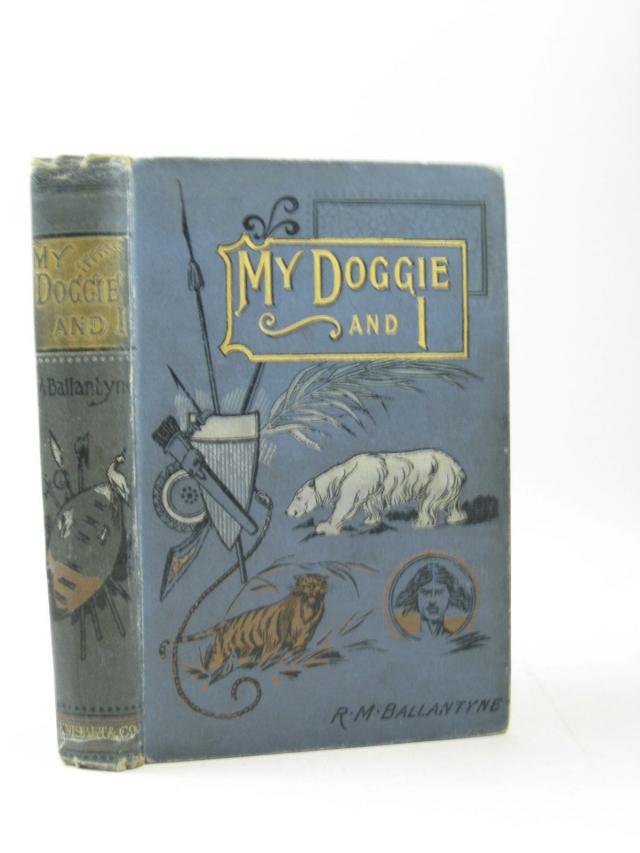
My Doggie and I

My Doggie and I

R. M. Ballantyne

Fiction / Children's / Travel

This work has been selected by scholars as being culturally important, and is part of the knowledge base of civilization as we know it. This work was reproduced from the original artifact, and remains as true to the original work as possible. Therefore, you will see the original copyright references, library stamps (as most of these works have been housed in our most important libraries around the world), and other notations in the work. This work is in the public domain in the United States of America, and possibly other nations. Within the United States, you may freely copy and distribute this work, as no entity (individual or corporate) has a copyright on the body of the work.As a reproduction of a historical artifact, this work may contain missing or blurred pages, poor pictures, errant marks, etc. Scholars believe, and we concur, that this work is important enough to be preserved, reproduced, and made generally available to the public. We appreciate your support of the preservation process, and thank you for being an important part of keeping this knowledge alive and relevant. --This text refers to an alternate Paperback edition. --This text refers to an alternate Paperback edition.
Read online
  • 241
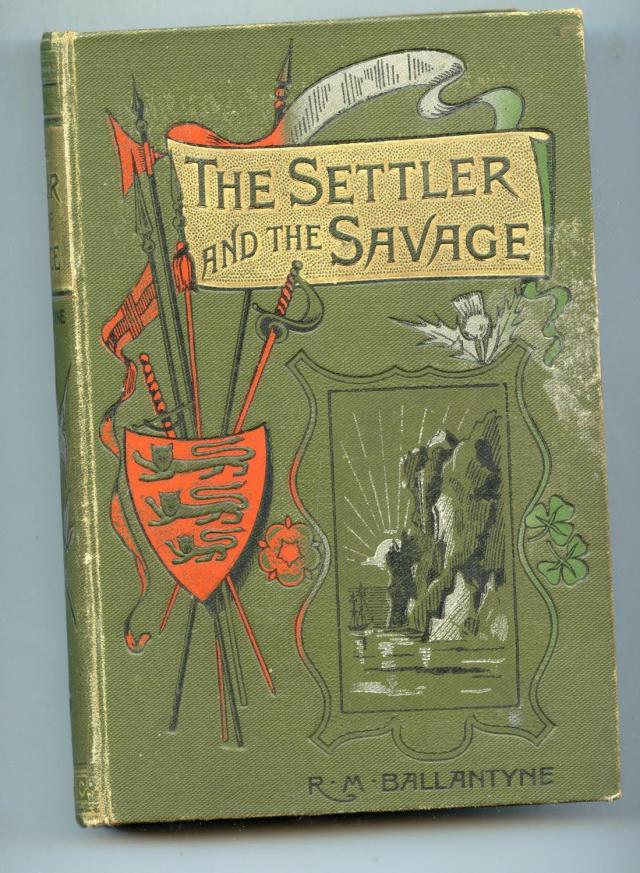
The Settler and the Savage

The Settler and the Savage

R. M. Ballantyne

Fiction / Children's / Travel

The Wild Karroo. A solitary horseman—a youth in early manhood—riding at a snail’s pace over the great plains, or karroo, of South Africa. His chin on his breast; his hands in the pockets of an old shooting-coat; his legs in ragged trousers, and his feet in worn-out boots. Regardless of stirrups, the last are dangling. The reins hang on the neck of his steed, whose head may be said to dangle from its shoulders, so nearly does its nose approach the ground. A felt hat covers the youth’s curly black head, and a double-barrelled gun is slung across his broad shoulders. We present this picture to the reader as a subject of contemplation. It was in the first quarter of the present century that the youth referred to—Charlie Considine by name—rode thus meditatively over that South African karroo. His depression was evidently not due to lack of spirit, for, when he suddenly awoke from his reverie, drew himself up and shook back his hair, his dark eyes opened with something like a flash. They lost some of their fire, however, as he gazed round on the hot plain which undulated like the great ocean to the horizon, where a line of blue indicated mountains. The truth is that Charlie Considine was lost—utterly lost on the karroo! That his horse was in the same lost condition became apparent from its stopping without orders and looking round languidly with a sigh. “Come, Rob Roy,” said the youth, gathering up the reins and patting the steed’s neck, “this will never do. You and I must not give in to our first misfortune. No doubt the want of water for two days is hard to bear, but we are strong and young both of us. Come, let’s try at least for a sheltering bush to sleep under, before the sun goes down.” Animated by the cheering voice, if not by the words, of its rider, the horse responded to the exhortation by breaking into a shuffling canter. After a short time the youth came in sight of what appeared to be a herd of cattle in the far distance. In eager expectation he galloped towards them and found that his conjectures were correct. They were cattle in charge of one of that lowest of the human race, a Bushman. The diminutive, black-skinned, and monkey-faced creature was nearly naked. He carried a sheepskin kaross, or blanket, on his left shoulder, and a knobbed stick, or “kerrie,” in his right hand. “Can you speak English?” asked Considine as he rode up. The Bushman looked vacant and made no reply. “Where is your master’s house?” asked the youth. A stare was the only answer. “Can’t you speak, you dried-up essence of stupidity!” exclaimed Charlie with impatience. At this the Bushman uttered something with so many klicks, klucks, and gurgles in it that his interrogator at once relinquished the use of the tongue, and took to signs, but with no better success, his efforts having only the effect of causing the mouth of the Bushman to expand from ear to ear. Uttering a few more klicks and gurgles, he pointed in the direction of the setting sun....
Read online
  • 239
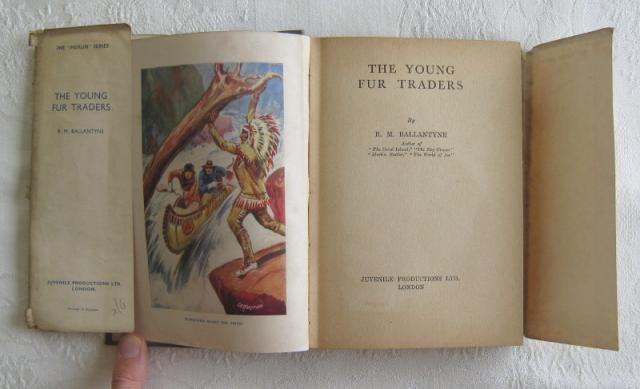
The Young Fur Traders

The Young Fur Traders

R. M. Ballantyne

Fiction / Children's / Travel

The Scottish juvenile fiction writer R. M. Ballantyne was born into a famous family of publishers. Leaving home at age 16 he went to work for the Hudson\'s Bay Company; after returning home to Scotland R. M. Ballantyne published his first book "Hudson\'s Bay" detailing his experiences in Canada. Later Ballantyne would write about more of his experiences with Native Americans and the Fur trappers he met in the most remote regions of Canada. With his success as a writer he withdrew from the business world to become a full time writer for the rest of his life. With over a hundred different books he has become one of the most cherished juvenile fiction writers today. Along with his other exploits throughout his life he also was tremendously successful with his artwork as his water color paintings were displayed at the Royal Scottish Academy.
Read online
  • 237
The Carter Girls

The Carter Girls

Nell Speed

Fiction / Childrens

Leopold Classic Library is delighted to publish this classic book as part of our extensive collection. As part of our on-going commitment to delivering value to the reader, we have also provided you with a link to a website, where you may download a digital version of this work for free. Many of the books in our collection have been out of print for decades, and therefore have not been accessible to the general public. Whilst the books in this collection have not been hand curated, an aim of our publishing program is to facilitate rapid access to this vast reservoir of literature. As a result of this book being first published many decades ago, it may have occasional imperfections. These imperfections may include poor picture quality, blurred or missing text. While some of these imperfections may have appeared in the original work, others may have resulted from the scanning process that has been applied. However, our view is that this is a significant literary work, which deserves to be brought back into print after many decades. While some publishers have applied optical character recognition (OCR), this approach has its own drawbacks, which include formatting errors, misspelt words, or the presence of inappropriate characters. Our philosophy has been guided by a desire to provide the reader with an experience that is as close as possible to ownership of the original work. We hope that you will enjoy this wonderful classic book, and that the occasional imperfection that it might contain will not detract from the experience. --This text refers to an alternate Paperback edition. --This text refers to an alternate Paperback edition.
Read online
  • 324
The Battery and the Boiler: Adventures in Laying of Submarine Electric Cables

The Battery and the Boiler: Adventures in Laying of Submarine Electric Cables

R. M. Ballantyne

Fiction / Children's / Travel

In which the Hero makes his First Flash and Explosion. Somewhere about the middle of this nineteenth century, a baby boy was born on the raging sea in the midst of a howling tempest. That boy was the hero of this tale. He was cradled in squalls, and nourished in squalor—a week of dirty weather having converted the fore-cabin of the emigrant ship into something like a pig-sty. Appreciating the situation, no doubt, the baby boy began his career with a squall that harmonised with the weather, and, as the steward remarked to the ship’s cook, “continued for to squall straight on end all that day and night without so much as ever takin’ breath!” It is but right to add that the steward was prone to exaggeration. “Stooard,” said the ship’s cook in reply, as he raised his eyes from the contemplation of his bubbling coppers, “take my word for it, that there babby what has just bin launched ain’t agoin’ to shovel off his mortal coil—as the play-actor said—without makin’ his mark some’ow an’ somew’eres.” “What makes you think so, Johnson?” asked the steward. “What makes me think so, stooard?” replied the cook, who was a huge good-natured young man. “Well, I’ll tell ’ee. I was standin’ close to the fore hatch at the time, a-talkin’ to Jim Brag, an’ the father o’ the babby, poor feller, he was standin’ by the foretops’l halyards holdin’ on to a belayin’-pin, an’ lookin’ as white as a sheet—for I got a glance at ’im two or three times doorin’ the flashes o’ lightnin’. Well, stooard, there was lightnin’ playin’ round the mizzen truck, an’ the main truck, an’ the fore truck, an’ at the end o’ the flyin’ jib-boom, an’ the spanker boom; then there came a flash that seemed to set afire the entire univarse; then a burst o’ thunder like fifty great guns gone off all at once in a hurry. At that identical moment, stooard, there came up from the fore-cabin a yell that beat—well, I can’t rightly say what it beat, but it minded me o’ that unfortnit pig as got his tail jammed in the capstan off Cape Horn. The father gave a gasp. ‘It’s born,’ says he. ‘More like’s if it’s basted,’ growled Jim Brag. ‘You’re a unfeelin’ monster, Brag,’ says I; ‘an’ though you are the ship’s carpenter, I will say it, you ’aven’t got no more sympathy than the fluke of an anchor!’ Hows’ever the poor father didn’t hear the remark, for he went down below all of a heap—head, legs, and arms—anyhow. Then there came another yell, an’ another, an’ half a dozen more, which was followed by another flash o’ lightnin’ an’ drownded in another roar o’ thunder; but the yells from below kep’ on, an’ came out strong between times, makin’ no account whatever o’ the whistlin’ wind an’ rattlin’ ropes, which they riz above—easy.—Now, stooard, do you mean for to tell me that all that signifies nothink? Do you suppose that that babby could go through life like an or’nary babby? No, it couldn’t—not even if it was to try—w’ich it won’t!” Having uttered this prophecy the cook resumed the contemplation of his bubbling coppers....
Read online
  • 229
The Life of a Ship

The Life of a Ship

R. M. Ballantyne

Fiction / Children's / Travel

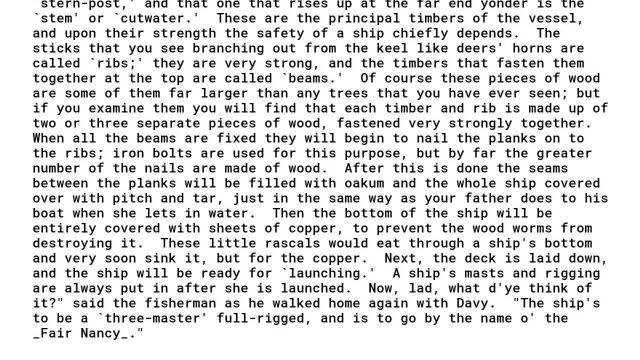
Song of the Sailor Boy. Oh! I love the great blue ocean, I love the whistling breeze,When the gallant ship sweeps lightly Across the surging seas.I watched my first ship building; I saw her timbers rise,Until her masts were towering Up in the bright blue skies. I heard the cheers ascending, I saw her kiss the foam,When first her hull went plunging Into her ocean home.Her flags were gaily streaming, And her sails were full and round,When the shout from shore came ringing, “Hurrah! for the Outward-bound!” But, alas! ere long a tempest Came down with awful roarAnd dashed our ship in pieces Upon a foreign shore.But He who holds the waters In His almighty hand,Brought all the sailors safely Back to their native land. Davy was a fisher boy; and Davy was a very active little boy; and Davy wanted to go to sea. His father was a fisherman, his grandfather had been a fisherman, and his great-grandfather had been a fisherman: so we need not wonder much that little Davy took to the salt water like a fish. When he was very little he used to wade in it, and catch crabs in it, and gather shells on the shore, or build castles on the sands. Sometimes, too, he fell into the water neck and heels, and ran home to his mother, who used to whip him and set him to dry before the fire; but, as he grew older, he went with his father in the boat to fish, and from that time forward he began to wish to go to sea in one of the large ships that were constantly sailing away from the harbour near his father’s cottage. One day Davy sat on a rock beside the sea, leaning on his father’s boathook, and gazing with longing eyes out upon the clear calm ocean, on which several ships and boats were floating idly, for there was not a breath of wind to fill their sails. “Oh, how I wish my father would let me go to sea!” said Davy, with a deep sigh. “I wonder if I shall ever sail away beyond that line yonder, far, far away, where the sky seems to sink into the sea!” The line that he spoke of was the horizon. Davy heaved another sigh, and smiled; for, just at that moment, his eyes fell on a small crab that stood before him with its claws up as if it were listening to what he said. “Oh, crab, crab,” cried the little boy, “you’re a happy beast!” At that moment he moved the boathook, and the crab ran away in such a desperate hurry that Davy opened his eyes wide and said, “Humph! maybe ye’re not a happy beast after all!” While he sat thus, a stout fisherman came up and asked him what he was thinking about. On being told, he said, “Will you come with me, boy, to the building-yard, and I’ll show you a ship on the ‘stocks.’ I’m goin’ as one of her crew when she’s ready for sea, and perhaps by that time your father will let you go too.” You may be sure that Davy did not refuse such a good offer; so the man and the boy went hand in hand to the yard where ships were built....
Read online
  • 236
Fanny, the Flower-Girl; or, Honesty Rewarded. To Which are Added Other Tales

Fanny, the Flower-Girl; or, Honesty Rewarded. To Which are Added Other Tales

Selina Bunbury

Childrens / Fiction / Christian Fiction

Leopold Classic Library is delighted to publish this classic book as part of our extensive collection. As part of our on-going commitment to delivering value to the reader, we have also provided you with a link to a website, where you may download a digital version of this work for free. Many of the books in our collection have been out of print for decades, and therefore have not been accessible to the general public. Whilst the books in this collection have not been hand curated, an aim of our publishing program is to facilitate rapid access to this vast reservoir of literature. As a result of this book being first published many decades ago, it may have occasional imperfections. These imperfections may include poor picture quality, blurred or missing text. While some of these imperfections may have appeared in the original work, others may have resulted from the scanning process that has been applied. However, our view is that this is a significant literary work, which deserves to be brought back into print after many decades. While some publishers have applied optical character recognition (OCR), this approach has its own drawbacks, which include formatting errors, misspelt words, or the presence of inappropriate characters. Our philosophy has been guided by a desire to provide the reader with an experience that is as close as possible to ownership of the original work. We hope that you will enjoy this wonderful classic book, and that the occasional imperfection that it might contain will not detract from the experience.
Read online
  • 224
The Palace Beautiful: A Story for Girls

The Palace Beautiful: A Story for Girls

L. T. Meade

Children's Books / Mystery / Fiction

EARLY DAYS. The three girls were called after flowers. This is how it came about: When Primrose opened her eyes on the world she brought back a little bit of spring to her mother\'s heart. Mrs. Mainwaring had gone through a terrible trouble—a trouble so dark and mysterious, so impossible to feel reconciled to, that her health had been almost shattered, and she had almost said good-bye to hope. The baby came in the spring-time, and the soft, velvety touch of the little face, and the sight of the round baby limbs, had made Mrs. Mainwaring smile: had caused her to pluck up heart, and to determine resolutely to take this new blessing, and to begin to live again. The baby came in the month of March, just when the primroses were beginning to open their pale and yet bright blossoms. Mrs. Mainwaring said that the child was a symbol of spring to her, and she called her Primrose. The next girl was born in Italy, in the middle of a rich and brilliant summer. Flowers were everywhere, and the baby, a black-haired, dark-eyed little mite, had a starry look about her. She was called Jasmine, and the name from the very first suited her exactly. The third and youngest of the sisters also came in the summer, but she was born in an English cottage. Her mother, who had been rich when Jasmine was born, was now poor; that is, she was poor as far as money is concerned, but the three little daughters made her feel rich. She called the child from the first her little country wild flower, and allowed Primrose and Jasmine to select her name. They brought in handfuls of field daisies, and begged to have the baby called after them. The three girls grew up in the little country cottage. Their father was in India, in a very unhealthy part of the country. He wrote home by every mail, and in each letter expressed a hope that the Government under which he served would allow him to return to England and to his wife and children. Death, however, came first to the gallant captain. When Primrose was ten years old, and Daisy was little more than a baby, Mrs. Mainwaring found herself in the humble position of an officer\'s widow, with very little to live on besides her pension. In the Devonshire village, however, things were cheap, rents were low, and the manners of life deliciously fresh and primitive. Primrose, Jasmine, and Daisy grew up something like the flowers, taking no thought for the morrow, and happy in the grand facts that they were alive, that they were perfectly healthy, and that the sun shone and the sweet fresh breezes blew for them. They were as primitive as the little place where they lived, and cared nothing at all for fashionably-cut dresses; or for what people who think themselves wiser would have called the necessary enjoyments of life. Mrs. Mainwaring, who had gone through a terrible trouble before the birth of her eldest girl, had her nerves shattered a second time by her husband\'s death; from that moment she was more ruled by her girls than a ruler to them. They did pretty much what they pleased, and she was content that they should make themselves happy in their own way....
Read online
  • 284
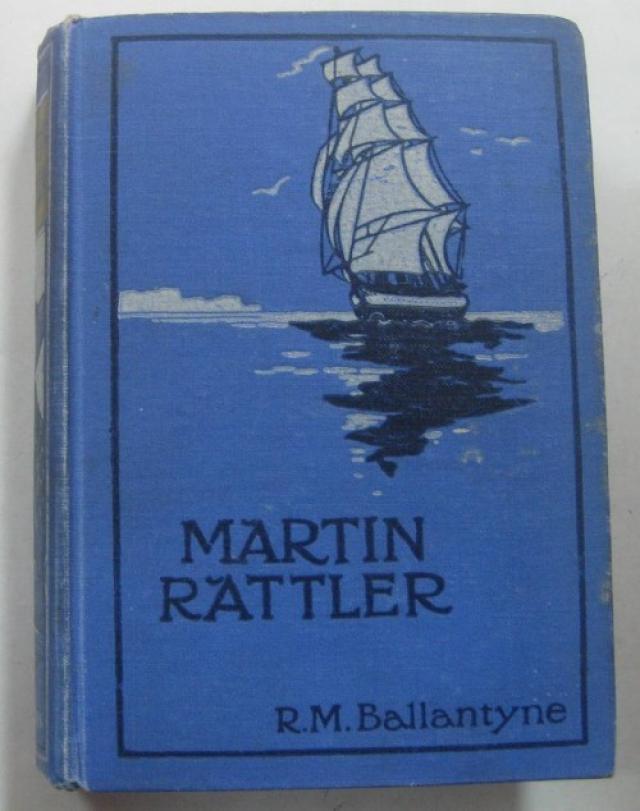
Martin Rattler

Martin Rattler

R. M. Ballantyne

Fiction / Children's / Travel

The story of Martin Rattler, a mischievous boy with a good heart who mistakenly ends up on the ship Firefly, headed to the South Seas. With his friend Barney O\'Flannagan, Martin escape pirates, survives a shipwreck, and explores South America in one adventure after another.
Read online
  • 215
The Spanish Brothers: A Tale of the Sixteenth Century

The Spanish Brothers: A Tale of the Sixteenth Century

Deborah Alcock

Fiction / Religion

On one of the green slopes of the Sierra Morena, shaded by a few cork-trees, and with wild craggy heights and bare brown wastes stretching far above, there stood, about the middle of the sixteenth century, a castle even then old and rather dilapidated. It had once been a strong place, but was not very spacious; and certainly, according to our modern ideas of comfort, the interior could not have been a particularly comfortable dwelling-place. A large proportion of it was occupied by the great hall, which was hung with faded, well-repaired tapestry, and furnished with oaken tables, settles, and benches, very elaborately carved, but bearing evident marks of age. Narrow unglazed slits in the thick wall admitted the light and air; and beside one of these, on a gloomy autumn morning, two boys stood together, watching the rain that pored down without intermission. They were dressed exactly alike, in loose jackets of blue cloth, homespun, indeed, but so fresh and neatly-fashioned as to look more becoming than many a costlier dress. Their long stockings were of silk, and their cuffs and wide shirt-frills of fine Holland, carefully starched and plaited. The elder—a very handsome lad, who looked fourteen at least, but was really a year younger—had raven hair, black sparkling eager eyes, good but strongly-marked features, and a complexion originally dark, and well-tanned by exposure to sun and wind. A broader forehead, wider nostrils, and a weaker mouth, distinguished the more delicate-looking younger brother, whose hair was also less dark, and his complexion fairer.
Read online
  • 256
Jarwin and Cuffy

Jarwin and Cuffy

R. M. Ballantyne

Fiction / Children's / Travel

R.M. Ballantyne, in full Robert Michael Ballantyne (born April 24, 1825, Edinburgh, Scot.—died Feb. 8, 1894, Rome, Italy), Scottish author chiefly famous for his adventure story The Coral Island (1858). This and all of Ballantyne’s stories were written from personal experience. The heroes of his books are models of self-reliance and moral uprightness. Snowflakes and Sunbeams; or, The Young Fur Traders (1856) is a boys’ adventure story based on Ballantyne’s experiences with the Hudson’s Bay Company. Annoyed by a geography-related mistake he had made in The Coral Island, he afterward traveled widely to research the backgrounds of his stories.
Read online
  • 223
The Moving Picture Boys on the Coast

The Moving Picture Boys on the Coast

Victor Appleton

Science Fiction / Fiction / Childrens

Moving pictures and photo plays are famous the world over, and in this line of books the reader is given a full description of how the films are made -- the scenes of little dramas, indoors and out, trick pictures to satisfy the curious, soul-stirring pictures of city affairs, life in the Wild West, among the cowboys and Indians, thrilling rescues along the seacoast, the daring of picture hunters in the jungle among savage beasts, and the great risks run in picturing conditions in a land of earthquakes. The volumes teem with adventures and will be found interesting from first chapter to last.
Read online
  • 253
Grandmother Dear: A Book for Boys and Girls

Grandmother Dear: A Book for Boys and Girls

Mrs. Molesworth

Children's / Fiction

Grandmother Dear - A Book for Boys and Girls is presented here in a high quality paperback edition. This popular classic work by Mrs. Molesworth is in the English language, and may not include graphics or images from the original edition. If you enjoy the works of Mrs. Molesworth then we highly recommend this publication for your book collection.
Read online
  • 204
Raftmates: A Story of the Great River

Raftmates: A Story of the Great River

Kirk Munroe

Fiction / Childrens

Raftmates - A Story of the Great River is presented here in a high quality paperback edition. This popular classic work by Kirk Munroe is in the English language, and may not include graphics or images from the original edition. If you enjoy the works of Kirk Munroe then we highly recommend this publication for your book collection.
Read online
  • 249
Silver Lake

Silver Lake

R. M. Ballantyne

Fiction / Children's / Travel

The Scottish juvenile fiction writer R. M. Ballantyne was born into a famous family of publishers. Leaving home at age 16 he went to work for the Hudson\'s Bay Company; after returning home to Scotland R. M. Ballantyne published his first book "Hudson\'s Bay" detailing his experiences in Canada. Later Ballantyne would write about more of his experiences with Native Americans and the Fur trappers he met in the most remote regions of Canada. With his success as a writer he withdrew from the business world to become a full time writer for the rest of his life. With over a hundred different books he has become one of the most cherished juvenile fiction writers today. Along with his other exploits throughout his life he also was tremendously successful with his artwork as his water color paintings were displayed at the Royal Scottish Academy.
Read online
  • 213
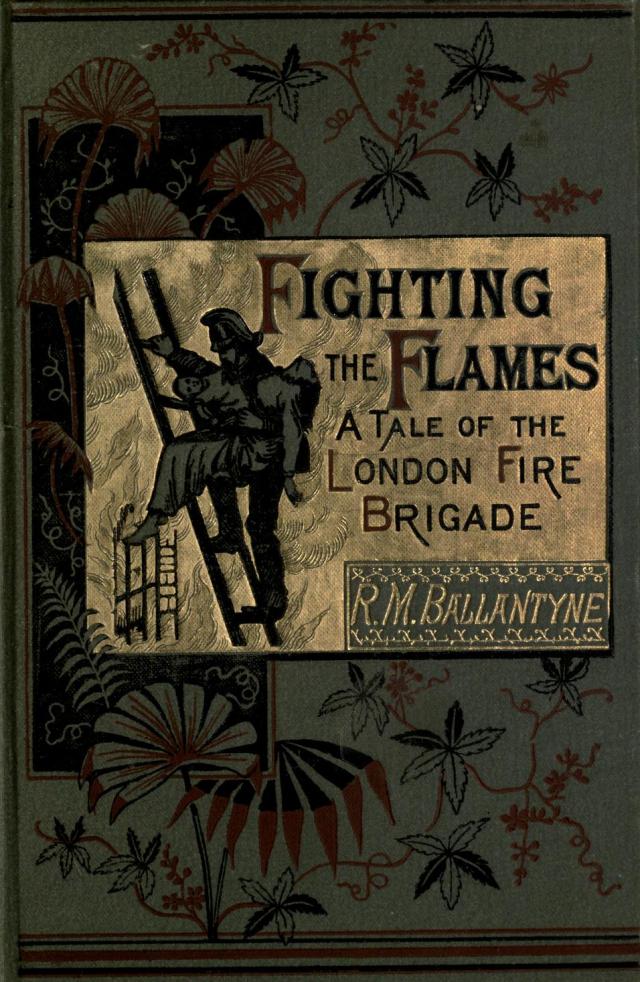
Fighting the Flames

Fighting the Flames

R. M. Ballantyne

Fiction / Children's / Travel

Frank Wilders is a bright, shining young star rising to distinguished heroism in the London Fire Brigade. No one is more proud of his accomplishments than his younger brother, Willie. As Frank battles the flames, Willie learns what the heart of a hero is made of. Through daring rescues, valiant hard work, plots of arson, attempted murder and winning the worthy hearts of virtuous young women, the best and worst of mid-19th century London is exposed. Fighting the Flames: A Tale of the London Fire Brigade is a masterpiece of fiction; a beautiful tapestry woven of adventure, heroism and the broad spectrum of human nature. R.M. Ballantyne expertly maneuvers his extensive and intricate cast of characters through a series of crossed paths, creating lively interplay between the wide varieties of human personalities and foibles that create the diversity of city life--all in the shadow of the great nightly battle with the flames.
Read online
  • 227
The Speedwell Boys and Their Racing Auto; Or, A Run for the Golden Cup

The Speedwell Boys and Their Racing Auto; Or, A Run for the Golden Cup

Roy Rockwood

Young Adult / Fiction

Excerpt from The Speedwell Boys and Their Racing Auto: Or a Run for the Golden Cup"Say, fellows! I Look at what\'s coming!""Oh, my eyes! See him wabble! Why, h\'ell be over the wall into the river, machine and all, if he doesn\'t watch out.""Say, Dan, did you ever see a fellow run a car as bad as Maxey? If we didn\'t know better wed think he had a fit, declared Billy Speedwell, who sat with his brother, and several of their chums, on a high, grassy bank overlooking the Colasha River and above the road, a mile or two below Riverdale."He certainly does make a mess of it," admitted the older Speedwell lad, gazing down the road, as were his friends, at a drab-painted automobile which was approaching them.They were five boys, all members of the River-dale Outing Club and all rode motorcycles which just now were leaning, in a row, against the bank. The chums had come out after school for a short spin into the country. It was fall, which fact was proven by the brilliant coloring of the leaves.About the PublisherForgotten Books publishes hundreds of thousands of rare and classic books. Find more at www.forgottenbooks.comThis book is a reproduction of an important historical work. Forgotten Books uses state-of-the-art technology to digitally reconstruct the work, preserving the original format whilst repairing imperfections present in the aged copy. In rare cases, an imperfection in the original, such as a blemish or missing page, may be replicated in our edition. We do, however, repair the vast majority of imperfections successfully; any imperfections that remain are intentionally left to preserve the state of such historical works.
Read online
  • 275
A Lincoln Conscript

A Lincoln Conscript

Homer Greene

Fiction / Childrens / Audiobook

On the second day of July in the year 1863 the Civil War in America was at its height. Late in the preceding month Lee had turned his face northward, and, with an army of a hundred thou-sand Confederate soldiers at his back, had marched up into Penn-sylvania. There was little to hinder his advance. Refraining, by reason of strict orders, from wanton destruction of property, his soldiers nevertheless lived on the rich country through which they passed. York and Carlisle were in their grasp. Harrisburg was but a day’s march away, and now, on this second day of July, flushed with fresh victories, they had turned and were giving desperate battle, through the streets and on the hills of Gettysburg, to the Union armies that had followed them. The old commonwealth was stirred as she had not been stirred before since the fall of Sumter. Every town and village in the state responded quickly to the governor’s call for emergency troops to defend the capital city. Mount Hermon, already depleted by gen-erous early enlistments, and by the draft of 1862, gathered to-gether the bulk of the able-bodied men left in the village and its surroundings, and sent them forth in defense of the common-wealth. Not that Mount Hermon was in especial danger from Lee’s invasion, far from it. Up in the northeastern corner of the state, on a plateau of one of the low foot-hills of the Moosic range, sheltered by the mountains at its back, it was well protected, both by reason of distance and location, from the advancing foe. But Mount Hermon was intensely patriotic. In the days preceding the Revolution the sturdy pioneers from Connecticut had met the equally sturdy settlers from the domain of Penn, and on this plateau they had fought out their contentions and settled their differences; the son of the Pennamite had married the daughter of the Yankee; and the new race, with love of country tingeing every drop of its blood a deeper red, had stayed on and possessed the land. So, on this July day, when the armies of North and South were striving and struggling with each other in bloody combat back and forth across the plain and up the hills of Gettysburg, Mount Hermon’s heart beat fast. But it was not for themselves that these people were anxious. It was for the fathers, husbands, sons, lovers in that army with which Meade, untried and unproven, was endeavoring to match the strategy and strength of Lee. News of the first day’s skirmishing had reached the village, and it was felt that a great battle was imminent. In the early evening, while the women were still busy at their household tasks, the men gathered at the post-office and the stores, eager for late news, anxious to discuss the situation as they had learned it. In the meantime the boys of the town had congregated on the village green to resume the military drills which, with more or less frequency, they had carried on during the summer. These drills were not wholly without serious intent. It was play, indeed; but, out of the ranks of these boys, three of the older ones had already gone to the front to fight real battles; and it was felt, by the men of the town, that the boys could not be too thoroughly imbued with the military spirit. So, on this July evening, wakened into new ardor by the news from Gettysburg, they had gathered to resume their nightly work—and play. There were thirty-three of them, ranging in years all the way from eight to eighteen. They were eager and enthusiastic. At the command to fall in there was much pushing and jostling, much striving for desirable places, and even the young captain, with great show of authority, could not quite adjust all differences to the complete satisfaction of his men. Before the confusion had wholly ceased, and while there were still awkward gaps in the ranks, a tall, straight, shy-mannered boy of seventeen, who had remained hitherto on the outskirts of the group, quietly slipped into one of the vacant places.
Read online
  • 229
Under Orders: The story of a young reporter

Under Orders: The story of a young reporter

Kirk Munroe

Fiction / Childrens

Excerpt from Chapter 1: “Thus far, therefore, life had gone easily and prosperously with this light-hearted young fellow, and its future looked bright before him. He knew nothing of its ruder aspects—of its despair, its hunger, and its poverty. There were those who said of him that, while he was a good fair-weather sailor, he was not of the stuff to face, and do brave battle with, the storms of adversity, should they ever overtake him. “Now, just such a storm had overtaken Myles Manning, and he was to be tried. Nearly a year before a trouble of the eyes with which Mr. Manning was afflicted had suddenly resulted in total blindness. It was at first supposed to be only temporary, but as time wore on, and one painful operation after another failed to afford relief, hope began to yield to despair, and his career of usefulness seemed ended. Thus far his salary had been continued, and the affairs of the Manning family had gone on much as usual. At last there came a letter in which, while regretting the necessity, the president of the company that had employed[6] Mr. Manning informed him that, as there was no present prospect that he would be able to resume his duties, the payment of his salary must cease from that date.” This edition is a reprint of a book published in 1890.
Read online
  • 338
Greenacre Girls

Greenacre Girls

Izola L. Forrester

Fiction / Children's

Leopold is delighted to publish this classic book as part of our extensive Classic Library collection. Many of the books in our collection have been out of print for decades, and therefore have not been accessible to the general public. The aim of our publishing program is to facilitate rapid access to this vast reservoir of literature, and our view is that this is a significant literary work, which deserves to be brought back into print after many decades. The contents of the vast majority of titles in the Classic Library have been scanned from the original works. To ensure a high quality product, each title has been meticulously hand curated by our staff. This means that we have checked every single page in every title, making it highly unlikely that any material imperfections – such as poor picture quality, blurred or missing text - remain. When our staff observed such imperfections in the original work, these have either been repaired, or the title has been excluded from the Leopold Classic Library catalogue. As part of our on-going commitment to delivering value to the reader, within the book we have also provided you with a link to a website, where you may download a digital version of this work for free. Our philosophy has been guided by a desire to provide the reader with a book that is as close as possible to ownership of the original work. We hope that you will enjoy this wonderful classic work, and that for you it becomes an enriching experience. If you would like to learn more about the Leopold Classic Library collection please visit our website at www.leopoldclassiclibrary.com
Read online
  • 189
The Speedwell Boys and Their Ice Racer; Or, Lost in the Great Blizzard

The Speedwell Boys and Their Ice Racer; Or, Lost in the Great Blizzard

Roy Rockwood

Young Adult / Fiction

This work has been selected by scholars as being culturally important, and is part of the knowledge base of civilization as we know it. This work was reproduced from the original artifact, and remains as true to the original work as possible. Therefore, you will see the original copyright references, library stamps (as most of these works have been housed in our most important libraries around the world), and other notations in the work.This work is in the public domain in the United States of America, and possibly other nations. Within the United States, you may freely copy and distribute this work, as no entity (individual or corporate) has a copyright on the body of the work.As a reproduction of a historical artifact, this work may contain missing or blurred pages, poor pictures, errant marks, etc. Scholars believe, and we concur, that this work is important enough to be preserved, reproduced, and made generally available to the public. We appreciate your support of the preservation process, and thank you for being an important part of keeping this knowledge alive and relevant.
Read online
  • 119
183